
| Problem
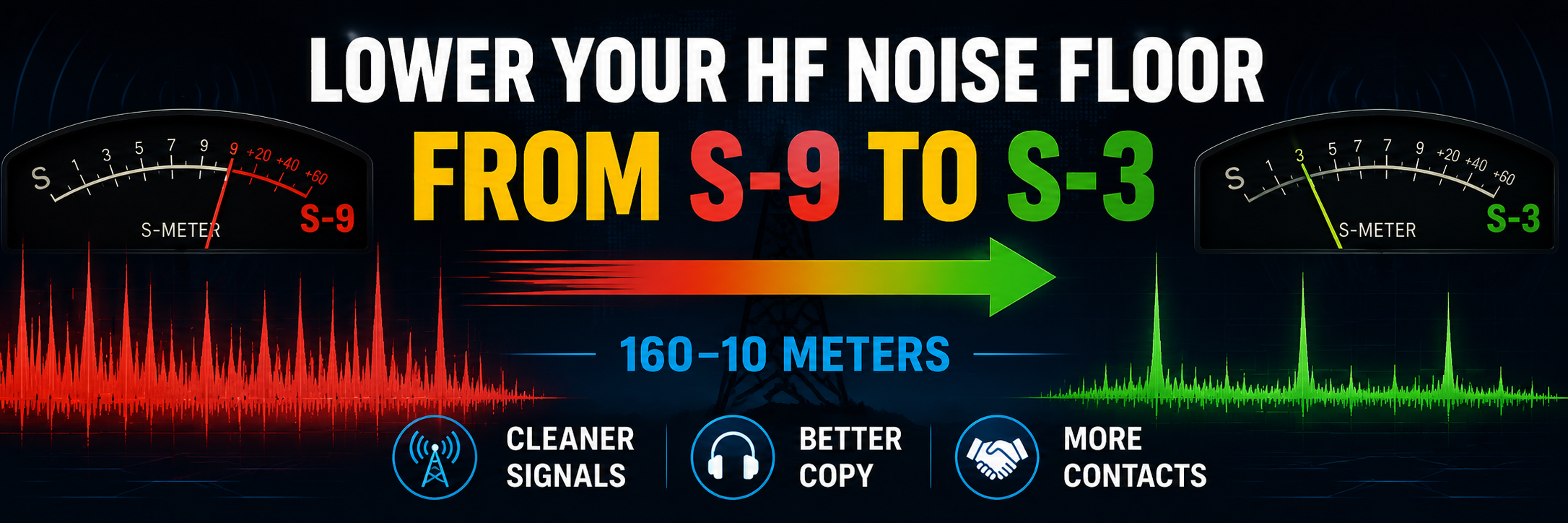
S-9 noise buries weak signals, reduces digital decoding depth, and limits emergency communications performance. |
Target
A practical station goal is a receive noise floor no greater than S-3 when band conditions allow. |
Method
Measure, isolate, remove sources, choke common-mode current, improve antenna placement, and use receive antennas. |
Contents
- Why S-9 Noise Is Unacceptable
- Understanding the Noise Sources
- Ten-Step HF Noise Reduction Workflow
- Band-by-Band Expectations
- The Real Standard: Signal-to-Noise Ratio
- Conclusion
Ten-Step HF Noise Reduction Workflow
| Step | Action | Purpose |
| 1 | Measure the noise | Record band, S-meter level, antenna, preamp/attenuator setting, and time of day. |
| 2 | Test with dummy load | Separate receiver/station noise from antenna-entered noise. |
| 3 | Run from battery | Shut off house power briefly to determine whether the noise is internal. |
| 4 | Find noisy devices | Unplug chargers, LEDs, dimmers, routers, computers, and switching supplies. |
| 5 | Choke common-mode current | Use proper HF common-mode chokes at the feed point and station entrance. |
| 6 | Improve antenna location | Move antennas and feedlines away from household wiring and electronics. |
| 7 | Use receive antennas | Loops, Beverages, K9AY, EWE, pennants, and phased arrays can improve SNR. |
| 8 | Use noise canceling | Phase a noise-sense antenna against the main antenna when a dominant source exists. |
| 9 | Report utility noise | Document power-line noise carefully and work with the utility. |
| 10 | Adjust receiver settings | Use attenuation, RF gain, filters, noise blanker, and noise reduction intelligently. |
Lowering the HF Noise Floor: Moving from S-9 to S-3 on 160 Through 10 Meters
For many amateur radio operators, the most frustrating problem on the HF bands is not lack of power, poor antennas, or bad propagation. It is noise. A station that hears an S-9 noise floor on 160 through 10 meters is operating with a severe handicap. Weak signals disappear. Digital modes lose decoding depth. CW becomes tiring. SSB contacts that should be easy become marginal. Emergency communications capability is reduced because the station cannot hear what it should be able to hear.
A common goal for a serious HF station should be a receive noise floor no higher than about S-3 under normal local conditions. That does not mean every band will always show S-3 at all times. On 160 and 80 meters, atmospheric noise from distant thunderstorms can naturally raise the band noise, especially at night or during storm season. But a constant S-8 or S-9 noise floor across multiple HF bands is usually not natural. It is usually local or neighborhood man-made noise, poor station design, common-mode pickup, or a combination of all three.
The difference between S-9 and S-3 is enormous. In the traditional HF S-meter scale, one S-unit is approximately 6 dB. Dropping from S-9 to S-3 requires about 36 dB of noise reduction. That is not achieved by adjusting one setting on the transceiver. It requires a systematic engineering approach: measure the noise, identify the source, remove what can be removed, isolate the antenna system, control common-mode current, and use receive antennas that reject noise.
Why S-9 Noise Is Unacceptable
An S-9 noise floor means the receiver is already being overloaded with unwanted energy before the desired signal ever arrives. Any signal below that level may be unreadable, even if the radio, antenna, and operator are otherwise capable.
For emergency communications, weak-signal work, traffic handling, DX, NVIS operation, or digital communications, hearing is more important than transmitting. A kilowatt transmitter cannot solve a deaf receiver. If the station noise floor is too high, the operator may be transmitting well but failing to copy stations that are easily readable elsewhere.
An S-3 noise floor gives the station room to hear weak signals. It allows the operator to take advantage of propagation openings, copy low-power stations, receive distant emergency traffic, and use the full capability of modern receivers.
Understanding the Noise Sources
HF noise usually comes from four broad categories.
First is natural atmospheric noise. This includes lightning, weather systems, and general atmospheric static. It is most noticeable on 160, 80, and 40 meters. It may rise and fall with time of day, season, and weather.
Second is man-made electrical noise. This includes switching power supplies, LED lighting, solar inverters, battery chargers, computers, routers, dimmers, plasma televisions, electric fences, HVAC controls, variable-speed motors, EV chargers, and poorly filtered consumer electronics. This is one of the largest causes of S-9 noise in modern neighborhoods.
Third is station-generated noise. Many operators unknowingly create their own noise problem inside the shack. Computers, monitors, USB chargers, wall warts, Ethernet equipment, power strips, inexpensive switching supplies, and poorly bonded station equipment can all raise the local noise floor.
Fourth is antenna and feed-line pickup. Even if the noise source is not inside the shack, the antenna system may be collecting local electrical noise through common-mode current on the outside of the coax shield. The coax then becomes part of the antenna and carries household and neighborhood noise directly into the receiver.
Step One: Measure the Noise Correctly
Before fixing the problem, the operator must know what kind of noise is being received.
Start by checking the noise level on each band from 160 through 10 meters. Record the S-meter reading, time of day, antenna used, preamp setting, attenuator setting, and receiver bandwidth. Turn off the preamp unless it is truly needed. On the lower HF bands, a preamp often makes a noisy band worse without improving copy.
Next, disconnect the antenna and terminate the receiver input with a 50-ohm dummy load. If the noise drops sharply, the noise is entering through the antenna system. If the noise remains high, the noise may be generated inside the station, by the radio, by attached accessories, or by power supply wiring.
Then run the station from a battery if possible. Turn off the main power to the house at the breaker panel, leaving only the battery-powered transceiver operating. If the S-9 noise drops dramatically, the problem is inside the house. If the noise remains, the source may be outside the house, in the neighborhood, or entering through the antenna system.
This one test is extremely valuable. A battery-powered receiver and a house power shutdown can quickly separate internal noise from external noise.
Step Two: Eliminate Noise Inside the Station
The shack should be treated as a controlled RF environment. Every device near the radio should be considered guilty until proven innocent.
Common station noise sources include laptop chargers, desktop computers, monitors, USB hubs, switching power supplies, network switches, routers, LED desk lamps, battery chargers, unfiltered power strips, and cheap wall adapters.
Turn off each device one at a time while watching the receiver noise floor. Do not rely only on the power switch. Many devices continue producing noise when plugged in. Physically unplug suspect devices from the wall.
Replace noisy switching power supplies with linear supplies where practical. Use high-quality filtered supplies for radios and accessories. Avoid cheap USB chargers near the station. Move computers and monitors away from the radio and feedline. Use ferrite chokes on power cords, USB cables, speaker wires, control cables, and Ethernet cables.
The goal is simple: the shack should not be a noise transmitter.
Step Three: Clean Up the House
The radio room does not cause many S-9 HF noise problems. They are caused by the house.
LED lighting is a major offender. Some LED bulbs and fixtures generate broadband HF noise. Dimmers can make the problem worse. Solar power systems can be severe noise sources if the inverter, optimizer wiring, or DC lines are not properly filtered. Battery chargers, garage door openers, HVAC controls, smart thermostats, aquarium heaters, treadmill motors, and appliances with variable-speed drives can also radiate noise.
The best method is a room-by-room shutdown test. Tune the receiver to a noisy frequency and listen while turning off circuits at the breaker panel. When the noise drops, identify everything on that circuit. Then plug items back in one at a time until the noise returns.
Keep a written log. Record the circuit, device, frequency range affected, and noise character. Some noise appears as buzzing. Some appear as raspy hash. Some appear as repeating pulses. Some create carriers every few kilohertz. A waterfall display or SDR receiver can help identify patterns.
Once the source is found, the solution may be as simple as replacing a power supply, changing LED bulbs, removing a dimmer, adding ferrite cores, relocating wiring, or replacing a defective device.
Step Four: Attack Common-Mode Current
Common-mode current is one of the most overlooked causes of high HF noise. In a proper coax-fed antenna system, RF energy should travel inside the coax structure: current on the center conductor and inside of the shield. But when common-mode current flows on the outside of the coax shield, the feedline becomes part of the antenna.
That outside shield can pick up noise from the house, shack, computer equipment, power wiring, and nearby electronics. The result is often a loud, broad noise floor that seems to cover multiple bands.
Common-mode current can be reduced with proper choking and antenna balance.
Install a high-quality common-mode choke at the antenna feed point. Add another choke where the feedline enters the shack or station ground area. In difficult installations, a third choke near the radio may help.
For HF, ferrite mix 31 is widely used for broadband suppression on lower HF bands. Mix 43 can be useful on upper HF. The choke must be designed for the frequency range and power level being used. A few snap-on ferrites may help, but serious S-9 noise problems often require serious choking: multiple turns through large ferrite cores or a properly built coaxial choke.
Balanced antennas should be fed as balanced antennas. A dipole fed directly with coax may work, but without a good current balun at the feed point, the coax can become part of the receiving system. End-fed antennas are especially prone to common-mode problems if not carefully installed with counterpoise control, grounding, and choking.
Step Five: Move the Antenna Away From Noise
An antenna close to the house is often an excellent noise collector. The closer the antenna is to wiring, electronics, metal gutters, solar equipment, and household devices, the more likely it is to receive local noise.
Distance is one of the best filters. Even moving an antenna 30 to 50 feet farther from the house can make a major difference. Raising the antenna can also help, but height alone does not always solve local electrical noise. Sometimes a lower, quieter receive antenna away from the house will outperform a higher transmit antenna located near noise sources.
Keep feedlines away from house wiring where possible. Avoid running coax parallel to AC wiring for long distances. Use direct outdoor routes instead of routing coax through noisy indoor areas. Bond and ground the station properly at the entry point, but do not confuse random ground rods with a complete bonding system. Grounding should follow electrical safety codes and should not create dangerous differences in potential between systems.
Step Six: Use Separate Receive Antennas
On 160, 80, and sometimes 40 meters, a separate receive antenna can be the difference between failure and success.
Large transmit antennas are not always good receive antennas. A full-size vertical, inverted-L, or end-fed wire may transmit well but receive tremendous local noise. A dedicated receive antenna can be designed for better signal-to-noise ratio rather than maximum signal strength.
Useful receive antenna options include magnetic loops, active receive loops, small shielded loops, Beverage antennas, terminated loops, K9AY loops, EWE antennas, pennants, flags, and phased receive arrays.
A receive antenna does not need to produce a strong S-meter reading. It needs to improve the ratio between the signal and the noise. A signal that reads S-5 on the transmit antenna with S-9 noise may be unreadable. The same signal reading S-2 on a quiet receive loop with S-1 noise may be perfectly copyable.
For suburban lots, a small receive loop can be especially useful. It can often be rotated to null a local noise source. Active loops should be installed away from the house and fed with well-choked coax. They should not be placed next to the same noise sources they are trying to avoid.
Step Seven: Use Noise Canceling and Phasing
When a noise source comes from a particular direction, a noise canceler can help. These devices use a main antenna and a noise-sensing antenna. By adjusting phase and amplitude, the operator can cancel or reduce the unwanted noise before it reaches the receiver.
Noise cancelers are not magic, but they can be very effective against a dominant local source, such as a power-line noise source, neighbor’s device, or solar inverter. They work best when the noise source is stable and the sense antenna hears the noise better than it hears the desired signal.
Phased receive antennas can accomplish similar results. Two or more receive antennas can be phased to create directional nulls. On the lower bands, this can greatly improve receive performance.
Step Eight: Learn the Sound of Power-Line Noise
Power-line noise is a special category. It often appears as harsh buzzing, frying, arcing, or raspy broadband noise. It may get worse in dry, windy weather or change after rain. Causes can include loose hardware, cracked insulators, defective lightning arrestors, bad transformers, corroded connections, or arcing utility equipment.
A portable AM broadcast receiver, portable shortwave receiver, or handheld receiver with a directional antenna can help locate the general area. Noise may increase near a pole, transformer, or power-line connection.
If the source appears to be utility equipment, document it carefully. Record dates, times, weather conditions, frequencies affected, and signal strength. Provide the utility with specific information. Do not climb poles, touch utility equipment, or attempt repairs yourself.
Step Nine: Adjust the Receiver Correctly
Receiver controls do not truly lower the external noise floor, but they can improve copy.
Turn off the preamp on noisy bands. Use attenuation when the band is already loud. Reduce RF gain when appropriate. Use the narrowest practical bandwidth for the mode. For CW and digital modes, narrower filters can make a major difference. Use noise blankers for impulse noise, but do not overuse them because they can distort strong signals. Noise reduction can help voice readability, but excessive settings may create artifacts.
For SSB, a narrower receive bandwidth may reduce fatigue. For CW, narrow filtering is often essential. For FT8 and other digital modes, avoid overdriving the receiver input and sound card. A clean, moderate signal level usually decodes better than an overloaded one.
The correct philosophy is this: solve noise at the source first, solve antenna pickup second, and use receiver controls last.
Step Ten: Build a Noise Reduction Plan
Lowering an HF noise floor from S-9 to S-3 should be treated as a project. The operator should not randomly add ferrites and hope for the best. A written plan works better.
Start with a baseline measurement on every band. Then test the receiver with a dummy load. Then test on battery power with house power turned off. Then isolate noisy circuits. Then identify noisy devices. Then improve antenna choking. Then move or redesign antennas. Then consider receive-only antennas or noise-cancelling equipment.
A practical goal is to remove the largest noise sources first. A single defective LED supply, solar inverter, battery charger, or switching supply may account for most of the problem. Once the largest source is fixed, smaller sources become easier to identify.
Band-by-Band Expectations
On 160 meters, atmospheric noise can be high, and a separate receive antenna is often necessary. Expect to use loops, Beverages, terminated antennas, or phased systems if serious weak-signal work is desired.
On 80 meters, local man-made noise and atmospheric noise both matter. A quiet receive antenna can greatly improve regional communications and nighttime operation.
On 40 meters, local noise is still common, but good choking, antenna placement, and household cleanup can make a major improvement.
On 30 and 20 meters, a constant S-9 noise floor is usually a strong sign of local or neighborhood interference. These bands should often be much quieter than the lower bands.
On 17, 15, 12, and 10 meters, natural noise is usually lower. If these bands show S-8 or S-9 noise when the band is otherwise quiet, the problem is very likely man-made.
The Real Standard: Signal-to-Noise Ratio
The goal is not simply to make the S-meter read lower. The real goal is to improve signal-to-noise ratio. A lower noise floor allows weak signals to rise out of the noise. That is what matters.
Sometimes an antenna with less signal but much less noise is better than an antenna with more signal and much more noise. This is especially true on receiving. Operators should judge antennas by readability, not just S-meter strength.
A strong station is not only a station that transmits well. A strong station hears well.
Conclusion
An S-9 HF noise floor should not be accepted as normal. It is a warning sign that the station, the house, the antenna system, or the surrounding environment has a serious noise problem. The target should be a quiet, controlled receive environment where the normal noise floor is no higher than about S-3 whenever band conditions allow.
Getting there requires discipline. Measure first. Eliminate station noise. Clean up the house. Control common-mode current. Move antennas away from noise. Use receive antennas. Apply ferrites correctly. Use receiver controls intelligently. Document power-line noise when it exists.
The amateur radio operator who lowers the noise floor gains more than comfort. He gains capability. He hears weaker stations, copies emergency traffic more reliably, improves digital performance, and becomes a more effective communicator.
On HF, the best amplifier is often not on the transmit side. It is the reduction of noise on the receive side.
Practical Station Checklist
- Baseline S-meter readings recorded on 160, 80, 40, 30, 20, 17, 15, 12, and 10 meters.
- Receiver tested with a 50-ohm dummy load.
- Station tested from battery power with house power off.
- Noisy circuits and devices identified by breaker-panel isolation.
- Switching power supplies, chargers, LED lamps, and dimmers evaluated.
- Common-mode choke installed at the antenna feed point.
- Additional choke installed at the station entrance or radio end as needed.
- Feed-line route kept away from AC wiring and noisy electronics.
- Separate receive antenna considered for 160, 80, and 40 meters.
- Power-line noise documented and reported to the utility when applicable.
© 2026 Amateur Radio Labs – WB6MTK