
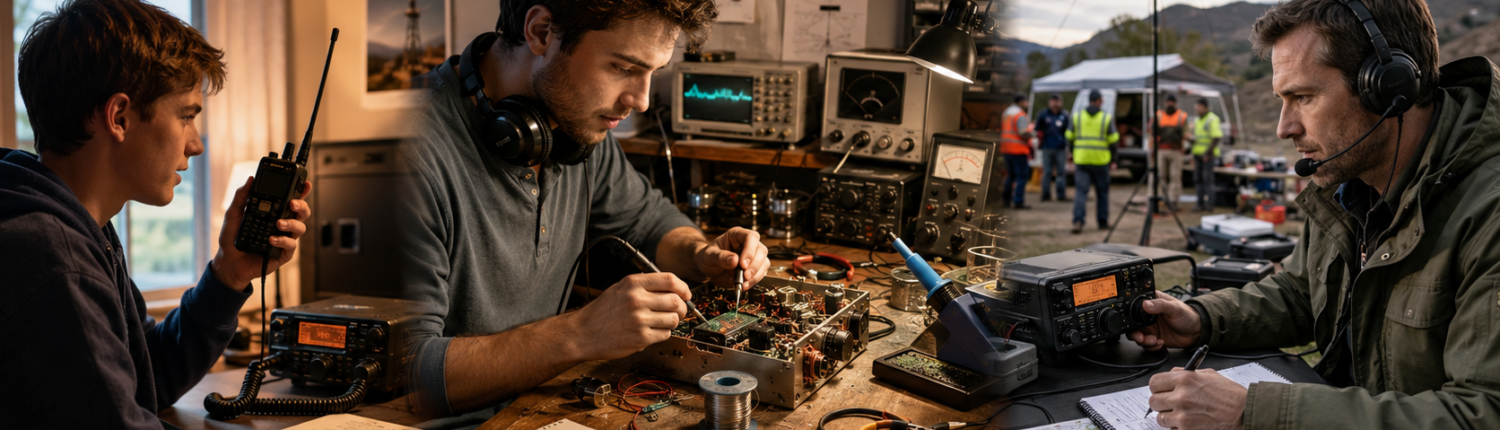
What Type of Amateur Radio Operator Are You
And What Do You Wish to Become?
From Button-Pusher to Builder, Communicator, and Community Asset
Prepared for WB6MTK.com
A practical challenge for new and experienced amateur radio operators
“The license is not the finish line. It is the invitation.”
Most people enter amateur radio the same way: they buy a radio, program a few frequencies, listen to local repeaters, make a few contacts, and begin learning the rhythm of the hobby. There is nothing wrong with that. In fact, nearly every experienced operator started there.
But that beginning point has a name.
It is called being an appliance operator.
An appliance operator knows how to turn the radio on, select a channel, push the push-to-talk button, and speak. The radio is treated much like a microwave, a television, or a cellphone. You do not need to know how it works internally. You only need to know which button gets the result.
That is a reasonable place to start.
But it is a poor place to stop.
Amateur radio was never intended to be only about owning equipment. It was meant to be a living laboratory of communications, electronics, experimentation, emergency service, technical growth, and personal discipline. The license is not the finish line. It is the invitation.
The real question is not simply, “What radio do you own?”
The better question is:
What type of amateur radio operator are you becoming?
The Appliance Operator: The Starting Point
The appliance operator depends mostly on factory settings, pre-programmed channels, online frequency lists, and someone else’s instructions. They may own a very capable radio but use only a fraction of its capability. They may have a license but still feel uncertain when asked to explain bandwidth, propagation, SWR, power supply noise, antenna gain, grounding, digital modes, or emergency message handling.
Again, this is not an insult. It is a stage of development.
Every new ham has to begin somewhere. The first step is getting on the air. The first goal is confidence. You learn the microphone. You learn your call sign. You learn how to speak clearly. You learn local repeater etiquette. You learn that the radio is not magic, but it still feels close to it when your signal reaches another station.
The danger is not being an appliance operator.
The danger is becoming comfortable there forever.
When an amateur radio operator never moves beyond pushing buttons, the hobby becomes shallow. The operator becomes dependent on repeaters, stored memories, plug-and-play antennas, and other people’s knowledge. In normal times, that may be inconvenient. In an emergency, it can become a serious limitation.
When the repeater is down, the cellphone network is overloaded, the internet is gone, the power is out, and the community needs disciplined communications, the appliance operator may suddenly discover that the radio was only one part of the system.
The real system was knowledge.
The Communicator: More Than Talking
A true amateur radio communicator does not just talk into a microphone. A communicator understands that radio is about moving information accurately, efficiently, and responsibly.
There is a difference between conversation and communication.
Conversation can be casual. Communication must be clear.
Conversation can wander. Communication has purpose.
Conversation may entertain. Communication must transfer meaning.
This difference matters greatly during emergencies. A good emergency communicator knows how to pass a message without changing its meaning. They know how to listen before transmitting. They understand brevity, phonetics, tactical call signs, net control procedures, message precedence, and the importance of writing things down.
They do not say, “I think they said…”
They say, “The message received was…”
This is where amateur radio becomes a public service skill. During a welfare check, shelter operation, neighborhood damage report, medical support request, or power outage, the person holding the microphone becomes part of a larger communications chain. Words matter. Accuracy matters. Discipline matters.
A good communicator is calm when others are anxious. They speak clearly when others are emotional. They do not flood the frequency with unnecessary talk. They do not try to become the center of attention. They serve the message, the net, and the people who need help.
That is a higher level of amateur radio.
And it begins with humility.
The Technician: Learning What Is Behind the Signal
At some point, a growing operator begins to ask better questions.
Why does this antenna work better at certain times of day?
Why can I hear distant stations on 20 meters but not on 80 meters?
Why is the noise floor so high?
Why does my signal report change when I move the coax?
Why does my power supply create noise?
Why does this radio perform better than that radio?
Why does grounding affect reception?
These questions mark the beginning of technical maturity.
The technician does not accept performance blindly. The technician investigates. They measure. They compare. They test. They learn how antennas behave, how feed lines lose power, how impedance matching works, how filters reduce interference, and how propagation changes with time, frequency, season, and solar activity.
This is where amateur radio becomes more than a hobby. It becomes applied science.
You do not need to be an electrical engineer to become a better amateur radio operator. But you do need curiosity. You need the willingness to learn why things work, not merely how to turn them on.
A technician starts to understand that the antenna is often more important than the radio. They learn that a clean installation may outperform an expensive radio connected to a poor antenna system. They discover that good coax, proper connectors, ferrite chokes, grounding, bonding, and power management can make the difference between frustration and success.
This stage changes the operator’s mindset.
The radio is no longer an appliance.
It becomes an instrument.
The Experimenter: The Heart of Amateur Radio
The experimenter is the operator who asks, “What happens if I try this?”
What happens if I build a wire antenna instead of buying one?
What happens if I compare vertical and horizontal polarization?
What happens if I test NVIS on 40 meters?
What happens if I try digital messaging during a local power outage drill?
What happens if I reduce noise before increasing power?
What happens if I create a portable station that can operate for three days without commercial power?
This is the spirit that built amateur radio.
The experimenter is not afraid to fail because failure becomes data. A poor signal report teaches something. A weak antenna teaches something. A noisy receiver teaches something. A failed field deployment teaches something very important: what must be fixed before the real emergency.
The experimenter keeps notes. They make diagrams. They compare results. They learn from older operators but are not trapped by tradition. They respect proven methods while still exploring better ones.
This is where real growth begins.
An appliance operator asks, “What should I buy?”
An experimenter asks, “What can I learn?”
That single change in thinking can transform a person’s entire amateur radio experience.
The Innovator: Building the Future Instead of Repeating the Past
Amateur radio has always depended on innovators. These are the operators who look at existing limitations and imagine better systems.
They ask questions like:
How can we pass welfare traffic more efficiently?
How can neighborhoods communicate when phones fail?
How can digital modes support local emergency operations?
How can we reduce the HF noise floor?
How can we make radio training less intimidating for new operators?
How can we connect youth, families, churches, neighborhoods, schools, and public service groups through practical communications training?
How can we combine traditional radio discipline with modern technology?
Innovation does not always mean inventing a new circuit or designing a satellite. Sometimes innovation means creating a better training method, a clearer emergency net procedure, a more reliable portable station, a better antenna deployment kit, or a more understandable guide for new operators.
An innovator sees amateur radio not as a museum, but as a workshop.
This is urgently needed today. The communications environment has changed. Cellphones, internet messaging, satellite services, and digital platforms have made people assume that communication is automatic. But emergencies reveal the weakness of that assumption. Systems fail. Infrastructure becomes overloaded. Power disappears. Networks become unavailable.
Amateur radio remains valuable because it can operate independently.
But that value only exists when operators are trained, disciplined, technically capable, and willing to adapt.
Owning a radio is not enough.
The future belongs to operators who can think.
The Emergency Communicator: Calm, Prepared, and Useful
Many people say they want to help during an emergency. Fewer people prepare seriously enough to be useful.
Emergency communication requires more than good intentions. It requires training, practice, equipment readiness, message discipline, and emotional control.
A good emergency communicator knows their equipment before the emergency begins. They know how long their batteries will last. They know which antennas work from home, from a vehicle, and from the field. They know how to operate without internet access. They know local simplex frequencies. They understand repeater failure. They know how to pass written traffic. They know how to work under a net control station.
Most importantly, they know how to stay calm.
In an emergency, radio operators should not become part of the confusion. They should reduce confusion. They should not spread rumors. They should not exaggerate. They should not transmit unverified information as fact. They should not turn the frequency into a discussion group.
The emergency communicator is a servant of accurate information.
This is one of the noblest roles in amateur radio. It brings together technical knowledge, communication discipline, personal character, and community service.
The question every operator should ask is simple:
If my community needed communications today, would I be an asset or merely a person with a radio?
That question may be uncomfortable.
It is also necessary.
Moving Beyond the Bigger Than Yours Mentality
Amateur radio sometimes suffers from the wrong kind of pride.
Bigger tower.
Bigger amplifier.
Bigger radio.
Bigger signal.
Bigger opinion.
But the best operators are not always the loudest stations on the band. They are often the most disciplined, most helpful, most curious, and most reliable people in the room.
A powerful station without humility can become a nuisance.
A modest station operated with skill can become a lifeline.
The future of amateur radio will not be secured by ego. It will be secured by operators who are willing to teach, learn, build, test, mentor, and serve. Clubs and radio groups should not exist merely as social circles. They should become technical learning communities. They should be places where new operators are encouraged, not embarrassed. They should be places where mistakes become lessons, not public humiliation.
A healthy amateur radio culture does not ask, “How can I prove I know more than you?”
It asks, “How can I help you become more capable?”
That is the Elmer spirit. That is the experimental spirit. That is the public service spirit.
And that is the spirit amateur radio must recover.
The Personal Challenge: What Will You Become?
Every amateur radio operator should periodically take inventory.
Are you only using repeaters, or are you learning simplex?
Are you only buying antennas, or have you tried building one?
Are you only reading signal reports, or are you learning why signals change?
Are you only checking into nets, or are you learning how to pass formal traffic?
Are you only collecting radios, or are you building communications capability?
Are you only listening to others, or are you preparing to teach someone else?
These questions are not meant to discourage anyone. They are meant to invite growth.
You do not have to become everything at once. You do not have to master every mode, band, antenna, circuit, or emergency procedure. Amateur radio is too large for any one person to know it all.
But you can take the next step.
Build one antenna.
Learn one digital mode.
Practice one emergency message format.
Test one battery system.
Reduce one source of noise.
Teach one new operator.
Improve one weakness in your station.
Participate in one field exercise.
Ask one serious technical question and chase the answer until you understand it.
That is how appliance operators become communicators.
That is how communicators become technicians.
That is how technicians become experimenters.
That is how experimenters become innovators.
That is how innovators become the future of amateur radio.
The Best Radio Is Still the Trained Operator
Radios will continue to improve. Digital modes will continue to expand. Software-defined radios, mesh networks, weak-signal systems, portable power, satellite links, and emergency communication tools will continue to evolve.
But the most important part of any station will remain the operator.
A trained operator can do much with simple equipment.
An untrained operator can do little with expensive equipment.
That is the central truth.
The goal is not to shame the beginner. The goal is to awaken the builder, the thinker, the communicator, and the servant inside every licensed amateur.
So ask yourself honestly:
What type of amateur radio operator am I today?
Then ask the more important question:
What type of amateur radio operator do I wish to become?
The answer may determine whether amateur radio remains only a pastime – or becomes one of the most valuable skills you will ever develop.
| Operator Challenge Choose one skill this month: build, test, teach, listen, document, or serve. Then do it on purpose. |
add your own text