
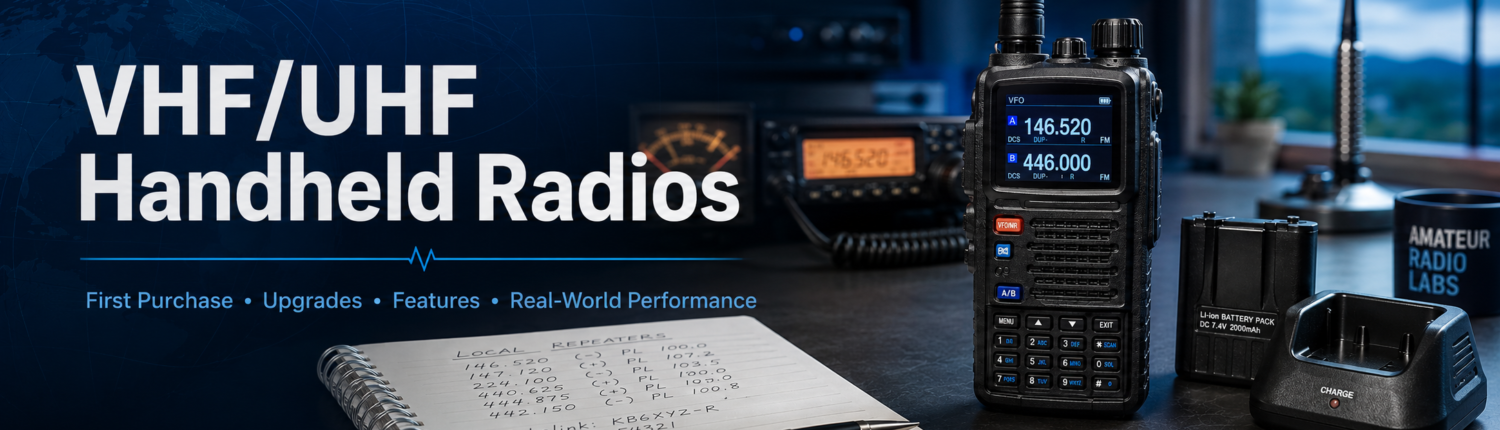
Choosing Your First or Upgrading Your VHF/UHF Handheld Radio
Introduction
For many amateur radio operators, the first radio they purchase is not an HF transceiver, a base station, or a mobile radio. It is usually a handheld VHF/UHF transceiver, commonly called an HT. The handheld radio is attractive because it is affordable, portable, easy to carry, and capable of getting a new operator on the air quickly through local repeaters, simplex contacts, club nets, emergency communication exercises, public service events, and neighborhood communications.
However, not all handheld radios are equal. Some are simple, inexpensive entry-level radios. Others are rugged, feature-rich, digital-capable, waterproof, GPS-enabled, Bluetooth-capable, and designed for serious field use. The challenge is not just buying a radio. The real challenge is buying the right radio for how you intend to operate.
A poor choice can lead to frustration: confusing menus, weak audio, poor battery life, difficult programming, poor receiver selectivity, spurious emissions, limited accessory support, or incompatibility with local repeaters and digital systems. A good choice can serve for years and become one of the most useful tools in the operator’s station.
Understanding the Role of a VHF/UHF Handheld
A VHF/UHF handheld is designed primarily for short- to medium-range communication. Most amateur handhelds cover the 2-meter band and the 70-centimeter band. The 2-meter band is commonly used for local repeaters, simplex communication, emergency nets, and public service events. The 70-centimeter band is also widely used for repeaters, linked systems, digital voice, cross-band operations, and urban-area communication.
A handheld radio is not a replacement for a full base station or a properly installed mobile radio. Its small antenna, limited transmit power, compact battery, and small speaker place practical limits on performance. Still, when properly selected and used, an HT can be one of the most important radios an amateur owns.
The handheld is especially valuable for:
Local repeater operation
Club nets
Emergency communications
Public service events
Neighborhood communications
Search-and-rescue support
Portable and field operation
Monitoring local activity
Backup communication during outages
Learning basic radio procedure
The best handheld radio is not necessarily the one with the most features. It is the one that performs reliably under the conditions where the operator will actually use it.
First Question: What Do You Need the Radio to Do?
Before buying a handheld, the operator should define the mission. A first-time Technician Class operator may simply need reliable access to local repeaters. An emergency communicator may need ruggedness, battery endurance, weather resistance, and simple operation under stress. A digital-mode enthusiast may need DMR, D-STAR, Yaesu System Fusion, or APRS. A public service volunteer may need loud audio, long battery life, and easy channel selection. A traveler may need wide repeater coverage and easy programming.
The correct buying question is not, “What is the best handheld?” The correct question is, “What is the best handheld for my operating mission?”
Analog Versus Digital Handheld Radios
The first major decision is whether to buy an analog-only handheld or a digital-capable handheld.
Analog FM Handhelds
Analog FM is still the foundation of VHF/UHF amateur handheld operation. Most local repeaters use FM voice, and nearly every handheld radio supports it. Analog radios are usually less expensive, easier to understand, and simpler to program than digital radios.
For a brand-new operator, a good dual-band analog FM handheld may be the best first choice. It allows the operator to learn repeater operation, simplex procedure, tones, offsets, net participation, and basic radio discipline before dealing with digital programming.
A quality analog handheld should provide good receiver performance, clean transmit audio, strong battery life, clear display visibility, and straightforward programming.
Digital Voice Handhelds
Digital voice radios offer expanded capability, but they also introduce added complexity. Common amateur digital systems include DMR, D-STAR, and Yaesu System Fusion. Each system has different programming methods, repeater infrastructure, operating culture, and network behavior.
A digital handheld can be a smart purchase if local repeaters support that digital mode or if the operator specifically wants access to digital networks. However, buying a digital radio before understanding local repeater availability can be a mistake.
Before purchasing a digital handheld, the operator should ask:
Which digital systems are active in my area?
Are local clubs using DMR, D-STAR, or Fusion?
Do I want local repeater access or worldwide network access through hotspots?
Am I willing to learn codeplugs or digital programming?
Will I use the digital features often enough to justify the cost?
Digital handhelds can be excellent, but only when they match the operator’s actual operating environment.
Dual-Band Capability: Why 2 Meters and 70 Centimeters Matter
For most amateur operators, the first handheld should be a dual-band VHF/UHF radio covering 2 meters and 70 centimeters. A single-band radio may be less expensive, but a dual-band radio provides far more flexibility.
The 2-meter band is commonly used for wide-area repeaters and simplex communication. It often performs better in open areas, rural locations, and longer local paths. The 70-centimeter band is often useful in urban environments, inside buildings, and with linked repeater systems. It also supports many digital repeaters and auxiliary systems.
A dual-band handheld allows the operator to participate in more nets, access more repeaters, and adapt to different operating conditions.
Transmit Power: How Much Is Enough?
Most handheld radios provide several power levels, often ranging from low power around 1 watt to high power around 5 watts. Some radios advertise slightly higher output power, but antenna efficiency and location usually matter more than a small increase in wattage.
A handheld radio with a poor antenna inside a building may perform badly even at full power. The same radio connected to a good external antenna at an elevated location may perform very well at low power.
More power also drains the battery faster and may cause the radio to heat up during extended transmissions. For emergency work and field use, operators should learn to use the lowest power level that maintains reliable communication.
Power is useful, but antenna placement is often more important.
Receiver Performance: The Overlooked Factor
Many buyers focus on transmit power and features, but receiver quality is just as important. A handheld with a weak or easily overloaded receiver may hear poorly in urban areas, near commercial transmitters, near paging systems, or around strong RF environments.
Receiver performance includes sensitivity, selectivity, intermodulation resistance, audio quality, and squelch behavior. Cheap radios may work acceptably in quiet RF environments but struggle near strong signals. Better radios often have more stable receivers, cleaner audio, and better resistance to overload.
If the operator lives in a city or near radio towers, receiver quality becomes especially important. A radio that looks impressive on paper may fail in real-world RF congestion.
Antennas: The Biggest Upgrade for Most Handhelds
The antenna supplied with many handheld radios is a compromise. It is short, convenient, and portable, but not always efficient. One of the most effective upgrades for a handheld is a better antenna.
Common handheld antenna options include:
A flexible dual-band whip for general use
A longer high-gain whip for improved range
A roll-up J-pole antenna for emergency and field deployment
A magnetic-mount antenna for temporary vehicle use
An outdoor base antenna for home operation
A speaker-mic antenna adapter setup for public service events
A handheld connected to an elevated roll-up J-pole or outdoor antenna can perform dramatically better than the same radio using the stock rubber antenna. For emergency communications, an external antenna can make the difference between marginal and reliable communication.
The operator should also pay attention to connector type. Many handhelds use SMA connectors, but the gender and arrangement vary. Adapters can be useful, but excessive adapter use may place mechanical stress on the radio’s antenna connector.
Battery Life and Power Management
Battery performance is a critical buying factor. A handheld used for emergency communication, public service, or field operations must operate for long periods without convenient charging.
Important battery considerations include:
Battery capacity
Availability of spare batteries
Drop-in charger quality
USB charging support
12-volt vehicle charging support
AA battery case availability
Charging speed
Battery replacement cost
Battery performance in cold or hot environments
For emergency communications, the ability to charge from a vehicle, solar system, USB power bank, or field battery can be extremely valuable. A radio with excellent features but poor power flexibility may not be ideal for preparedness use.
Spare batteries are not a luxury. They are part of a serious handheld station.
Ruggedness, Weather Resistance, and Build Quality
A radio used only indoors does not need the same ruggedness as a radio used in the field. Operators who participate in emergency communications, public service events, hiking, search-and-rescue support, storm response, or outdoor activities should consider durability carefully.
Important build-quality features include:
Strong case construction
Weather resistance or waterproof rating
Solid knobs and buttons
Readable display
Secure belt clip
Durable battery latch
Strong antenna connector
Good speaker audio
Accessory jack protection
Resistance to dust and moisture
A rugged radio may cost more, but it may survive conditions that would damage a cheaper radio. For emergency service, reliability is more important than novelty.
Display and Controls
A handheld must be easy to operate. Small radios often rely on menus, multi-function buttons, and programming software. This can become frustrating during stressful situations.
A good handheld should allow the operator to quickly adjust volume, squelch, channel, power level, tone settings, and memory selection. The display should be readable in daylight and low light. The keypad should be usable with reasonable accuracy.
For emergency communications, a radio should not require the operator to fight through complicated menus under pressure. Simplicity is a performance feature.
Programming: The Hidden Buying Issue
Programming is one of the most important practical concerns when buying a handheld. Some radios are easy to program from the front panel. Others are much easier to program with software. Digital radios, especially DMR radios, may require more detailed programming.
A good handheld should support reliable programming software and a dependable programming cable or USB interface. The operator should be able to program local repeaters, simplex channels, emergency frequencies, weather channels where supported, tone settings, offsets, names, scan groups, and digital contacts if applicable.
For new operators, a radio that is difficult to program can become discouraging. For emergency communicators, poor programming can become a serious operational problem.
Every handheld should have a clean, organized memory plan.
Audio Quality: Speaker, Microphone, and Accessories
Audio quality matters. A handheld may have excellent specifications but still be difficult to use if the speaker is weak or the microphone audio is poor.
For public service events and emergency nets, the radio should have clear, strong receive audio. A good speaker microphone can improve usability by allowing the radio to remain clipped to a vest, belt, pack, or harness.
Accessory compatibility should be considered before purchase. Some radios use common accessory connectors, while others use proprietary arrangements. The operator should check the availability of speaker microphones, headsets, programming cables, battery eliminators, charging accessories, and replacement batteries.
Scanning and Monitoring Features
Many handheld radios include scanning functions. Scan speed and usability vary significantly. Some radios scan slowly, making them less useful for monitoring multiple repeaters or event channels. Others provide better scan banks, priority channels, dual watch, and customizable scan lists.
Operators should understand that an amateur handheld is not the same as a dedicated scanner. If wide-area monitoring is a major goal, a dedicated scanner may perform better. However, a good HT can still provide useful monitoring of local amateur repeaters, simplex channels, and selected public safety or weather broadcasts where legal and supported.
Emergency Communications Features
For emergency communications, the best handheld is not necessarily the most expensive. It is the one that is reliable, understandable, well programmed, and power-flexible.
Useful emergency features include:
Dual-band VHF/UHF operation
Strong battery life
Spare battery availability
Vehicle charging support
External antenna capability
Weather resistance
Loud speaker audio
Simple channel selection
Lockable keypad
Clear memory labels
Low-power settings
USB or 12-volt charging options
Compatibility with local emergency nets
Easy operation by tired or stressed operators
Emergency radios should be tested before they are needed. A radio sitting in a go-kit with an unknown charge state, old programming, and an untested antenna is not a communications plan.
Public Service and Event Operation
For parades, races, walks, community events, and support operations, the handheld must be comfortable, dependable, and easy to hear in noisy environments.
Important features include loud audio, speaker-mic support, secure belt attachment, good battery endurance, clear memory labels, and reliable repeater/simplex operation. Operators should also consider carrying a spare battery, small notepad, pen, earbud, and a backup antenna.
A handheld used for public service should be programmed before the event and tested on the assigned frequencies.
APRS, GPS, and Location Features
Some VHF/UHF handhelds include APRS and GPS features. APRS can be useful for position reporting, short messages, event tracking, search-and-rescue support, and field operations. GPS can also help with location awareness and time synchronization.
These features are valuable for some operators but unnecessary for others. An operator who works public service events, field operations, or emergency communications may find APRS useful. A casual repeater operator may not need it.
The buyer should avoid paying for features that will not be used.
Bluetooth and Modern Convenience Features
Some handhelds include Bluetooth, smartphone integration, USB-C charging, color displays, recording, data functions, or app-based programming. These features can be convenient, but they should be evaluated carefully.
Convenience should not replace basic radio quality. A radio with modern features but poor RF performance, poor battery support, or confusing programming may not be the best choice.
Legal and Practical Cautions
Amateur radios are designed for use on amateur radio frequencies by licensed amateur operators. Many amateur handhelds can receive outside the amateur bands, and some may be physically capable of transmitting outside amateur allocations. That does not mean such transmissions are legal.
FRS, GMRS, MURS, marine, aviation, public safety, and business radio services have their own rules, equipment requirements, licensing requirements, and channel restrictions. Amateur handhelds generally should not be used as substitute radios for those services unless the radio is specifically approved for that service and the operator is authorized.
A responsible operator understands both technical capability and legal authority.
The Budget Radio Question
Low-cost handheld radios have introduced many people to amateur radio. They are affordable, widely available, and often capable of basic repeater operation. For a new operator with a limited budget, a low-cost radio may be better than no radio at all.
However, there are tradeoffs. Budget radios may have weaker receivers, less durable construction, less consistent quality control, poorer documentation, confusing menus, limited accessory quality, and questionable spectral cleanliness depending on the model. They may also be harder for a new operator to program correctly.
A budget radio can be a starting point, but it should not always be treated as the final answer. As the operator gains experience, upgrading to a higher-quality handheld may improve reliability, ease of use, audio quality, and field performance.
Mid-Range Handhelds: Often the Best Value
For many operators, the best choice is a well-supported mid-range dual-band handheld. These radios usually offer better receiver performance, better build quality, improved audio, better documentation, more reliable programming, and stronger accessory support than the cheapest radios.
A mid-range handheld is often ideal for new operators who are serious about staying active, emergency communicators building a dependable go-kit, and operators upgrading from a basic first radio.
This category often provides the best balance of cost, quality, and practical usefulness.
Premium Handhelds: When They Make Sense
Premium handhelds can include digital voice, GPS, APRS, waterproof construction, advanced displays, wide receive coverage, strong accessory ecosystems, Bluetooth, and excellent build quality. These radios make sense when the operator needs the features and will actually use them.
A premium handheld may be the right choice for:
Serious emergency communications operators
Operators active in digital voice systems
Public service and event leaders
Search-and-rescue or field teams
Operators who need APRS/GPS
Operators who value ruggedness and long-term support
Experienced operators upgrading from basic radios
The risk with premium handhelds is buying complexity instead of capability. A radio is only valuable if the operator learns to use it well.
Upgrading From Your First Handheld
An operator should consider upgrading when the first handheld no longer supports the mission. Common reasons to upgrade include poor receiver performance, weak audio, limited battery options, lack of digital capability, difficult programming, poor accessory support, or unreliable performance during events.
An upgrade should solve a specific problem. Do not upgrade merely because a newer radio exists. Upgrade because the current radio limits communication effectiveness.
Good upgrade reasons include:
You need better audio in noisy environments.
You need a more rugged radio for field use.
You need DMR, D-STAR, Fusion, APRS, or GPS.
You need better battery and charging options.
You need a more reliable receiver in strong RF areas.
You need easier programming and better memory management.
You need weather resistance.
You need better accessory support.
A proper upgrade should make operating simpler, clearer, and more dependable.
Pricing Considerations
Pricing changes over time, and actual prices should be checked with current dealers and used-market listings before purchase. As a general guide, handheld radios usually fall into several practical ranges.
Budget analog handhelds are usually the least expensive and may cost only a modest amount. These are useful for basic repeater access and entry-level learning, but quality can vary.
Mid-range analog handhelds usually cost more but often provide better receiver quality, audio, durability, documentation, and accessory support.
Digital-capable handhelds are typically more expensive, especially those supporting DMR, D-STAR, Fusion, APRS, GPS, Bluetooth, or waterproof construction.
Premium handhelds can cost several times more than entry-level models, but they may provide long-term value for operators who need their advanced features.
The radio itself is not the total cost. A realistic handheld budget should include:
Radio
Spare battery
Better antenna
Programming cable
Speaker microphone
Vehicle charger
Protective case
External antenna adapter
Roll-up emergency antenna
Charging solution for field use
A $50 radio with no accessories may not be as useful as a $200 radio with a spare battery, better antenna, and proper programming support.
First-Time Buyer Recommendation
For most first-time amateur radio operators, the best starting point is a quality dual-band analog FM handheld with good documentation, reliable programming support, strong battery options, and local repeater compatibility.
The first radio should help the operator learn, not discourage them. It should be simple enough to operate but capable enough to remain useful after the operator gains experience.
A good first handheld should have:
2-meter and 70-centimeter coverage
5-watt class output
Good receiver performance
Clear transmit and receive audio
Good battery life
Easy memory programming
CTCSS and DCS tone support
Repeater offset support
Clear display
Accessory availability
Spare battery availability
External antenna compatibility
The new operator should also purchase or build a better antenna solution early. Improving the antenna often produces more benefit than replacing the radio.
Upgrade Recommendation
For an operator upgrading from a basic handheld, the best choice depends on the limitation being solved.
If the problem is poor audio or weak receive performance, choose a higher-quality analog dual-band radio.
If the problem is emergency readiness, choose a rugged radio with better battery and charging options.
If the problem is digital access, choose the digital system that matches the repeaters and operators in your area.
If the problem is public service operation, choose a radio with loud audio, reliable accessories, and long battery life.
If the problem is field deployment, choose a radio with weather resistance, external antenna support, and multiple charging options.
The best upgrade is not always the most expensive radio. The best upgrade is the one that removes the weakness in the current station.
Practical Buying Checklist
Before purchasing a VHF/UHF handheld, ask these questions:
Does it cover both 2 meters and 70 centimeters?
Does it support the repeaters in my local area?
Is analog FM enough, or do I need digital voice?
Which digital mode is actually used near me?
Is the radio easy to program?
Can I get a programming cable and software?
Are spare batteries available?
Can it charge from a vehicle or field power source?
Is the speaker loud enough?
Is the display readable?
Does it support CTCSS and DCS tones?
Can I connect an external antenna?
Is it rugged enough for my use?
Are accessories easy to find?
Does it have good documentation?
Will I still be happy with it one year from now?
A disciplined checklist prevents emotional buying.
Common Mistakes to Avoid
The first mistake is buying only by price. Cheap radios can be useful, but the lowest price does not always produce the best operating experience.
The second mistake is buying a digital radio without knowing whether the local area supports that digital system.
The third mistake is ignoring the antenna. The stock antenna is often the weakest part of the handheld station.
The fourth mistake is failing to program the radio properly before it is needed.
The fifth mistake is assuming that more transmit power automatically means better communication.
The sixth mistake is buying a complex radio and never learning its menus, memories, tones, scan functions, or emergency features.
The seventh mistake is forgetting spare power. A dead radio is not part of a communications plan.
Building a Complete Handheld Station
A serious handheld setup should be treated as a small station, not just a radio. A complete handheld station may include:
Dual-band handheld transceiver
Spare battery
Charging cradle
Vehicle charging cable
USB or field charging method
Speaker microphone
Better flexible antenna
Roll-up J-pole antenna
Coax adapter
Small notebook and pen
Printed frequency list
Local repeater directory
Emergency net channel plan
Protective carry pouch
Earbud or headset for events
For emergency work, the handheld should be tested periodically. Batteries should be charged, programming should be updated, and antennas should be verified.
Final Thoughts
A VHF/UHF handheld is often the first radio an amateur operator owns, but it should not be treated as a disposable accessory. It is a practical communications tool that can support local nets, emergency work, public service events, field operations, and everyday amateur radio activity.
For a first radio, choose reliability, simplicity, dual-band capability, good battery support, and easy programming. For an upgrade, identify the specific limitation of the current radio and select a replacement that solves that problem.
The best handheld radio is not the one with the longest feature list. It is the one that works when needed, is understood by the operator, supports the local communication environment, and fits into a complete station plan. A well-selected VHF/UHF handheld can become one of the most useful and dependable radios in the amateur radio operator’s entire station.