
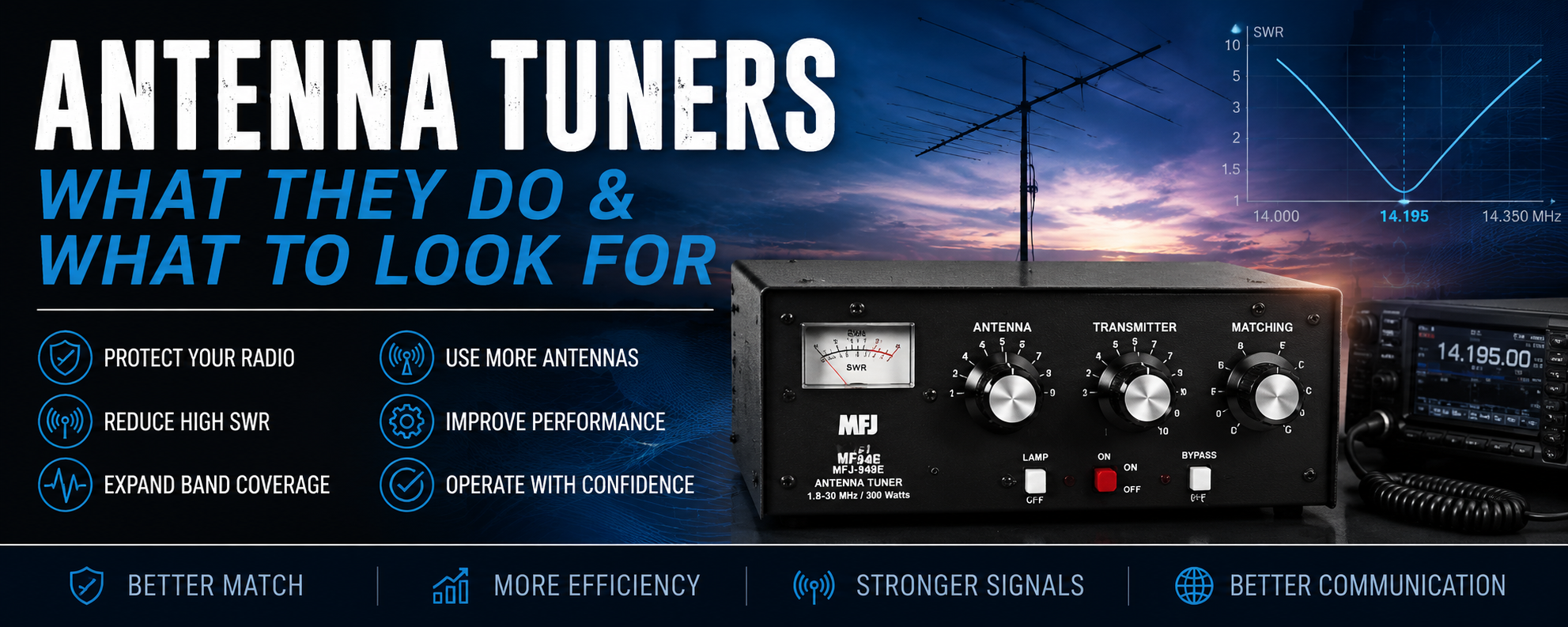
What a Tuner Does vs. What It Does Not Do
An antenna tuner is an impedance-matching network. It does not tune the physical antenna, does not guarantee efficient radiation, and does not erase losses in a poor antenna system. It transforms the impedance presented to the transmitter so the radio can safely deliver power. The must-have features include adequate power margin, wide matching range, accurate SWR and power metering, true bypass, quality components, proper balanced-line support when needed, low-power tuning, and reliability under real operating conditions.
| Key principle: A low SWR at the transmitter proves the transmitter sees an acceptable load. It does not prove the antenna is radiating efficiently. |
The Does and Doesn’t
| A tuner does | A tuner does not |
| Makes the transmitter see a safe impedance | Physically changes the antenna length or radiation pattern |
| Transforms impedance through inductance and capacitance | Guarantees a strong radiated signal |
| Helps reduce transmitter foldback caused by mismatch | Eliminates feed-line loss after the tuner |
| Improves operating flexibility across bands | Replaces a good ground, counterpoise, radial system, or choke |
| Allows practical use of some compromise antennas | Makes every antenna efficient |
Must-Have Feature Checklist
| Feature | Why it matters |
| Adequate power rating | Use conservative headroom, especially for digital modes and amplifiers. |
| Wide matching range | Needed for non-resonant wires, multiband antennas, portable use, and emergencies. |
| Accurate SWR/power metering | Shows forward power, reflected power, SWR, and tuning response. |
| True bypass | Removes tuner from the RF path for resonant antennas and troubleshooting. |
| Antenna selection | Allows switching among coax, balanced-line, random-wire, or bypass outputs. |
| Quality components | Large inductors, proper capacitor spacing, heavy relays/switches, strong connectors. |
| Balanced-line support | Required when feeding ladder line or open-wire line correctly. |
| Memory tuning | Speeds automatic tuning and reduces relay wear. |
| Low-power tuning | Protects tuner components and minimizes unnecessary interference. |
| Emergency reliability | Rugged, simple, field-friendly, and supported by written operating notes. |
Introduction
An antenna tuner is one of the most misunderstood pieces of equipment in an amateur radio station. Many operators buy one because they are told it will tune the antenna, fix high SWR, or make any antenna work on any band. Those statements contain a little truth, but they are also misleading.
An antenna tuner does not physically change the antenna. It does not magically make a poor antenna efficient. It does not remove losses from bad coax, poor grounding, or a poorly designed radiating system. What it actually does is match impedances so the transmitter can safely and efficiently deliver power into the antenna system connected to it.
When properly selected and used, an antenna tuner is an extremely valuable station tool. It can expand operating flexibility, protect transmitter finals, allow multiband operation, and help the operator get the best practical performance from an antenna system. When misunderstood, it can hide serious antenna problems while wasting power as heat.
What an Antenna Tuner Actually Does
The term antenna tuner is not technically perfect. A better term would be impedance matching network.
Your transmitter is designed to work into a specific load impedance, normally 50 ohms resistive. Most modern amateur transceivers expect to see something close to a 50-ohm load at the radio antenna connector. When the antenna system does not present that load, some of the transmitted energy is reflected back toward the transmitter. This mismatch is measured as standing wave ratio, or SWR.
The antenna tuner sits between the transmitter and the antenna system. Its job is to transform the impedance presented by the antenna system into a value the transmitter can handle. The transmitter wants to see 50 ohms. The antenna system may present something very different. The tuner creates a matching network so the transmitter sees an acceptable load.
That is what the tuner does. It does not necessarily mean the antenna is now efficient. It means the transmitter is seeing a better match.
The Critical Difference: Matching vs. Radiation
A tuner can make the radio happy. It cannot guarantee that your signal is strong.
This distinction is critical. An antenna system includes the transmitter, tuner, feed line, antenna, ground or counterpoise system, and the surrounding environment. The tuner only corrects the impedance match at the point where it is installed.
If the tuner is located in the shack, it matches the transmitter to the feed line and antenna system as seen from the shack. However, if the coax is operating with high SWR between the tuner and the antenna, significant losses may still occur in the feed line.
A tuner in the shack may show a perfect 1:1 SWR at the transmitter, but the antenna may still be inefficient. Power may be lost in the coax, in traps, in poor connections, in lossy ground systems, or in the tuner itself.
A good match is not the same as a good antenna. A good antenna tuner helps transfer power. A good antenna system radiates it.
| Station reality: A tuner in the shack can show a perfect meter reading while the feed line or antenna system is still wasting power. |
Why Antenna Tuners Are Used
Antenna tuners are commonly used for several important reasons.
First, they help protect the transmitter. Modern solid-state transceivers usually reduce power when they see high SWR. This protects the final amplifier transistors. If the radio sees too much reflected power, it may fold back power, produce distortion, or shut down transmission.
Second, a tuner can expand band coverage. Many antennas do not naturally cover an entire band with low SWR. A dipole cut for the lower portion of 40 meters may not have a low SWR at the upper end of the band. A tuner can allow the operator to use a wider portion of the band without physically changing the antenna.
Third, tuners make many multiband antennas practical. Non-resonant wire antennas, ladder-line-fed doublets, end-fed wires, random wires, loops, and verticals often require a tuner to operate across multiple bands.
Fourth, tuners compensate for real-world installation limits. HOA restrictions, small lots, roof limitations, trees, building materials, and neighborhood noise can force compromise antennas. A tuner gives the operator more flexibility when the antenna cannot be ideal.
Finally, a tuner improves station convenience. Without a tuner, the operator may need multiple antennas, antenna switches, physical adjustments, or band-specific installations. A tuner can simplify operation by allowing one antenna system to cover several frequencies.
What an Antenna Tuner Cannot Do
A tuner cannot make a bad antenna good. A short, poorly installed, lossy antenna may be matched by a tuner, but that does not mean it will radiate well. If most of the power is being lost as heat, the tuner may still show a low SWR.
A tuner cannot eliminate feed-line loss. If the tuner is located in the shack and the feed line has high SWR, the feed line may experience additional loss. This is especially important when using coaxial cable on bands where the antenna impedance is far from 50 ohms.
A tuner cannot replace proper grounding. For end-fed wires, verticals, and random-wire antennas, the ground or counterpoise system is part of the antenna. Poor grounding can cause RF in the shack, distorted audio, computer interference, microphone burns, and weak radiation.
A tuner cannot fix common-mode current. Common-mode current occurs when RF travels on the outside of the coax shield or station wiring. This can cause RF feedback, noise pickup, and interference. A proper choke or current balun is often required.
A tuner cannot violate physics. A severely shortened antenna on 160 meters or 80 meters can be matched, but radiation resistance may be extremely low and losses may dominate.
Manual vs. Automatic Antenna Tuners
Manual tuners use knobs, switches, roller inductors, variable capacitors, or switched inductors to adjust the matching network. The operator manually tunes for lowest SWR or best match. Manual tuners are often preferred by experienced operators because they are simple, rugged, repairable, and usually capable of handling a wide range of impedances.
Manual tuners offer wide matching range, high power handling, good durability, better visibility into what the station is doing, and strong suitability for unusual antennas. Their disadvantages are slower tuning, a need for operator skill, and the need to log or remember settings.
Automatic tuners use relays, capacitors, inductors, and control circuits to find a match automatically. Some are built into transceivers, while others are external units. Automatic tuners are convenient, fast, and excellent for frequent band changes, mobile stations, remote stations, and modern digital operation.
The disadvantages of automatic tuners include limited matching range depending on model, relay wear over time, possible difficulty with extreme impedances, and the need to tune at reduced power on many models.
For many modern HF stations, an external automatic tuner is the most convenient solution. For high-power, experimental, or unusual antenna systems, a quality manual tuner may still be the better choice.
Internal Tuners vs. External Tuners
Many HF transceivers include a built-in automatic tuner. These internal tuners are useful, but they are usually limited. Most internal tuners are designed to match modest SWR ranges, commonly around 3:1 or less. They are excellent for trimming a near-resonant antenna but are not intended to match highly reactive or non-resonant antennas across many bands.
An internal tuner is best for slightly mismatched dipoles, band-edge adjustments, commercial multiband antennas, minor SWR correction, and everyday convenience.
An external tuner usually offers a wider matching range and greater power-handling capability. It is better for non-resonant wire antennas, ladder-line-fed doublets, random wires, end-fed antennas, higher-power operation, wider impedance matching, and experimental antenna work.
A built-in tuner is helpful. A serious station often benefits from a capable external tuner.
Where the Tuner Is Installed Matters
The location of the tuner has a major effect on system efficiency.
A shack-mounted tuner is installed near the radio. This is the most common arrangement. It is convenient and easy to control, but it only matches the transmitter to the feed line and antenna system. If the feed line is coax and the antenna is far from resonance, losses in the coax can be significant.
A remote tuner is installed outside, usually at the base of a vertical, near the feed point of a wire, or at the antenna feed point. This can greatly improve efficiency because the tuner matches the antenna before the signal travels through the coax.
Remote tuners are especially useful for vertical antennas, random wires, end-fed wires, non-resonant antennas, multiband outdoor installations, and low-loss coax runs after the match point. In many installations, the best tuner location is at the antenna, not in the shack.
Balanced vs. Unbalanced Antenna Systems
Coaxial cable is unbalanced. Ladder line and open-wire feed line are balanced. A center-fed doublet fed with ladder line is a balanced antenna system.
If you are feeding a balanced antenna system, the tuner should properly support balanced operation. This usually means using a true balanced tuner or a suitable external balun with a tuner designed for unbalanced output.
Placing a balun at the wrong point can create heating, losses, and saturation problems, especially under high SWR conditions. For ladder-line-fed antennas, a high-quality balanced tuner is often the best solution.
Must-Have Feature 1: Adequate Power Rating
The tuner must be rated for the power you intend to use, with comfortable headroom. If you operate a 100-watt transceiver, do not buy a tuner barely rated for 100 watts under ideal conditions. A tuner rated for 300 watts or more is often a better choice for a barefoot HF station because it provides margin for mismatch, digital duty cycle, and component heating.
For amplifier operation, the tuner must be rated for the amplifier output power. A legal-limit station requires a tuner designed for high voltage, high current, and continuous RF stress.
Power rating is not just about watts. It is also about impedance, voltage, current, duty cycle, and mode. Digital modes such as FT8, RTTY, JS8Call, and other high-duty-cycle modes place more stress on tuners than casual SSB operation.
| Buying rule: For a 100-watt station, margin matters. A tuner rated well above the operating power is often the smarter purchase. |
Must-Have Feature 2: Wide Matching Range
A tuner’s matching range determines how difficult of a load it can match. Some tuners can only handle modest mismatches. Others can match a much wider range of impedances.
A limited-range tuner may work well with resonant antennas but fail with random wires, short verticals, or multiband doublets. For serious amateur radio use, especially if you plan to experiment with antennas, choose a tuner with a wide matching range.
A wide matching range is especially important for non-resonant wire antennas, portable antennas, emergency antennas, compromise antennas, multiband operation, and field deployments. The tuner should not be selected only for today’s antenna. It should support the antenna systems you may use later.
Must-Have Feature 3: Accurate SWR and Power Metering
A good tuner should include accurate metering or work with a quality external meter. At a minimum, the operator should be able to see forward power, reflected power, SWR, and tuning response.
Good metering helps the operator understand what is happening. It also helps identify problems such as bad coax, poor connectors, water intrusion, intermittent antennas, or unexpected changes in antenna behavior.
Needle meters are useful because they show movement and trends. Digital meters can be precise and easy to read. Either can work well if properly designed. A tuner without useful metering leaves the operator blind.
Must-Have Feature 4: True Bypass Switch
A tuner should have a true bypass function. Bypass allows the operator to remove the tuner from the RF path when it is not needed. This is important when using a resonant antenna or when troubleshooting.
Without bypass, the operator may not know whether a problem is caused by the antenna, the feed line, the tuner, or the radio. A bypass switch also reduces unnecessary insertion loss when the antenna already presents a good match.
Must-Have Feature 5: Antenna Selection Capability
Many tuners include multiple antenna outputs. This is very useful for a station with more than one antenna. A tuner with antenna selection allows the operator to switch between antennas without adding a separate coax switch.
Useful antenna outputs may include Coax 1, Coax 2, balanced line, random wire, and bypass path. This feature becomes increasingly valuable as the station grows.
Must-Have Feature 6: Quality Components
A tuner handles RF voltage and current. Component quality matters. Look for large inductors, properly spaced capacitors, quality switches, heavy-duty relays in automatic tuners, good internal layout, solid connectors, adequate ventilation, and robust enclosure construction.
Cheap tuners may work at low power with easy loads, but they can arc, heat, drift, or fail under difficult conditions. A tuner is not the place to buy the cheapest possible component if you plan to operate seriously.
Must-Have Feature 7: Proper Balun or Balanced Output Support
If you plan to use balanced feed line, the tuner must support it properly. Many tuners include a built-in 4:1 voltage balun. This may be acceptable for some installations, but it is not always ideal. Under high mismatch conditions, some built-in baluns can heat, saturate, or become inefficient.
For serious balanced-line operation, consider a true balanced tuner, a high-quality external current balun, a tuner designed for ladder-line-fed antennas, and proper attention to RF current balance. If you use ladder line, do not treat balanced output as an afterthought. It is central to the antenna system.
Must-Have Feature 8: Memory Tuning for Automatic Tuners
For automatic tuners, memory tuning is a major convenience. A memory tuner stores successful tuning solutions by frequency. When the operator returns to a previously used frequency, the tuner recalls the settings quickly instead of searching from scratch.
This is especially valuable for contesting, nets, digital modes, band hopping, remote operation, and emergency communication work. Memory tuning reduces tuning time and relay wear.
Must-Have Feature 9: Safe Tuning Power Requirements
Many tuners require low power during tuning. This protects tuner components and prevents unnecessary interference. A good tuner should clearly specify its required tuning power and be easy to tune without transmitting excessive power into the band.
For automatic tuners, the ideal system uses a low-power tuning carrier or is controlled directly by the transceiver. For manual tuners, the operator should tune using reduced power, then increase power after the match is established.
Never tune at full power unless the tuner is specifically designed for it and the operating conditions justify it.
Must-Have Feature 10: High Voltage and Current Capability
A tuner may experience very high RF voltage or current depending on antenna impedance. High-impedance loads can create high voltage across capacitors. Low-impedance loads can create high current through inductors and switches.
This is why tuner power ratings can be misleading. A tuner may be rated for a certain wattage into a moderate mismatch but fail when matching a highly reactive antenna. A well-built tuner should have enough physical spacing, insulation, and component strength to handle difficult real-world loads.
Must-Have Feature 11: Low-Loss Design
Every tuner has some loss. A good tuner minimizes that loss. Loss occurs as heat in inductors, capacitors, switches, relays, baluns, and wiring. Loss increases when the tuner is forced to match extreme impedances.
Signs of tuner loss may include warm components, reduced signal strength, arcing, unstable tuning, burning smell, power foldback, and poor reports despite low SWR. A tuner should be efficient under the conditions where you intend to use it.
Must-Have Feature 12: Mode and Duty-Cycle Suitability
Operating mode matters. SSB voice has a relatively low average duty cycle. CW has a higher duty cycle. Digital modes can be much more demanding because they may transmit continuous or near-continuous RF for extended periods.
A tuner used for digital modes should have extra power-handling margin. For example, if you plan to operate 100 watts on FT8, a tuner rated only barely above 100 watts may not be the best choice. More headroom is safer.
Must-Have Feature 13: Good Documentation
A quality tuner should come with clear documentation. Good documentation should explain power limits, tuning procedures, supported impedance range, antenna connection options, grounding recommendations, balanced-line limitations, tuning power requirements, and maintenance guidance.
Poor documentation often indicates poor engineering support.
Must-Have Feature 14: Ground Connection
A tuner used with end-fed wires, random wires, or unbalanced antennas should have a solid ground connection point. This does not mean a ground lug magically solves RF problems. It means the tuner must allow proper connection to an RF ground, counterpoise, radial system, or station ground scheme where appropriate.
For random-wire and end-fed antenna systems, the counterpoise is not optional. It is part of the antenna.
Must-Have Feature 15: Reliability Under Emergency Conditions
For emergency communication work, reliability is more important than convenience. An emergency-capable tuner should be rugged, simple to operate, power appropriate, easy to troubleshoot, compatible with field antennas, usable without internet or complex setup, clearly labeled, and supported by written tuning notes.
A tuner used for emergency work should not be a mystery box. The operator should know how to use it quickly under stress.
Common Tuner Network Types
Most antenna tuners use combinations of inductance and capacitance to transform impedance. An L-network uses one inductor and one capacitor. It can be efficient and simple, but may have a more limited matching range depending on configuration.
The T-network is common in many manual tuners. It usually has two capacitors and one inductor. It offers wide matching flexibility, but it can be less efficient if adjusted poorly.
A pi-network uses two capacitors and an inductor arranged like the Greek letter pi. It is commonly associated with tube transmitters and some matching systems.
Balanced tuner networks are designed to feed balanced transmission line directly. These are often preferred for open-wire or ladder-line-fed doublets. The best network depends on the antenna system, power level, and operating goals.
The SWR Myth
Many operators become obsessed with achieving a perfect 1:1 SWR. This is not always necessary. A low SWR at the transmitter is important because the transmitter must operate safely. However, a 1.5:1 or 2:1 SWR may be perfectly acceptable for many systems, especially if the transmitter is not reducing power and feed-line losses are reasonable.
The real goal is not a perfect meter reading. The real goal is efficient radiation, safe transmitter operation, and reliable communication.
A low SWR reading can be comforting, but it does not prove the antenna is working well. A dummy load has an excellent SWR and radiates almost nothing. Low SWR does not automatically mean good radiation.
| Dummy load lesson: A dummy load has excellent SWR and radiates almost nothing. SWR alone is not a performance measurement. |
When You May Not Need a Tuner
Not every station requires an external tuner. You may not need one if you use resonant antennas for each band, your SWR is already acceptable, your radio’s internal tuner handles minor mismatch, you operate only narrow portions of bands, or you use monoband antennas.
A well-designed resonant antenna system is often better than relying on a tuner to correct a poor installation. The best tuner is often a properly designed antenna.
When a Tuner Is Strongly Recommended
A tuner is strongly recommended if you use non-resonant antennas, operate multiple HF bands, use ladder line, use a random wire, use an end-fed antenna, operate portable or emergency stations, want flexibility across entire bands, use an amplifier, experiment with antennas, or cannot install ideal antennas.
For many amateur operators, a tuner is not optional. It is part of a practical HF station.
Choosing a Tuner for a 100-Watt HF Station
For a typical 100-watt HF station, a good tuner should have at least 100-watt capability, preferably more margin; coverage from 160 through 10 meters if needed; low-power tuning support; accurate SWR indication; bypass function; wide enough matching range for planned antennas; good build quality; support for coax-fed antennas; balanced-line support if needed; and clear documentation.
A 100-watt operator using mostly resonant antennas may be satisfied with an internal tuner or a modest external automatic tuner. An operator using random wires, ladder line, or experimental antennas should choose a more capable unit.
Choosing a Tuner for High-Power Operation
High-power operation requires more careful tuner selection. A high-power tuner should have a power rating above the expected operating level, large components, excellent switch quality, wide capacitor spacing, heavy-duty inductors, good ventilation, reliable metering, low loss at high current, strong connectors, and clear duty-cycle ratings.
High power can create high RF voltage and current inside the tuner. A tuner that works well at 100 watts may arc or overheat at amplifier power. Do not use a lightweight tuner with a high-power amplifier.
Choosing a Tuner for Digital Modes
Digital modes require careful attention because they often operate at high duty cycle. For digital operation, look for conservative power rating, good cooling, low loss, stable matching, reliable relays, low-power tuning, ability to handle long transmissions, and adequate headroom above operating power.
A tuner used for FT8, JS8Call, RTTY, or similar modes should not be operated at its absolute maximum rating for long periods.
Choosing a Tuner for Portable and Emergency Use
Portable and emergency tuners need a different set of priorities. Important features include small size, low weight, low current draw, battery compatibility, fast tuning, rugged connectors, weather resistance if used outdoors, simple operation, ability to match field antennas, clear status indicators, and predictable behavior.
For emergency work, the operator should practice with the tuner before it is needed. A tuner that is unfamiliar during an emergency becomes a liability.
Common Antenna Systems and Tuner Needs
A resonant dipole may only need a tuner at the band edges, if at all. An internal tuner may be sufficient.
A multiband trap dipole can benefit from a tuner to smooth out SWR across band segments, but the tuner should not be used to force operation far outside the antenna’s intended design.
An off-center-fed dipole may benefit from a tuner across multiple bands, but common-mode current control is important.
An end-fed half-wave often uses a transformer and may still require a tuner for some bands. A counterpoise or common-mode choke may be needed depending on installation.
A random wire usually requires a tuner and a counterpoise. The tuner may need a wide matching range.
A vertical may require a tuner, especially if it is multiband or non-resonant. Radials or a proper ground system are critical.
A ladder-line-fed doublet is one of the best multiband wire antenna systems when used with a proper tuner. A true balanced tuner is often preferred.
Warning Signs That the Tuner Is Hiding a Problem
A tuner can hide serious system problems. Warning signs include the tuner finding a match but signal reports being poor, RF appearing in the shack, microphone bite, computer or USB problems during transmit, tuner arcing, SWR changes in rain or wind, warm coax, hot baluns, warm tuner components, or a match that changes dramatically with small frequency moves.
These signs suggest the issue is not just SWR. The antenna system needs inspection.
Practical Operating Advice
Use the tuner wisely. Tune at low power. Record settings for manual tuners. Use resonant antennas when possible. Keep feed-line losses low. Use ladder line when appropriate. Install chokes where needed. Build a proper ground or counterpoise system. Do not assume a low SWR means success.
After tuning, evaluate actual performance. Listen to received signal strength. Compare reports. Use reverse beacon networks if available. Check whether the antenna performs as expected for the band, distance, and propagation conditions.
The best operators do not simply tune for the lowest SWR. They tune the entire station for communication effectiveness.
The Most Important Buying Advice
Do not buy an antenna tuner based only on wattage. Buy it based on the antenna systems you intend to use.
Ask what bands you want to operate, what antennas you will use, whether you will use coax or ladder line, whether you will operate digital modes, whether you may add an amplifier later, whether you will operate portable or emergency stations, whether automatic tuning is needed, whether balanced output is needed, and how much mismatch the tuner must handle.
The best tuner is the one that fits the entire station design.
Final Thoughts
An antenna tuner is not a magic box. It is an impedance matching device. Its purpose is to make the transmitter see a load it can safely deliver power into. That is extremely useful, but it is not the same as making the antenna efficient.
A good tuner can improve station flexibility, protect the transmitter, and make multiband operation practical. A poor tuner, or a good tuner used incorrectly, can waste power, hide antenna problems, and give the operator a false sense of success.
The serious amateur radio operator should understand the difference between matching and radiating. The tuner handles the match. The antenna system handles the communication.
The tuner may make the radio happy. Your job is to make the signal effective.
Recommended Minimum Tuner Capability by Station Type
| Station type | Recommended tuner capability |
| Basic 100-watt HF station | Internal tuner may be acceptable for near-resonant antennas; external tuner should include bypass, SWR indication, and adequate power margin. |
| Serious multiband HF station | Use an external tuner with wide matching range, multiple antenna outputs, good metering, and strong components. |
| Balanced-line doublet station | Use a true balanced tuner or a proven tuner and external current balun arrangement designed for high SWR conditions. |
| Digital-mode station | Use generous duty-cycle headroom and avoid operating the tuner at maximum rating for long transmissions. |
| Emergency/portable station | Prioritize ruggedness, predictable operation, low-current draw, field antenna compatibility, and written tuning notes. |
| High-power station | Use a heavy-duty tuner with large components, wide capacitor spacing, strong switching, and conservative ratings. |
Quick Buying Questions
- What bands do I want to operate?
- Will I use coax, ladder line, or both?
- Will I operate digital modes or high-duty-cycle transmissions?
- Will I add an amplifier later?
- Do I need a remote tuner at the antenna instead of a shack tuner?
- Do I need balanced output or a high-quality external current balun?
- How wide of a matching range will my antenna system require?
- Is the tuner rugged enough for emergency or portable service?
Closing Summary
An antenna tuner is a valuable station tool when the operator understands its real purpose. It matches impedance; it does not create antenna efficiency by itself. The strongest stations combine a capable tuner with sound antenna design, low-loss feed line, proper grounding or counterpoise systems, current choking where needed, and disciplined operating practices. Buy the tuner for the station you are building, not just the transmitter sitting on the desk today.
r own text