
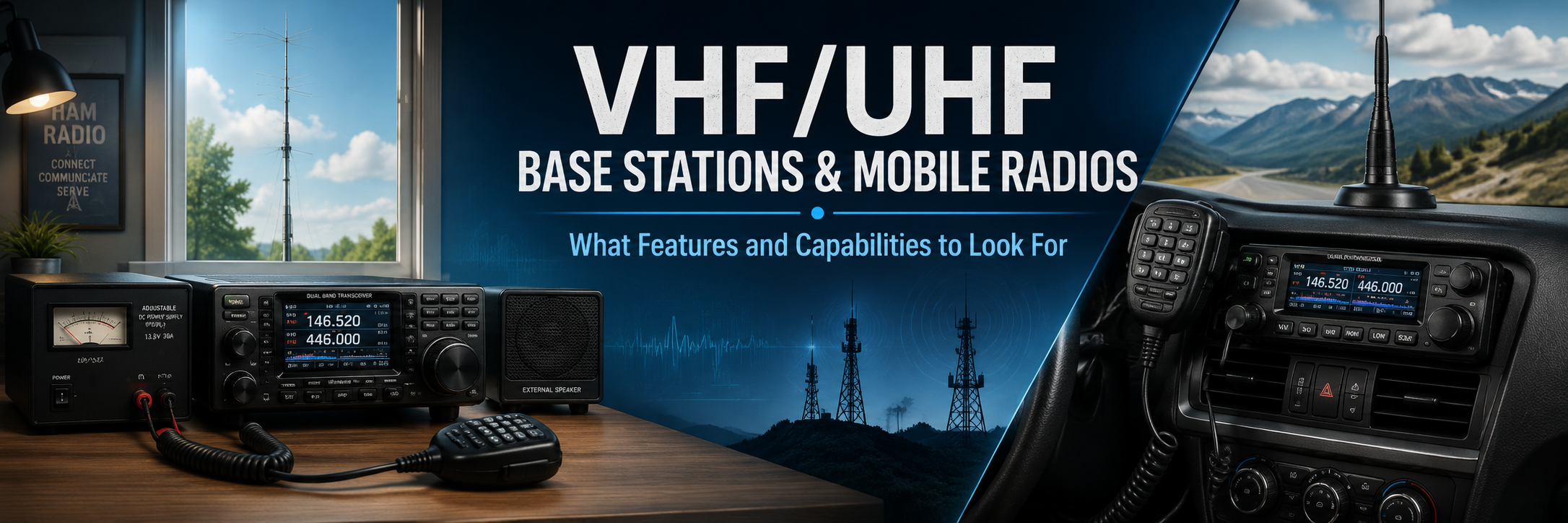
VHF/UHF BASE AND MOBILE
VHF/UHF Base Stations and Mobile Radios:
What Features and Capabilities Should You Look For?
Why VHF and UHF Still Matter
VHF and UHF radios are often the most-used radios in an amateur station. While HF gets much of the attention because of long-distance communications, VHF and UHF are the practical workhorses of local and regional radio. They are used for repeaters, simplex communications, emergency nets, public service events, neighborhood communications, club activities, APRS tracking, digital voice, packet, and local coordination.
For many amateur operators, a VHF/UHF mobile radio or base station becomes the radio that is used every day. It is also the radio most likely to be relied upon when normal communications fail. Because of that, choosing the right VHF/UHF station equipment deserves more thought than simply buying the cheapest dual-band radio available.
A good VHF/UHF radio should be easy to operate, rugged enough for regular use, technically capable, and flexible enough to grow with your operating needs.
Base Station vs. Mobile Radio: What Is the Difference?
In amateur radio, many “base stations” on VHF and UHF are actually mobile radios installed in a home station environment. Unlike HF, where large desktop transceivers are common, VHF/UHF operation often uses compact mobile radios powered by an external DC power supply.
A mobile radio can serve very well as a base station when connected to:
- A proper 12–13.8 volt DC power supply
- A good outdoor antenna
- Low-loss coaxial cable
- Proper grounding and lightning protection
- An external speaker or headset if needed
- A computer interface for programming or digital operation
A dedicated base station, where available, may offer a larger display, better controls, stronger audio, more advanced receiver features, and improved ergonomics. However, a high-quality mobile radio installed correctly can outperform a poorly installed base station with a poor antenna system.
The most important lesson is simple: the radio matters, but the antenna system, coax, power supply, and installation often matter more.
The Primary Bands: 2 Meters and 70 Centimeters
Most VHF/UHF amateur radio activity occurs on two bands:
2 meters, 144–148 MHz
This is the most common VHF amateur band. It is widely used for repeaters, simplex, emergency communications, public service events, APRS, packet, and local nets. It generally performs better than UHF in open terrain and can cover longer distances under favorable conditions.
70 centimeters, 420–450 MHz
This is the most common UHF amateur band. It is also heavily used for repeaters, linked repeater systems, digital voice, satellite work, short-range communications, and urban operation. UHF often performs better around buildings and inside vehicles, but it may have more feedline loss than VHF.
A dual-band 2 meter/70 centimeter radio is usually the best starting point for most amateur operators. It provides access to the majority of local repeater systems and simplex activity.
Some operators may also consider radios that include:
1.25 meters, 222–225 MHz
This band is less crowded in many areas and can be excellent for local communications where activity exists.
6 meters, 50–54 MHz
Some all-mode or multi-band radios include 6 meters. This band can support local FM, weak-signal work, and occasional long-distance propagation.
For most operators, however, a strong dual-band VHF/UHF radio is the practical choice.
Power Output: How Much Do You Need?
Most mobile VHF/UHF radios provide approximately 25 to 75 watts of output power, depending on band and model. A common configuration is around 50 watts on VHF and 35 to 50 watts on UHF.
Higher power can be useful, but it should not be the first priority. Good antenna height, low-loss coax, and proper installation usually provide more improvement than simply increasing transmitter power.
For a mobile installation, 25 to 50 watts is usually enough for repeater and local simplex use. For a home base station, 50 watts with a good outdoor antenna can provide excellent local and regional coverage.
Look for radios with selectable power levels, such as:
- Low power for short-range work
- Medium power for normal local use
- High power for weak paths or emergency operation
Using the minimum effective power reduces heat, extends equipment life, conserves battery power, and helps avoid unnecessary interference.
Receiver Quality Matters More Than Many Operators Realize
Many buyers focus on transmitter power, but receiver performance is just as important. A radio with a poor receiver may overload in strong-signal areas, miss weak signals, or perform poorly near commercial radio systems, paging transmitters, public safety systems, or other high-power RF sources.
Important receiver characteristics include:
Sensitivity
The ability to hear weak signals.
Selectivity
The ability to reject nearby signals on adjacent frequencies.
Intermodulation rejection
The ability to operate in strong RF environments without producing false signals or desensitization.
Audio clarity
A receiver should provide clear, understandable audio, especially during emergency nets or mobile operation.
Dual receive capability
Some radios allow you to monitor two frequencies at once, such as a repeater and a simplex frequency.
In urban areas or near mountaintop transmitter sites, receiver quality can make the difference between a usable radio and a frustrating one.
Dual-Band, Dual-Watch, and True Dual Receive
Many VHF/UHF radios are advertised as dual-band, but not all dual-band radios operate the same way.
Dual-band means the radio can operate on both VHF and UHF.
Dual-watch usually means the radio can monitor two frequencies, but may not truly receive both at the same time.
True dual receive means the radio has the ability to receive two frequencies simultaneously.
For emergency communications, public service events, or club use, true dual receive can be extremely useful. For example, an operator may want to monitor:
- A local repeater and a simplex tactical channel
- A voice net and APRS frequency
- Two repeaters at the same time
- A command frequency and a neighborhood frequency
A true dual-receive radio is generally more capable than a basic dual-band radio, especially in a base or emergency station.
Memory Channels and Programming
A good VHF/UHF radio should have enough memory channels to store repeaters, simplex frequencies, calling frequencies, emergency channels, APRS channels, travel repeaters, and special-use channels.
Look for the following memory features:
- Large memory capacity
- Alphanumeric channel names
- Memory banks or groups
- Easy scan-list organization
- Independent tone settings per channel
- Repeater offset storage
- Narrowband/wideband settings
- Import/export programming capability
Computer programming support is very important. Programming dozens or hundreds of repeater channels manually from the front panel can be time-consuming and error-prone. A radio that supports reliable PC programming is much easier to maintain.
Before buying, confirm that programming software and cables are available and that the radio can be backed up and restored easily.
Repeater Operation Features
Most VHF/UHF activity uses repeaters, so repeater features are essential.
A good radio should support:
- Standard repeater offsets
- Custom repeater offsets
- CTCSS tones
- DCS tones
- Tone encode and decode
- Tone scan
- Reverse repeater monitoring
- Busy channel lockout
- Time-out timer
- Automatic repeater shift where available
CTCSS and DCS are commonly used to access repeaters or control squelch. Tone scan can be helpful when traveling or identifying an unknown repeater tone.
Reverse repeater monitoring is also useful. It allows the operator to listen on the repeater input frequency to determine whether another station is close enough for direct simplex communication.
Simplex Capability: Do Not Ignore It
Repeaters are convenient, but simplex operation is one of the most important capabilities in amateur radio. During a power failure, wildfire, earthquake, storm, or infrastructure outage, repeaters may be unavailable. Simplex operation allows stations to communicate directly without relying on an intermediate system.
When evaluating a VHF/UHF radio, consider how well it supports simplex work.
Important simplex features include:
- Good receiver sensitivity
- Clear transmitted audio
- Selectable power levels
- Easy frequency entry
- Fast access to simplex memories
- Strong external speaker audio
- Ability to operate from emergency power
- Good antenna options
Every VHF/UHF base station should have several local simplex channels programmed and tested before they are needed.
Cross-Band Repeat: Useful but Not a Substitute for Planning
Some dual-band radios offer cross-band repeat. This allows the radio to receive on one band and retransmit on another. For example, a handheld radio on UHF could communicate through a mobile or base radio that retransmits to a VHF repeater.
Cross-band repeat can be useful for:
- Extending handheld coverage
- Temporary event communications
- Emergency communications
- Field operations
- Linking a portable operator back to a stronger station
However, cross-band repeat must be used carefully. The operator is responsible for proper identification, frequency coordination, duty cycle, interference prevention, and compliance with amateur radio rules. Cross-band repeat can also cause overheating if the radio is used heavily without proper ventilation.
It is a valuable feature, but it should be treated as an advanced capability rather than a casual convenience.
Digital Voice: D-STAR, DMR, System Fusion, P25, and Others
Modern VHF/UHF radios may include digital voice modes. The most common amateur digital voice systems include:
D-STAR
Developed for amateur radio and used heavily by Icom and others. It supports digital voice, callsign routing, reflectors, and data features.
DMR
Originally a commercial digital standard, widely adopted by amateur operators. It uses talkgroups, time slots, color codes, and networked repeaters.
System Fusion / C4FM
Commonly associated with Yaesu radios and repeaters. It supports digital voice, automatic mode selection, and linked networks.
P25
A public safety digital standard used by some amateur operators, especially those with commercial-radio backgrounds.
NXDN and other modes
Less common but used in some areas.
Before buying a digital-capable radio, study what is actually used in your area. A DMR radio is not very useful if your local area is primarily System Fusion. A D-STAR radio may be excellent where D-STAR repeaters and reflectors are active. The best digital radio is the one that matches your local operating environment and your intended use.
Important digital voice features include:
- Compatibility with local repeaters
- Easy programming
- Contact list support
- GPS support
- Clear audio
- Firmware support
- Hotspot compatibility
- Ability to operate analog FM as well as digital
Digital voice can be powerful, but it should not replace basic analog FM capability. In emergency communications, analog FM remains the common denominator.
APRS, Packet, and Data Capability
APRS, the Automatic Packet Reporting System, is one of the most useful VHF data systems in amateur radio. It can support position reporting, short messages, weather data, telemetry, and situational awareness.
A VHF/UHF radio may support APRS directly, or it may require an external TNC, computer, or soundcard interface.
Useful APRS and data features include:
- Built-in GPS
- Built-in TNC
- 1200 baud packet support
- Data connector
- Bluetooth or USB interface
- Messaging support
- Weather station input
- Computer control
- Easy display of received stations
Packet radio and data modes can also support emergency communications, Winlink access, keyboard-to-keyboard messaging, and local information exchange. Operators interested in emergency communications should consider whether their VHF/UHF radio can be connected easily to a computer for data operation.
Display, Controls, and Ease of Use
A radio that looks impressive in a catalog may be difficult to use under pressure. During emergency operations or mobile use, the operator must be able to change channels, adjust volume, change squelch, select power level, and read the display without confusion.
Important ergonomic features include:
- Large, readable display
- Clear channel names
- Dedicated volume and squelch controls
- Logical menu structure
- Programmable function buttons
- Easy band selection
- Easy memory selection
- Backlit controls
- Microphone keypad
- Detachable control head
- Good mobile mounting options
For base station use, a larger display and external speaker may be more important than compact size. For mobile use, simple controls and safe operation are critical.
Avoid radios that require deep menu navigation for basic functions.
Audio Quality: Transmit and Receive
Audio quality is often overlooked. A radio used in a vehicle, emergency operations center, net control position, or noisy room must have strong, clear audio.
Look for:
- Loud and clear receive audio
- External speaker jack
- Good microphone audio
- Adjustable microphone gain
- Noise reduction features where available
- Audio filtering
- Speaker-microphone options
- Headset compatibility
For base station operation, an external speaker can greatly improve intelligibility. For mobile operation, a properly mounted speaker can make the difference between hearing a net clearly and missing important traffic.
Transmitted audio should be clean, natural, and understandable. Excessive microphone gain, poor microphone placement, or low-quality microphones can make even a good radio sound bad.
Heat Management and Duty Cycle
VHF/UHF mobile radios are compact, but they can generate significant heat during extended transmissions. This is especially important for net control, cross-band repeat, digital operation, packet, or emergency communications.
Consider:
- Cooling fan design
- Heat sink size
- Duty cycle rating
- Ventilation space
- Power level selection
- Mounting location
- External fan support if needed
A radio mounted under a seat with poor airflow may overheat during heavy use. A base station radio used for long nets should have good ventilation and should not be operated at maximum power unless necessary.
Heat is one of the enemies of radio reliability.
Power Supply Requirements for Base Stations
Most VHF/UHF mobile radios require a 13.8 volt DC power source. For base station use, a quality power supply is essential.
When choosing a power supply, consider:
- Current rating
- Voltage stability
- Low RF noise
- Overload protection
- Anderson Powerpole compatibility
- Battery backup integration
- Proper fusing
A 50-watt VHF/UHF mobile radio may draw roughly 10 to 15 amps on transmit, depending on model and power level. The power supply should have enough capacity to support the radio without voltage sag.
Avoid cheap switching power supplies that generate RF noise. A noisy power supply can raise the receiver noise floor and reduce station performance.
Mobile Installation Considerations
A mobile VHF/UHF radio installation is more than placing a radio in a vehicle and plugging it into a cigarette lighter socket. A proper mobile installation should be safe, reliable, and electrically sound.
Important mobile installation features include:
- Direct battery power connection
- Proper fusing at the battery
- Correct wire gauge
- Clean cable routing
- Secure radio mounting
- Safe control-head placement
- External speaker placement
- Proper antenna mount
- Good vehicle grounding
- Protection from heat and moisture
For most mobile radios, direct wiring to the battery is preferred over accessory sockets. Accessory sockets may not provide enough current and can introduce noise or voltage drops.
The radio should be mounted where it does not interfere with airbags, vehicle controls, passenger movement, or driver visibility.
Antenna System: The Real Performance Multiplier
The antenna system is often more important than the radio itself. A basic radio connected to a good antenna will often outperform an expensive radio connected to a poor antenna.
For mobile use, common antenna choices include:
- Quarter-wave whip
- Half-wave antenna
- 5/8-wave antenna
- Dual-band mobile antenna
- NMO-mounted antenna
- Magnetic mount antenna
- Lip mount or bracket mount antenna
For permanent mobile installation, an NMO mount through the vehicle roof is often one of the best-performing and most durable options. Magnetic mounts are convenient but may have grounding limitations, cable wear issues, and lower long-term reliability.
For base station use, common antenna choices include:
- Vertical dual-band antenna
- Collinear vertical
- Directional Yagi antenna
- Ground-plane antenna
- J-pole antenna
- Discone for receive
- Separate VHF and UHF antennas
A base station antenna should be mounted as high and clear as practical, using quality feedline and proper weatherproofing.
Feedline Loss: Especially Important on UHF
Coaxial cable loss increases as frequency increases. This means UHF is more sensitive to poor coax than VHF. A long run of cheap coax can waste much of your transmitter power and reduce received signal strength.
For short mobile antenna runs, quality small coax is usually acceptable. For base station installations with longer cable runs, low-loss coax is strongly recommended.
Important feedline considerations include:
- Cable type
- Cable length
- Frequency of operation
- Connector quality
- Weatherproofing
- Routing and strain relief
- Lightning protection
- SWR and loss testing
On UHF, feedline loss can be severe. Do not spend money on a good radio and then handicap the station with poor coax.
Scanning and Monitoring Features
Many VHF/UHF radios include scanning features. These can be helpful for monitoring repeaters, simplex channels, weather channels, public service frequencies where legal to receive, and emergency channels.
Useful scanning features include:
- Memory scan
- Program scan
- Priority scan
- Dual-watch
- Weather alert
- Skip channels
- Scan banks
- Adjustable scan resume
A radio used for emergency communications should allow practical scanning without becoming confusing. Operators should be able to quickly stop scanning and return to the assigned operating frequency.
Weather Alert and Public Safety Awareness
Some VHF/UHF radios include NOAA weather receive and weather alert functions. This can be useful in emergency preparedness, storm monitoring, and field operations.
Useful weather-related features include:
- NOAA weather channel reception
- Weather alert monitoring
- Priority weather alert
- Easy access to weather memories
Weather receive capability does not replace a dedicated weather radio, but it is a useful feature in a communications station.
Remote Control and Computer Integration
Modern VHF/UHF radios may support remote control or computer integration. This can be especially useful for base stations, gateways, packet stations, APRS stations, or remote-controlled installations.
Look for:
- USB connectivity
- CAT or CI-V style control
- Audio input/output access
- Data port
- Bluetooth support
- Firmware updates
- Manufacturer programming software
- Third-party software compatibility
Computer control is not required for every operator, but it becomes increasingly valuable as the station grows.
Emergency Communications Features
For emergency communications, the best VHF/UHF radio is not necessarily the most complicated one. It is the one that can be operated reliably, quickly, and correctly under stress.
Important emergency communications features include:
- Simple operation
- Clear display
- Strong audio
- Multiple power levels
- Easy memory channel selection
- Local repeater and simplex programming
- External power compatibility
- Battery backup capability
- Data capability if needed
- Cross-band repeat if properly managed
- Rugged construction
- Good heat management
- Reliable antenna connection
Emergency radios should be programmed before an emergency, not during one. Every local repeater, simplex channel, calling frequency, emergency net frequency, and tactical channel should be stored and labeled clearly.
A printed frequency list should also be kept with the station.
Analog FM Still Belongs at the Center
With all the attention given to digital voice, hotspots, internet-linked repeaters, and advanced data modes, analog FM remains the foundation of VHF/UHF amateur radio.
Analog FM is:
- Widely supported
- Easy to understand
- Easy to program
- Compatible across brands
- Useful for simplex
- Common in emergency communications
- Independent of the internet
- Familiar to most operators
Digital systems are valuable, but analog FM is still the universal language of VHF/UHF local communications.
A serious VHF/UHF station should be excellent at analog FM first, then add digital capability where it makes sense.
Mobile Radio as a Home Base Station
Using a mobile radio as a home base station is common and practical. To do it correctly, the operator should add the proper support equipment.
A good home VHF/UHF station should include:
- Dual-band mobile transceiver
- 13.8 volt DC power supply
- Outdoor antenna
- Low-loss coax
- Lightning arrestor
- Grounding system
- External speaker
- Programming cable and software
- Backup battery
- Printed frequency plan
- Station log or net log materials
This kind of station can serve daily operation, club nets, neighborhood communications, and emergency communications.
Key Features to Look For When Buying
The following checklist can help when evaluating a VHF/UHF base or mobile radio.
| Feature | Why It Matters |
|---|---|
| Dual-band VHF/UHF | Provides access to 2 meters and 70 centimeters |
| 50-watt class output | Good practical power for mobile and base use |
| Selectable power levels | Reduces heat and conserves battery power |
| Good receiver performance | Improves weak-signal and strong-signal operation |
| True dual receive | Allows monitoring two frequencies at once |
| Large memory capacity | Stores repeaters, simplex, travel, and emergency channels |
| Alphanumeric channel names | Makes operation easier under pressure |
| CTCSS/DCS support | Required for many repeaters |
| Computer programming | Makes setup faster and more reliable |
| Detachable control head | Improves mobile installation flexibility |
| External speaker jack | Improves audio clarity |
| Data port or USB | Supports APRS, packet, programming, and control |
| APRS/GPS support | Useful for tracking and situational awareness |
| Digital voice support | Useful where local systems exist |
| Cross-band repeat | Helpful for advanced field or emergency use |
| Strong cooling system | Important for extended transmit duty |
| Weather receive/alert | Useful for preparedness |
| Firmware support | Extends long-term usefulness |
| Rugged microphone and controls | Improves daily reliability |
What to Avoid
Avoid choosing a radio based only on price, power output, or appearance. Some radios offer many features but are difficult to program, poorly documented, or weak in receiver performance.
Be cautious of:
- Poor manuals
- Weak programming support
- Limited memory labels
- Complicated menus
- No external speaker jack
- No data interface
- Poor heat management
- Cheap microphones
- Poor receiver selectivity
- Unknown long-term support
- Proprietary programming cables that are hard to find
- Digital modes not used in your area
A radio that is frustrating to operate will not be used often, and a radio that cannot be programmed easily may fail when it is needed most.
Recommended Capability Levels
Basic Local Operator
A basic local operator needs a dependable analog FM dual-band radio with good audio, memory channels, and repeater support.
Minimum recommended features:
- 2 meter/70 centimeter operation
- 25 to 50 watts output
- CTCSS/DCS
- Memory channels with labels
- External speaker jack
- Computer programming
- Good mobile or base antenna
This is enough for local repeaters, simplex, nets, and general communication.
Serious Amateur Operator
A more serious operator should look for better receiver performance, true dual receive, better scanning, data capability, and stronger installation options.
Recommended features:
- True dual receive
- Large memory capacity
- APRS or packet capability
- Detachable control head
- Strong audio
- Data connection
- Better cooling
- Weather alert
- Cross-band repeat if needed
This level is suitable for regular club work, event support, mobile operation, and emergency preparation.
Emergency Communications Operator
An emergency communications operator should prioritize reliability, simplicity, power flexibility, and system independence.
Recommended features:
- Analog FM excellence
- Local repeater and simplex memories
- External power and battery backup
- Clear channel labels
- Strong receive audio
- Printed frequency plan
- Data capability for message handling if needed
- Good antenna and low-loss coax
- Cross-band repeat only with proper training
- Reliable power supply and backup power
The emergency station should be tested regularly before it is needed.
Advanced Technical Operator
An advanced operator may want digital voice, packet, APRS, satellite operation, remote control, computer integration, and advanced filtering.
Recommended features:
- Digital voice mode used locally
- APRS/GPS
- Packet/data port
- Full computer control
- Firmware updates
- True dual receive
- Satellite-friendly operation if desired
- High-quality receiver
- Remote-head or remote-control capability
This level supports experimentation and advanced station integration.
Base Station Installation Priorities
For a strong VHF/UHF base station, spend money in the right order.
First, choose the right antenna location. Height and clear surroundings are extremely important.
Second, use quality feedline. Poor coax can erase much of the advantage of a good radio.
Third, use a reliable power supply and backup power.
Fourth, choose a radio with good receiver performance, clear controls, and proper programming support.
Fifth, organize the station with printed frequency lists, labeled channels, and clean cabling.
A clean, reliable, well-documented station is more valuable than a complicated station that only one person understands.
Mobile Installation Priorities
For mobile use, safety and reliability come first.
The radio should be mounted securely. The microphone should be easy to reach. The display should be visible without distracting the driver. The power wiring should be fused and connected properly. The antenna should be mounted where it performs well and does not strike obstacles.
A good mobile installation should survive heat, vibration, road noise, and repeated use. Temporary installations are acceptable for occasional use, but a serious mobile station deserves a permanent or semi-permanent installation.
The Best Radio Is the One That Fits the Mission
There is no single best VHF/UHF radio for every operator. The right radio depends on the mission.
Ask these questions before buying:
- Will this radio be used mostly at home, in a vehicle, or both?
- Are local repeaters analog, DMR, D-STAR, Fusion, or mixed?
- Is simplex operation important?
- Will this radio be used for emergency communications?
- Is APRS or packet needed?
- Does the radio need to support cross-band repeat?
- Can it be programmed easily?
- Is the display readable?
- Is the audio loud and clear?
- Can it run from backup power?
- Is the antenna system good enough to justify the radio?
A carefully chosen mid-level radio with a good antenna system will usually provide better service than an expensive radio installed poorly.
Final Thoughts
VHF/UHF base and mobile radios are central tools in amateur radio. They support daily communication, local nets, repeaters, emergency operations, public service events, digital systems, and neighborhood preparedness.
When choosing a radio, do not focus only on transmitter power or the number of advertised features. Look at receiver quality, ease of use, memory management, audio clarity, power flexibility, data capability, and installation requirements.
For most amateur operators, the best VHF/UHF station is a dependable dual-band radio with a strong antenna system, good power supply, clear programming, and practical emergency capability.
A radio that is simple, reliable, and well installed will serve far better than a complicated radio that is hard to operate. In local communications, the best station is not always the most expensive one. It is the one that works when you need it, can be operated under pressure, and is supported by a complete station design.