
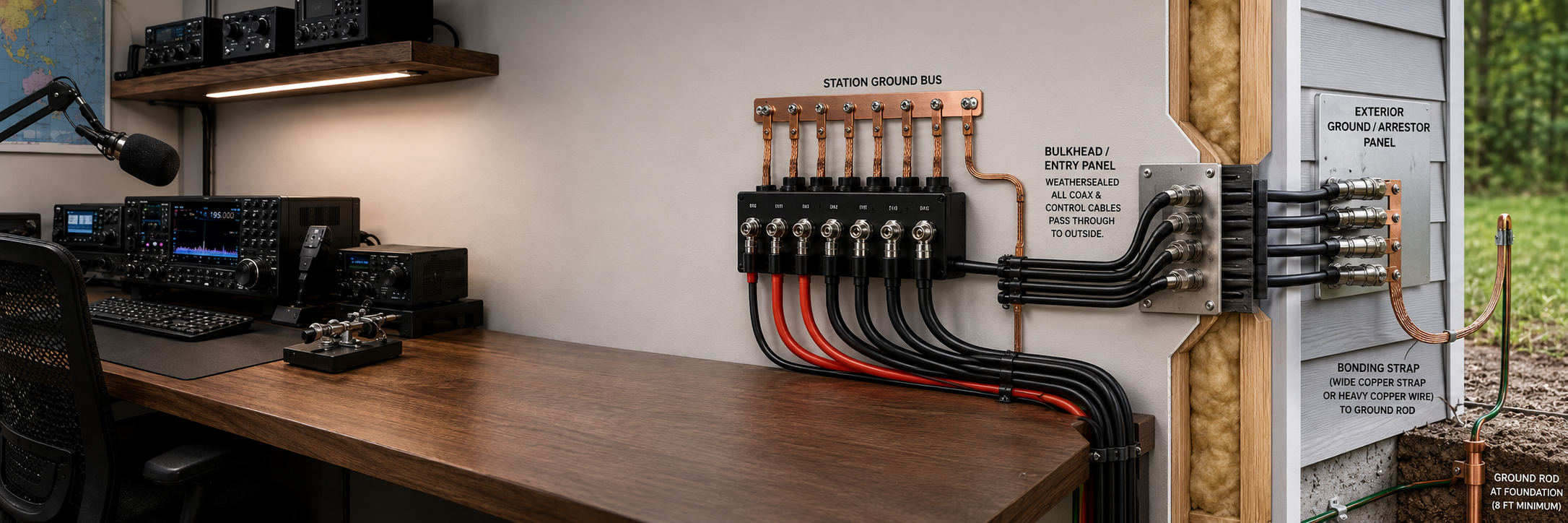
Grounding Your Ham Shack Equipment and Doing It Right
Plus: Choosing the Correct Power Cable Size for Your Station Loads
Grounding is one of the most misunderstood subjects in amateur radio. Many operators know they “need a ground,” but fewer understand that a good station grounding system is not one thing. It is a system of bonding, safety grounding, RF management, lightning protection, and proper power distribution. Done correctly, grounding improves safety, reduces equipment damage, lowers noise problems, and helps keep RF out of microphones, computers, speakers, keyers, and digital interfaces. Done poorly, grounding can create shock hazards, ground loops, RF feedback, damaged equipment, and a false sense of security.
A proper amateur radio station should be designed around two practical goals: keep dangerous energy away from people and equipment, and keep all station equipment at the same electrical potential. That second point is important. Grounding is not simply pounding a rod into the dirt and connecting equipment to it. In most stations, the better word is bonding. You are bonding the station equipment, power supply, coax shields, surge protectors, antenna entry panel, and electrical grounding system together so that current has a controlled path and voltage differences are minimized.
This article explains how to ground a ham shack correctly, what mistakes to avoid, and how to choose the correct power cable size for radios, amplifiers, power supplies, batteries, and DC distribution systems.
1. Grounding Is Not Just One Ground
In an amateur radio station, the word “ground” can mean several different things. Confusing these is where many station problems begin.
Electrical Safety Ground
The electrical safety ground is the green or bare wire in the AC power system. It is connected to the grounding conductor in the home’s electrical system and ultimately to the building grounding electrode system. Its purpose is human safety. If a hot conductor faults to a metal radio chassis, amplifier case, power supply cabinet, or rack frame, the safety ground provides a low-resistance fault path so the breaker trips.
The electrical safety ground is not optional. Never defeat it with a three-prong-to-two-prong adapter. Never cut off the ground pin. Never operate station equipment from damaged outlets, questionable extension cords, or ungrounded receptacles.
RF Ground
An RF ground is not always the same as an electrical safety ground. At radio frequencies, wire length, surface area, inductance, and layout matter. A long piece of wire may look like a ground at DC but act like an inductor, radiator, or part of the antenna system at RF.
For some antenna systems, especially end-fed wires, random wires, verticals, and certain unbalanced installations, the station equipment and feedline shield may become part of the antenna system unless a proper counterpoise, radial field, current choke, or feedpoint design is used. In these cases, the “ground problem” may really be an antenna system problem.
Lightning Ground
Lightning protection is about giving high-energy surge current a short, straight, low-impedance path outside the shack. It is not about sending lightning through your operating desk. Lightning energy should be intercepted at the antenna entry point and diverted to the grounding electrode system before it reaches your equipment.
Lightning grounding requires short conductors, proper bonding, listed surge protectors, an outside entry panel, and a connection to the building grounding electrode system. A separate unbonded ground rod outside the shack is not a complete lightning protection system and can actually create dangerous voltage differences.
Equipment Bonding
Equipment bonding is the practice of connecting all station equipment chassis together with low-impedance conductors so the entire station remains at the same potential. This reduces shock risk, RF feedback, and noise caused by voltage differences between pieces of equipment.
In a well-built shack, the transceiver, tuner, amplifier, power supply, computer interface, coax switch, antenna switch, rotor controller, and equipment rack are bonded to a common station ground bus.
2. The Most Important Rule: Bond Everything Together
A dangerous mistake is installing a separate “radio ground rod” that is not bonded to the home’s electrical grounding electrode system. This can create a voltage difference between the radio equipment and the AC safety ground during a fault, nearby lightning event, or utility surge.
The correct approach is to bond the station ground system to the building grounding electrode system. In the United States, grounding and bonding must follow current electrical code, including applicable NEC/NFPA 70 requirements and local code. Consult a licensed electrician when modifying building grounding, adding ground rods, or installing a permanent entry panel.
The operating principle is simple: all grounds must be part of one bonded grounding system. The goal is not to create multiple isolated grounds. The goal is to create one common reference system so that hazardous current does not choose a path through your equipment, coax, microphone, computer, or body.
3. The Correct Shack Grounding Layout
A good station grounding system usually has these major parts:
- A station ground bus behind or under the operating desk.
- Short bonding straps from each equipment chassis to the station ground bus.
- A coax entry panel where feedlines enter the building.
- Lightning arrestors or surge protectors mounted at the entry panel.
- A low-impedance outside ground connection from the entry panel to the grounding electrode system.
- Bonding from the radio ground system to the building electrical ground.
- Proper AC safety grounding through three-wire grounded outlets.
- Common-mode chokes where needed to keep RF off coax shields and station wiring.
Think of the system as a controlled path. Antenna feedlines come to an outside entry point. Surge protectors are mounted there. The entry panel is bonded to the grounding electrode system. Inside the shack, equipment is bonded to a common bus. The AC safety ground remains intact. Everything is connected together so there are no isolated grounds fighting each other.
4. The Station Ground Bus
The station ground bus is the central bonding point for the equipment at the operating position. It may be a copper bar, copper pipe, copper strap, or commercial ground bus mounted behind the desk or on the wall.
Each piece of equipment should be bonded to this bus with the shortest practical conductor. For RF bonding, wide copper strap is often better than round wire because RF current flows mostly near the surface of the conductor and because wide strap has lower inductance. Copper braid can work, but it can corrode, trap moisture, and become less effective over time if used in poor environments. For permanent installations, flat copper strap or solid copper bonding conductors are generally preferred.
Good bonding practices include:
- Use short, direct connections.
- Avoid coiled wires or long loops.
- Keep bonding conductors as straight as practical.
- Clean paint, oxidation, and coating from contact points.
- Use star washers or proper bonding hardware.
- Tighten connections securely.
- Protect outdoor connections from corrosion.
- Inspect connections periodically.
A poor bonding conductor can become part of the RF problem. A long, thin wire may not behave like a ground at HF. At 80, 40, 20, 15, and 10 meters, conductor length matters. What looks like a simple ground wire may actually be an RF radiator.
5. The Coax Entry Panel
The coax entry panel is one of the best improvements a serious station can make. Instead of running coax through a window, wall hole, or random opening, feedlines should enter through a deliberate entry point.
A proper entry panel provides:
- A single location for coax entry.
- A place to mount lightning arrestors.
- A place to bond coax shields before they enter the shack.
- A clean disconnect point during storms or station maintenance.
- A transition between the outside antenna system and inside radio equipment.
The entry panel should be mounted outside or at the building entrance point, not across the room behind the radio. Lightning protection works best before surge energy enters the building. Arrestors should be bonded with short, straight conductors to the grounding electrode system.
The feedline path should be planned so lightning surge energy does not travel through the shack to find ground. The worst layout is an antenna wire or coax line that enters the room, passes across the operating desk, and then finds a ground connection somewhere behind the radio. That puts the equipment and operator in the surge path.
6. Lightning Protection: What Grounding Can and Cannot Do
No practical amateur station grounding system can guarantee survival from a direct lightning strike. The purpose of lightning protection is risk reduction. A well-designed system can greatly reduce damage from nearby strikes, static buildup, induced surges, and utility transients. It may also improve the chances of surviving a direct event, but nothing should be considered absolute protection.
Good lightning protection includes:
- Bonded ground electrodes.
- A short, straight path from arrestors to ground.
- Coax surge protectors rated for the frequency and power level.
- Rotor cable and control line surge protection.
- AC surge protection.
- Disconnect procedures when the station is not in use.
- Physical antenna disconnects during severe weather.
- Proper bonding between all ground systems.
Lightning does not like sharp turns, long wire paths, or small conductors. It is a fast, high-energy event. At lightning frequencies, inductance is often more important than simple DC resistance. That is why short, wide, straight conductors are preferred.
A ground rod by itself is not enough. A ground rod that is not bonded to the electrical service ground can create a dangerous difference in voltage between the radio equipment and the house wiring. During a surge event, the station ground rod and the electrical ground may rise to different voltages. Equipment connected between those two systems can be damaged, and the operator can be placed at risk.
7. RF in the Shack: Grounding May Not Be the Real Problem
Many operators try to fix RF feedback by adding more ground wires. Sometimes that helps. Often it does not. RF in the shack is frequently caused by common-mode current on the outside of the coax shield.
Common-mode current occurs when the feedline becomes part of the antenna system. This is common with end-fed antennas, off-center-fed dipoles, poorly balanced antennas, verticals without adequate radials, and antennas installed close to the shack.
Symptoms of RF in the shack include:
- Hot microphone.
- Distorted transmitted audio.
- Computer lockups during transmit.
- USB disconnects during digital operation.
- Touchy SWR readings.
- Speakers buzzing.
- Keyers malfunctioning.
- RF burns from metal equipment.
- Tuner behavior changing when cables are moved.
- Transmit problems only on certain bands.
The best cure may not be another ground rod. The better cure may be:
- A proper current balun or choke at the antenna feedpoint.
- A common-mode choke at the shack entry point.
- A better radial or counterpoise system.
- Balanced feedline used correctly.
- Improved antenna placement.
- Better bonding between equipment.
- Shorter station interconnects.
- Ferrite chokes on USB, audio, control, and power cables.
Grounding and bonding are part of the solution, but they do not replace good antenna engineering.
8. Grounding Different Types of Station Equipment
HF Transceiver
The HF transceiver should be bonded to the station ground bus using the manufacturer’s ground terminal or chassis ground point. Keep the connection short. Do not rely only on the coax shield or DC negative lead to bond the radio.
Power Supply
The power supply should be connected to a properly grounded AC outlet. Its chassis should also be bonded to the station ground bus. The DC negative output may or may not be internally bonded to the chassis depending on design. Do not assume. Check the manual.
Antenna Tuner
An antenna tuner often has a ground terminal because it may be used with unbalanced antennas, long wires, or end-fed systems. Bond the tuner chassis to the station ground bus. If using a random wire or end-fed antenna, provide the correct counterpoise or radial system. Do not expect the tuner ground lug alone to make a poor antenna system behave properly.
Linear Amplifier
An amplifier should have a solid chassis bond to the station ground bus and must be connected to a properly sized AC circuit. High-power amplifiers increase the importance of RF bonding, correct coax routing, and proper surge protection. Amplifiers can also place greater demand on station power wiring, so cable size and circuit capacity matter.
Computer and Digital Interface
Computers introduce USB, audio, Ethernet, monitor, and switching power supply noise paths. Bonding, ferrite chokes, and good cable routing are important. Avoid running RF coax, amplifier cables, USB cables, and audio cables in tangled bundles.
Coax Switches and Antenna Switches
Coax switches should be bonded to the station ground system. If located outside, they should be weatherproofed and bonded to the outside ground system. Remote antenna switches need surge protection on both coax and control lines.
9. Common Grounding Mistakes
Mistake 1: Installing an Isolated Ground Rod
A separate ground rod outside the shack that is not bonded to the electrical service ground is one of the most common and dangerous mistakes. It may appear logical, but it can create hazardous voltage differences.
Mistake 2: Using Long, Thin Ground Wires
A long piece of small wire may be acceptable for some DC bonding, but it is usually poor for RF and lightning energy. Long conductors have inductance. At RF, they may not be ground at all.
Mistake 3: Running Lightning Energy Through the Shack
Surge protection should happen where cables enter the building. Do not bring coax into the shack and then connect it to a ground bus across the room as the primary lightning path.
Mistake 4: Believing a Ground Rod Clears Breakers
A ground rod does not replace the AC safety ground. A ground rod usually does not have low enough resistance to trip a breaker during a line-to-chassis fault. Breakers trip because of a low-impedance fault path back to the electrical source, not because a rod is in the dirt.
Mistake 5: Using the Coax Shield as the Only Equipment Bond
The coax shield connects equipment together, but it should not be the only bonding path. A separate station bonding system helps control voltage differences and RF current paths.
Mistake 6: Ignoring Control Lines
Rotor cables, remote switch cables, Ethernet cables, speaker cables, and USB cables can all carry surge energy or RF current. Protect and route them correctly.
Mistake 7: Trying to Fix Antenna Problems With Shack Grounding
If the antenna lacks a proper return path, radial system, counterpoise, or current choke, the shack may become part of the antenna. Fix the antenna system first.
10. Power Cable Size Matters
Grounding protects people and equipment from faults, RF problems, and surge energy. Power cable sizing protects equipment from voltage drop, overheating, nuisance shutdowns, poor transmitter performance, and fire risk.
Many amateur stations operate from 13.8-volt DC power supplies. At low voltage, cable size becomes very important because even a small voltage drop can be significant. A 0.7-volt drop in a 120-volt AC circuit is minor. A 0.7-volt drop in a 13.8-volt DC radio circuit can cause transmitter instability, low output power, display dimming, distorted audio, or radio shutdown.
A radio drawing 22 amps on transmit needs much heavier cable than a scanner drawing 1 amp. The cable must be sized for the load, cable length, duty cycle, acceptable voltage drop, insulation rating, and fuse size.
11. Understanding Current Load
The current load is how many amps the equipment draws. Use the manufacturer’s specifications, not guesses. A 100-watt HF transceiver commonly draws about 20 to 25 amps at full transmit power. A 50-watt VHF/UHF mobile may draw about 10 to 15 amps. A high-power DC amplifier may draw 60, 80, 100 amps, or more.
Typical station current examples:
| Equipment | Approximate Current Draw |
|---|---|
| HT charger | 0.5 to 2 amps |
| Scanner or receiver | 1 to 3 amps |
| QRP HF radio | 2 to 8 amps |
| 50-watt VHF/UHF mobile | 10 to 15 amps |
| 100-watt HF transceiver | 20 to 25 amps |
| 100-watt VHF/UHF mobile/base | 20 to 30 amps |
| Medium DC amplifier | 40 to 80 amps |
| Large DC amplifier | 80 to 150+ amps |
Always verify the actual equipment manual. Transmit current is usually much higher than receive current.
12. Voltage Drop: The Hidden Problem
The longer the cable, the more resistance it has. The smaller the wire, the more resistance it has. The more current you draw, the greater the voltage drop.
For DC radio power, remember that current travels out on the positive conductor and returns on the negative conductor. A 10-foot power run is really a 20-foot electrical path because both conductors matter.
The practical formula is:
Voltage Drop = Current × Total Circuit Resistance
For a DC radio cable, total circuit resistance includes both the positive and negative conductors. When planning a station, try to keep voltage drop under about 3% for sensitive radio equipment. On a 13.8-volt system, 3% is only about 0.4 volts. That is not much margin.
A radio that is supposed to receive 13.8 volts may not behave properly if only 12.8 or 12.5 volts reaches the radio during transmit.
13. Recommended DC Cable Sizes for 13.8-Volt Radio Equipment
The following chart is a conservative practical guide for copper cable in amateur radio DC power installations. It assumes a desire to limit voltage drop and maintain stable radio operation. Use manufacturer specifications, current electrical code, and proper ampacity charts for final design.
| Load Current | Up to 10 ft One-Way | 10–20 ft One-Way | 20–35 ft One-Way |
| 5 amps | 16 AWG | 14 AWG | 12 AWG |
| 10 amps | 14 AWG | 12 AWG | 10 AWG |
| 20–25 amps | 10 AWG | 8 AWG | 6 AWG |
| 30–40 amps | 8 AWG | 6 AWG | 4 AWG |
| 50–60 amps | 6 AWG | 4 AWG | 2 AWG |
| 80–100 amps | 4 AWG | 2 AWG | 1/0 AWG |
This table is intentionally conservative. Many radios are shipped with power cables that are acceptable for short runs but marginal for longer installations. If the radio power supply is across the room, under a desk, in a rack, or connected through a battery backup system, cable length becomes important.
When in doubt, use larger copper cable, not smaller. Larger cable reduces voltage drop, runs cooler, and gives better performance.
14. Use Copper Cable, Not Cheap Substitute Cable
Use real copper wire. Avoid copper-clad aluminum cable for radio power distribution. Copper-clad aluminum may look like copper, but it has higher resistance and different mechanical properties. It is not a good choice for high-current DC radio power systems unless specifically designed and rated for the application.
Good cable choices include:
- Fine-strand copper power cable.
- Welding cable for high-current flexible DC runs.
- Marine-grade tinned copper cable in damp or corrosive environments.
- Properly rated automotive or battery cable for battery systems.
- Commercial DC distribution cable from reputable suppliers.
Make sure the insulation is rated for the environment. Cable used outdoors, in vehicles, near batteries, or in hot locations must be rated accordingly.
15. Fuse the Cable, Not Just the Radio
A fuse protects the wire from overheating and starting a fire. It is not only there to protect the radio.
The fuse should be placed as close to the power source as practical. If a cable shorts between the power supply or battery and the radio, the fuse must open before the cable overheats. A fuse located only at the radio end may not protect the entire cable run.
Important fuse principles:
- Fuse the positive lead near the source.
- Use the fuse size recommended by the equipment manufacturer.
- Do not install a fuse larger than the cable can safely carry.
- Do not bypass fuses because they nuisance trip.
- Use DC-rated fuses and breakers for DC systems.
- For battery systems, use proper battery fusing close to the battery.
- Large battery banks require serious overcurrent protection.
For mobile installations, many radio manufacturers fuse both the positive and negative leads. Follow the manufacturer’s instructions. In fixed stations, positive-lead fusing is standard, but the equipment manual should control the final installation.
16. Powerpole Connectors and DC Distribution
Anderson Powerpole connectors are widely used in amateur radio because they provide a convenient standard for 12-volt DC equipment. They are especially useful in emergency communications, go-kits, battery boxes, field stations, and shared operating environments.
However, connectors must be installed correctly. Poor crimps, undersized contacts, loose housings, and overloaded connectors create heat and voltage drop.
Good DC distribution practice includes:
- Use a properly rated DC distribution panel.
- Use individual fusing for each connected device.
- Match connector current rating to the load.
- Use the correct crimp tool.
- Pull-test each crimp.
- Keep polarity standardized.
- Label circuits clearly.
- Avoid daisy-chaining high-current equipment through light-duty connectors.
A 100-watt HF radio should not be powered through a light-duty accessory cord, cigarette lighter plug, or unknown jumper cable. High-current radios deserve dedicated wiring.
17. Power Supplies and Cable Size
A power supply may be rated at 30 amps, 50 amps, or more, but that does not mean every small wire connected to it can safely carry that current. Each branch circuit leaving the supply should be fused according to the wire size and equipment load.
A common mistake is connecting several radios and accessories directly to the main terminals of a large supply with no branch protection. If one small wire shorts, the power supply may deliver enough current to melt the wire before anything trips.
A better arrangement is:
Power Supply → Main Fuse or Breaker → DC Distribution Panel → Individual Fused Outputs → Equipment
This keeps the system organized, safer, and easier to troubleshoot.
18. Battery Backup and Emergency Power
Battery systems require even more attention to cable size and fusing because batteries can deliver enormous fault current. A 12-volt battery may seem harmless because the voltage is low, but the available current can be very high. A short circuit across a battery can melt tools, burn cables, cause fire, or damage the battery.
Battery installation guidelines:
- Fuse close to the battery positive terminal.
- Use cable sized for maximum expected current.
- Use proper crimped lugs, not twisted wire under screws.
- Protect cables from abrasion.
- Use grommets when passing through metal.
- Secure batteries to prevent movement.
- Vent flooded lead-acid batteries properly.
- Use correct charging equipment.
- Keep battery cables short and protected.
- Use DC-rated disconnects and breakers.
For LiFePO4 batteries, use batteries with a proper battery management system and follow the manufacturer’s charging and current limits.
19. AC Power Considerations in the Shack
Many grounding and power problems begin at the AC outlet. A serious station should not depend on questionable wall outlets, cheap power strips, undersized extension cords, or overloaded circuits.
Good AC station practice includes:
- Use properly grounded three-prong outlets.
- Consider a dedicated 120-volt circuit for the radio desk.
- Use a dedicated 240-volt circuit for large amplifiers when required.
- Avoid long household extension cords for permanent installations.
- Use surge protection on AC power.
- Keep RF cables separated from AC power cables where practical.
- Do not overload power strips.
- Do not defeat safety grounds.
- Have questionable wiring checked by a licensed electrician.
If a station uses a generator, inverter, UPS, or transfer switch, neutral-ground bonding becomes important. Incorrect bonding can create shock hazards or nuisance trips. Follow the manufacturer’s instructions and local electrical code.
20. Practical Shack Grounding Checklist
Use this checklist to evaluate a station:
| Item | Correct Practice |
| AC outlet | Properly grounded, correctly wired, not overloaded |
| Station bus | Copper bus or strap bonding all equipment |
| Equipment bonds | Short, direct, low-impedance connections |
| Coax entry | Single entry point with arrestors |
| Surge protection | Coax, rotor, control, and AC lines protected |
| Ground rods | Bonded to building grounding electrode system |
| Feedline shields | Bonded at entry panel |
| RF control | Common-mode chokes used where needed |
| DC wiring | Sized for current and voltage drop |
| Fusing | Installed near power source and sized correctly |
| Battery power | Proper fusing, cable size, and secure mounting |
| Cable routing | RF, DC, AC, USB, and audio cables organized |
| Inspection | Connections checked periodically for corrosion or looseness |
21. Example: 100-Watt HF Transceiver
A typical 100-watt HF transceiver may draw 20 to 25 amps at full transmit power. If the power supply is directly under the radio and the cable run is only a few feet, 10 AWG copper cable may be sufficient. If the power supply is 15 or 20 feet away, 8 AWG or even 6 AWG may be a better choice to reduce voltage drop.
The radio chassis should be bonded to the station ground bus. The power supply chassis should also be bonded. The coax should enter through a grounded entry panel with a surge protector. If RF appears in the audio, computer, or microphone, add common-mode chokes and evaluate the antenna system.
This is a basic but correct design philosophy: short bonds, proper fusing, adequate wire size, and controlled cable entry.
22. Example: VHF/UHF Base Station
A 50-watt VHF/UHF radio may draw 10 to 15 amps on transmit. It may work from smaller wire over a short distance, but voltage drop still matters. VHF/UHF radios may also be sensitive to poor power connections because high transmit current occurs quickly when keyed.
Use a dedicated fused DC line, proper connectors, and clean bonding. The antenna feedline should be grounded at the building entrance, especially if the antenna is mounted outside, on a mast, or above the roofline. If the station uses a mast-mounted antenna, the mast should also be bonded to the grounding system.
23. Example: High-Current DC Amplifier
A DC amplifier drawing 80 to 100 amps requires serious wiring. Small jumpers, light-duty Powerpole connectors, cheap fuse holders, or undersized cable are not acceptable. Use large copper cable, high-current DC-rated fusing, proper lugs, and short cable runs.
At these current levels, voltage drop becomes a major performance issue. A one-volt drop can significantly affect amplifier output and stability. Heat at connectors is a warning sign. Warm cables, warm fuse holders, or warm connectors indicate excessive resistance or overload.
High-current DC systems should be treated with the same seriousness as AC wiring.
24. The Right Way to Think About Grounding and Power
A good amateur radio station is not just a collection of radios. It is an electrical system. The antenna system, feedlines, power supplies, batteries, AC wiring, station equipment, surge protection, and grounding system all interact.
Good grounding does not happen by accident. Good power distribution does not happen by using whatever cable is in the drawer. Both require planning.
The right approach is:
- Bond all station equipment together.
- Bond the station ground to the building grounding electrode system.
- Keep lightning energy outside the shack.
- Use a proper coax entry panel.
- Use surge protection on all incoming lines.
- Fix antenna common-mode current at the source.
- Use the correct DC cable size.
- Fuse power cables at the source.
- Avoid cheap connectors and undersized wire.
- Inspect the station regularly.
25. Final Thought
Grounding your shack correctly is not about adding random ground wires. It is about creating a safe, bonded, low-impedance system that controls fault current, RF current, and surge energy. The best station grounding systems are deliberate, simple, direct, and bonded together.
The same discipline applies to power wiring. A radio station that depends on undersized wire, poor connectors, unfused battery leads, overloaded power strips, or questionable AC outlets is not properly built. Radios need clean, stable power. Operators need safe equipment. Antennas need controlled entry points. Surge energy needs a path that does not go through the operating desk.
When grounding and power distribution are done correctly, the station becomes safer, quieter, more stable, and more professional. That is the standard every serious amateur radio operator should aim for.