
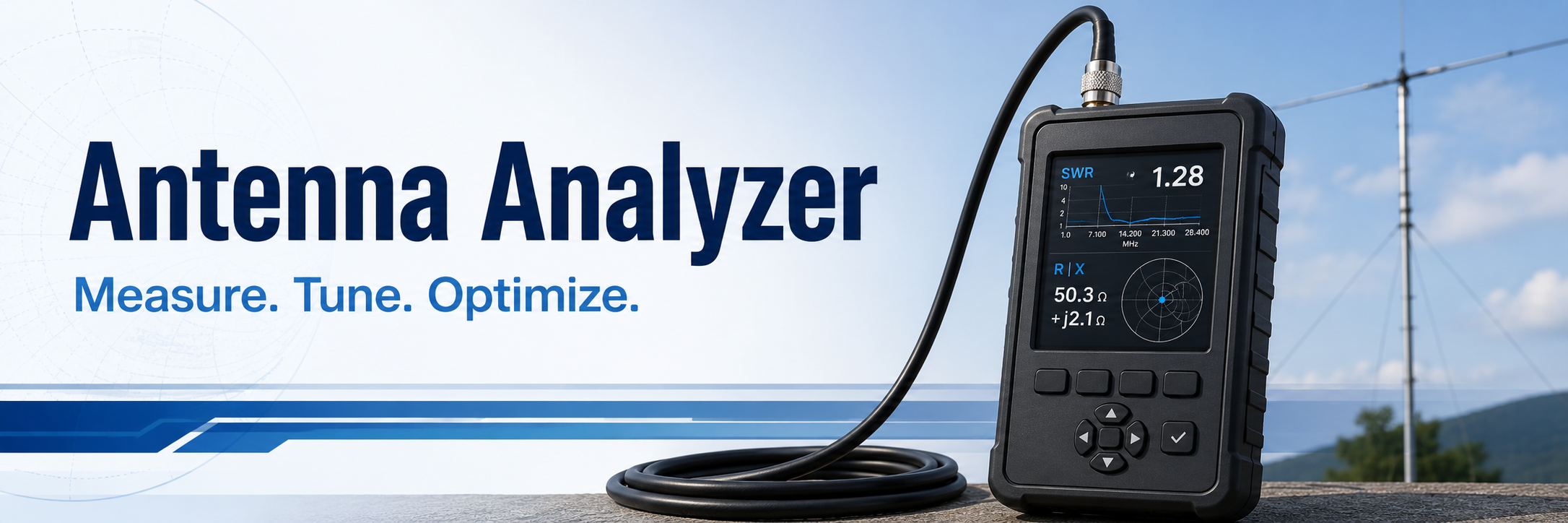
Antenna Analyzer: The Key to a Better Signal and More Efficient Station
Measure. Understand. Optimize.
When it comes to antennas, guessing is not good enough. An antenna analyzer eliminates much of the guesswork by providing accurate data about your antenna’s performance across frequency. Whether you are installing a new antenna, troubleshooting a system, or fine-tuning for maximum efficiency, an antenna analyzer is one of the most valuable tools in any amateur radio station or field kit.
What Is an Antenna Analyzer?
An antenna analyzer is a test instrument that measures the electrical characteristics of antennas, feed lines, and other RF components. The most common measurements include:
- SWR, or Standing Wave Ratio
- Return loss
- Impedance, including resistance and reactance
- Phase angle
- Smith chart display
- Cable loss on some models
By connecting the analyzer to your antenna system, you can see how well it is matched to your transceiver and over what frequency range it performs best.
Why It Matters
An antenna that is not properly matched can cause several problems, including:
- Increased power loss and reduced signal strength
- Excessive RF in the shack due to feed line radiation
- Stress on your transmitter’s final amplifier
- Poor SWR leading to unreliable communications
- Reduced receive and transmit efficiency
Using an analyzer, you can adjust the antenna or tuner for the lowest practical SWR and best impedance match. The result is better performance, cleaner signals, and a more reliable station.
Key Features to Look For
Not all antenna analyzers are created equal. Here are important features to consider:
| Feature | Why It Matters |
|---|---|
| Wide frequency range | Covers the bands you operate on, including HF, VHF, and UHF |
| Measurement accuracy | More accurate data means better antenna adjustments |
| Sweep speed | Faster sweeps save time in the field |
| Display type | Color screens with graphs are easier to read |
| Smith chart | Useful for matching and impedance analysis |
| Data storage/export | Allows you to save and compare results over time |
| Battery operation | Essential for portable and field use |
| PC connectivity | Allows logging, updates, and advanced analysis |
How It Works in Simple Terms
An antenna analyzer works by sending a small RF test signal into your antenna system. It then measures how much of that signal is reflected back. From this information, it calculates impedance, SWR, and related measurements across a range of frequencies.
In basic terms:
- The analyzer sends a test signal into the antenna system.
- It measures the reflected signal coming back from the antenna.
- It calculates impedance and SWR across the selected frequency range.
- The results are displayed as numbers, graphs, and, on some models, Smith charts.
This allows the operator to identify where the antenna is resonant, how wide the usable bandwidth is, and what adjustments may be needed.
Common Uses
An antenna analyzer can be used for many station and field tasks, including:
- Finding the resonant frequency of an antenna
- Adjusting antenna length for the lowest SWR
- Checking multiband antennas across all bands
- Comparing different antennas
- Verifying coaxial cable quality and length
- Troubleshooting tuner, balun, or matching network performance
For amateur radio operators, this means you can test and understand your antenna system before connecting it to an expensive transceiver.
Popular Antenna Analyzer Options
There are several well-known antenna analyzer options available, including:
- RigExpert AA-55 ZOOM / AA-230 ZOOM
- NanoVNA-F / NanoVNA-H
- MFJ-259B HF/VHF/UHF Analyzer
- AAE and other analyzer models
Choose an analyzer that fits your operating needs, budget, and the frequency range you use most often. A technician working mostly on VHF/UHF may need different capabilities than an HF operator building wire antennas or multiband systems.
Understanding the Results
The most common result most operators look at first is SWR. Lower SWR usually indicates a better match between the antenna system and the transmitter. An SWR close to 1:1 is ideal, but many practical antennas operate very well at 1.5:1 or less across the desired operating range.
A general rule is:
- Lower SWR, closer to 1:1, is better.
- A good general goal is SWR 1.5:1 or less across your operating band.
- The Smith chart shows impedance position. The closer the plot is to the center, the closer the system is to 50 ohms.
However, SWR alone does not tell the whole story. An antenna analyzer that displays resistance, reactance, and Smith chart data gives you a much better understanding of what is actually happening in the antenna system.
Tips for Best Results
To get reliable measurements from your analyzer:
- Always measure at the end of your feed line, not only at the radio.
- Keep the test power low as recommended by the manufacturer.
- Measure outdoors when possible because nearby objects can affect readings.
- Make small adjustments and re-measure after each change.
- Save your baseline measurements for future reference.
Good records are especially useful when diagnosing seasonal changes, weather-related issues, damaged coax, or antenna movement after wind or storms.
Final Thought
An antenna analyzer turns data into knowledge, and knowledge into better communication. Whether you are a casual operator, a serious DXer, an emergency communicator, or an antenna experimenter, this tool helps you get the most from your antennas and your radio.
Measure it right. Match it right. Work it worldwide.