
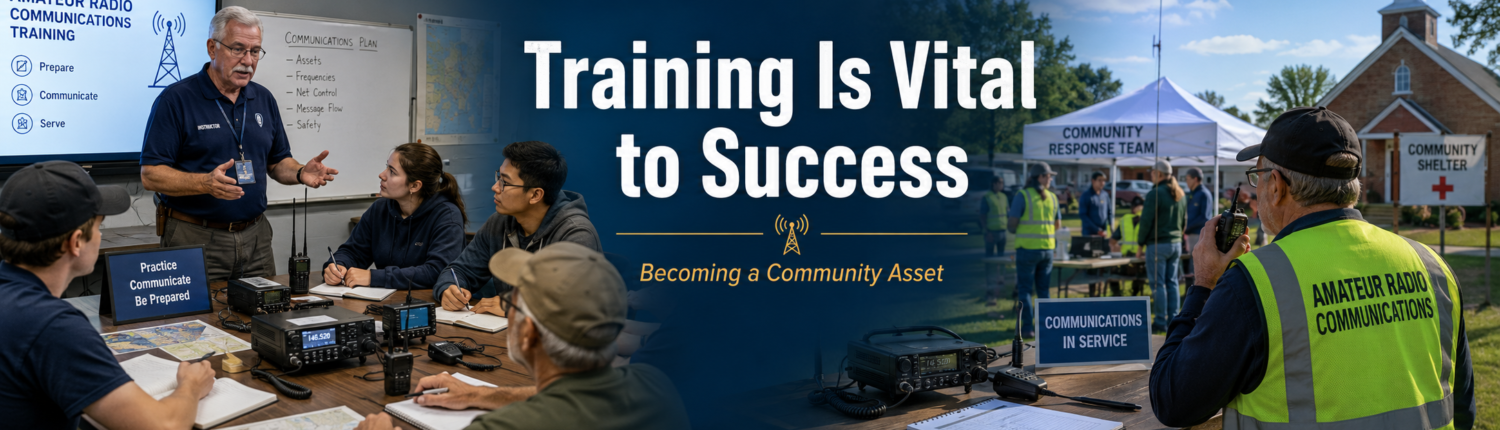
Training Is Vital to Success
Becoming a Trusted Community Communications Asset
A License Is the Beginning, Not the Finish Line
Earning an amateur radio license is an important accomplishment. It demonstrates that an operator understands basic regulations, operating practices, radio theory, and safety requirements. However, passing an examination does not automatically prepare someone to serve effectively during a community event, communications outage, natural disaster, or other emergency.
A license grants permission to operate. Training develops the ability to operate well.
Community communications require accuracy, discipline, patience, technical competence, and the ability to work as part of an organized team. These qualities are developed through repeated practice—not simply through owning equipment or occasionally talking on a repeater.
The amateur radio operator who wishes to serve the community must make training a continuing priority.
Why Training Matters
During ordinary amateur radio conversations, a delayed response, unclear transmission, or equipment problem may be inconvenient but harmless. During an emergency or public-service operation, the same mistake could delay important information, confuse decision-makers, or place additional pressure on an already strained communications system.
Training prepares operators to function under conditions that may include:
Congested radio channels
Damaged infrastructure
Weak or intermittent signals
Power outages
Long operating periods
Conflicting information
Rapidly changing assignments
Unfamiliar equipment
Stress, fatigue, and time pressure
A trained operator knows how to remain calm, listen carefully, follow instructions, and communicate only what is necessary. These abilities make the operator useful to both the communications team and the organization being supported.
Reliable Communication Is a Learned Skill
Good emergency communication is not the same as casual conversation. Effective communicators must learn how to transmit information clearly, briefly, and accurately.
A trained operator understands the importance of:
Listening before transmitting
Using standard phonetics when necessary
Speaking clearly and at a controlled pace
Avoiding unnecessary words
Repeating critical information
Confirming names, locations, times, and numbers
Recording messages correctly
Maintaining an accurate station log
Protecting sensitive or restricted information
Following the direction of the net control station
These procedures may appear simple, but they become difficult when an operator is tired, distracted, or working in a noisy environment. Repetition makes correct procedure more natural and dependable.
Net Training Builds Teamwork
One of the most important forms of amateur radio training is participation in organized nets. A net is a structured communications system in which stations follow established procedures and operate under the direction of a net control station.
Regular net participation teaches operators how to:
Check into a directed net
Wait to be recognized before transmitting
Report signal quality and operating status
Pass formal or informal traffic
Request assistance
Relay messages for weaker stations
Accept assignments
Maintain discipline during busy operations
Recognize priority and emergency traffic
Close an assignment properly
Operators who participate only during an actual emergency may be unfamiliar with the procedures, voices, coverage areas, and expectations of the group. Those who train regularly already understand the system and can begin working with minimal instruction.
Message Handling Requires Accuracy
In community service communications, the operator is often responsible for transmitting information from one person or location to another. The operator should not add personal opinions, remove important details, or change the meaning of the message.
Formal message-handling training teaches operators how to:
Copy a message exactly
Use standardized message forms
Record the sender and intended recipient
Include the correct date and time
Assign or record message numbers
Request fills when information is unclear
Read back critical information
Document when and how the message was delivered
Maintain a record for later review
Accuracy is especially important when messages involve supplies, personnel, medical resources, shelter needs, transportation, or public safety concerns. The best communicator is not necessarily the fastest speaker. The best communicator is the one who delivers the correct information to the correct destination with the least confusion.
Equipment Training Prevents Failure
An operator should never wait for an emergency to learn how to use a radio, antenna, battery, power supply, programming cable, or digital communications system.
Every operator should be able to perform basic tasks without relying entirely on someone else. These tasks include:
Selecting the correct frequency
Changing between simplex and repeater operation
Setting offset and tone values
Adjusting power levels
Locking and unlocking the controls
Programming commonly used channels
Connecting an external antenna
Checking standing wave ratio when appropriate
Using headphones or an external speaker
Connecting emergency power
Troubleshooting common audio and connection problems
Operators should also practice using their equipment in conditions similar to those expected during an assignment. A radio that works well in a quiet home station may be difficult to hear in a crowded shelter, command post, church building, parking area, or outdoor staging location.
The Importance of Emergency Power Training
Commercial power may be unavailable during the very event in which amateur radio is most needed. Operators should therefore understand how to safely use batteries, generators, solar systems, and vehicle power.
Training should include:
Estimating current requirements
Choosing the correct wire size
Using properly rated fuses
Avoiding reverse-polarity connections
Monitoring battery voltage
Understanding battery capacity
Conserving power during extended operations
Operating safely around generators
Preventing carbon monoxide exposure
Maintaining ventilation around batteries
Protecting equipment from voltage fluctuations
An operator who brings a radio but cannot keep it powered is of limited value. A trained operator arrives with a realistic power plan and understands how long the station can remain operational.
Antenna Training Expands Capability
The antenna is one of the most important parts of any radio station. Operators should practice deploying antennas before they are needed.
Training may include:
Installing portable VHF and UHF antennas
Using magnetic-mount, roll-up, and mast-mounted antennas
Setting up HF dipoles and end-fed antennas
Selecting safe antenna locations
Keeping antennas away from power lines
Routing feed lines safely
Weatherproofing connections
Using temporary supports without damaging property
Improving coverage through antenna height and placement
Choosing between simplex, repeater, and HF communications
An operator who understands antenna deployment can often restore communications in locations where handheld radios alone are ineffective.
Practice Under Realistic Conditions
Training is most valuable when it includes realistic exercises. Operators should practice in conditions that challenge their normal habits and expose weaknesses before an actual emergency.
Useful exercises include:
Operating from a battery for several hours
Deploying a station from a go-kit
Communicating without local repeaters
Passing messages through relay stations
Setting up in an unfamiliar location
Operating during a simulated power outage
Using low power to determine coverage limits
Working from a vehicle or temporary shelter
Logging every transmission and message
Rotating operators during a long exercise
Practicing with damaged or limited infrastructure scenarios
Exercises should not be designed merely to make everyone feel successful. They should identify problems, reveal training needs, and improve future performance. A failed cable, missing adapter, poorly programmed radio, weak battery, or unclear procedure discovered during training is a success—because it can be corrected before a real deployment.
Work With the Organization You Intend to Support
A community communicator should understand the mission and procedures of the organization being served. Amateur radio operators may support emergency management agencies, hospitals, shelters, churches, neighborhoods, volunteer organizations, races, parades, public events, or search-and-rescue groups.
Each organization has different expectations.
Operators should learn:
The organization’s command structure
Who may request communications support
Which information may be transmitted
Which information must remain confidential
Where radio operators will be assigned
How messages will be documented
What identification or credentials are required
Which safety rules apply
How operators check in and out
Who has authority to release the operator
The amateur radio operator is there to support the organization—not to take control of its operations.
Learn the Incident Command System
Operators who may support government or emergency-response organizations should become familiar with the Incident Command System. The Incident Command System provides a standardized method for organizing personnel, assignments, resources, and communications.
Basic training helps operators understand:
Chain of command
Unity of command
Operational periods
Assignments and reporting relationships
Resource accountability
Staging areas
Communication plans
Incident documentation
Safety responsibilities
Understanding this structure makes it easier for amateur radio operators to integrate into an organized response without creating confusion.
Safety Must Be Part of Every Training Program
A community asset must not become an additional victim or liability. Operators should receive training in both personal and operational safety.
Important safety topics include:
Electrical safety
Generator safety
Battery handling
Antenna placement
Heat and cold exposure
Hydration
Fatigue management
Lifting and equipment movement
Traffic and roadside safety
Situational awareness
Personal protective equipment
Severe weather awareness
Fire and evacuation procedures
Operators must also understand their limitations. Amateur radio communicators are not automatically trained firefighters, law-enforcement officers, paramedics, building inspectors, or disaster commanders. A disciplined operator stays within the assigned communications role unless properly trained and authorized to perform another function.
Professional Conduct Builds Trust
Organizations evaluate amateur radio operators not only by the quality of their signals, but also by their behavior.
Professional operators:
Arrive on time
Dress appropriately
Bring the necessary equipment
Follow instructions
Avoid arguments
Treat all participants respectfully
Protect confidential information
Avoid political or personal commentary
Remain calm under pressure
Accept correction professionally
Complete documentation
Leave the operating area orderly
A technically skilled operator with poor judgment or an uncooperative attitude may not be invited back. A dependable operator who communicates clearly and works well with others becomes a trusted member of the support team.
Training Must Be Continuous
Communications systems, radio equipment, digital modes, procedures, and community needs continue to change. Training should therefore be an ongoing process.
A strong training program may include:
Weekly or monthly nets
Classroom instruction
Equipment workshops
Message-handling exercises
Public-service events
Field exercises
Emergency simulations
Digital communications practice
First-aid and safety courses
Incident Command System courses
After-action reviews
Individual study and skill development
Operators should maintain records of completed courses, exercises, net participation, and equipment capabilities. This information helps team leaders understand who is prepared for specific assignments.
After-Action Reviews Turn Experience Into Improvement
Every exercise, public-service event, and deployment should be followed by a review. The purpose is not to assign blame. The purpose is to improve.
A useful after-action review asks:
What was expected to happen?
What actually happened?
What worked well?
What did not work?
Were messages handled accurately?
Did the equipment perform as expected?
Were assignments clearly understood?
Did operators have the correct frequencies and contact information?
Were staffing levels adequate?
What should be changed before the next operation?
Lessons should be documented and converted into specific corrective actions. Without this step, the same problems are likely to occur again.
Become Known Before You Are Needed
The best time to establish trust with community organizations is before an emergency occurs. Operators should participate in meetings, exercises, public events, and planning activities whenever appropriate.
This allows leaders to become familiar with the communications team’s capabilities and limitations. It also allows radio operators to understand the organization’s facilities, personnel, and procedures.
A community should not meet its amateur radio communications team for the first time during a disaster.
Regular involvement demonstrates commitment and helps build the relationships necessary for effective cooperation.
Measure Readiness Honestly
Owning several radios, antennas, batteries, and go-kits does not automatically mean an operator is ready. Readiness must be demonstrated.
An operator should be able to answer questions such as:
Can I deploy my station without assistance?
Do I know the group’s primary and backup frequencies?
Can I operate without a repeater?
Can I pass a message accurately?
Can I keep my station powered for the expected assignment?
Do I know who I report to?
Can I maintain a clear operating log?
Can I work calmly during a busy directed net?
Do I understand my safety responsibilities?
Have I practiced these skills recently?
Honest evaluation identifies weaknesses that can be corrected through additional training.
From Radio Operator to Community Asset
A community asset is someone who can be trusted to provide useful support under difficult conditions. For amateur radio operators, this means combining technical knowledge with communication discipline, teamwork, safety, preparation, and service.
The transition from hobbyist to community communicator does not happen automatically. It occurs through consistent training, realistic exercises, constructive evaluation, and a willingness to continue learning.
The most valuable operator may not own the most expensive radio or have the strongest signal. The most valuable operator is often the one who arrives prepared, understands the assignment, communicates accurately, follows established procedures, and remains dependable throughout the operation.
Conclusion
Training is not an optional activity for amateur radio operators who wish to serve their communities. It is the foundation of effective communications support.
A license opens the door. Equipment provides capability. Training creates competence.
Through regular nets, practical exercises, message-handling practice, equipment preparation, safety instruction, and cooperation with community organizations, amateur radio operators can develop the skills required to serve with confidence and professionalism.
When communications systems are overloaded or unavailable, communities do not simply need people who own radios. They need trained communicators who can be trusted to perform.
That is how an amateur radio operator becomes a true community asset.
