
Introduction
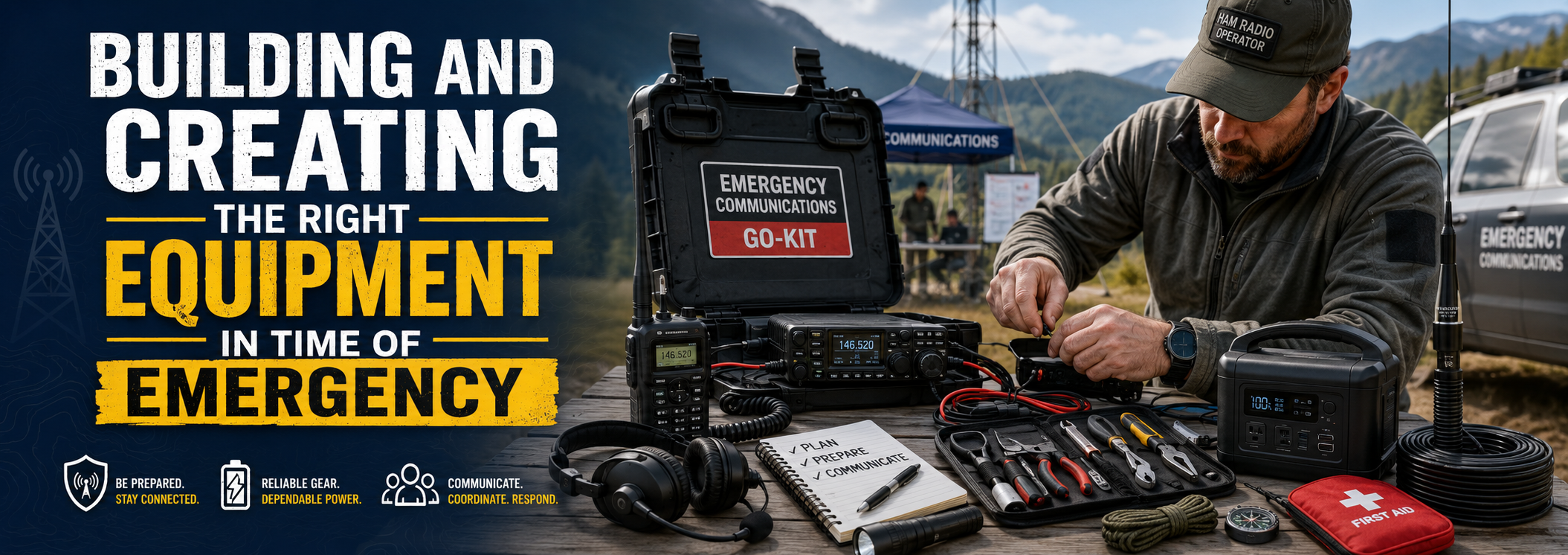
Amateur radio emergency communication does not normally occur from the comfort of a perfectly equipped home station. During an emergency, operators may be asked to report to a shelter, emergency operations center, public-safety facility, medical location, church building, neighborhood command post, or remote field site.
The operator may have little advance notice. Commercial power may be unavailable. Permanent antennas may be damaged or inaccessible. Internet and cellular service may be unreliable. Space may be limited, and the operating location may be noisy, crowded, or exposed to weather.
For these reasons, portability is not simply a convenient feature. It is a fundamental capability.
A portable amateur radio station must be designed as a complete communications system rather than a collection of unrelated equipment. The radio is only one component. Power, antennas, feed lines, grounding, accessories, documentation, transportation, operator comfort, and rapid deployment are equally important.
The objective is to create a station that can be moved safely, assembled quickly, operated reliably, and adapted to changing mission requirements.
Portability Is a Communications Capability
A home station may provide excellent performance, but it cannot serve every location. Emergency communication assignments frequently require the operator to move closer to the people, agencies, or facilities being supported.
A portable station gives the operator the ability to establish communication where existing systems are unavailable or overloaded. That mobility can make the difference between possessing communications equipment and actually providing useful communications service.
- Relocate when conditions change.
- Support multiple facilities or operating sites.
- Establish communication in areas without permanent radio equipment.
- Operate independently of commercial power.
- Replace or supplement a damaged fixed station.
- Deploy antennas appropriate for the terrain and required distance.
- Provide temporary communication for exercises, events, and emergencies.
A portable station should not be considered a reduced-quality version of a home station. When properly designed, it is a specialized field communications platform.
Begin With the Mission
Before purchasing cases, radios, batteries, or antennas, determine what the equipment is expected to accomplish.
A portable station designed for local VHF and UHF communication will be different from one intended for statewide HF communication. A neighborhood operator may need only a handheld radio, spare battery, headset, and compact antenna. An operator supporting an emergency operations center may require multiple radios, digital interfaces, logging equipment, external antennas, and extended-duration power.
- What communication distances must be covered?
- Will communication use repeaters, simplex, HF, digital modes, or several systems?
- How long must the station operate without commercial power?
- Will the equipment be carried by hand or transported in a vehicle?
- Will the operator work indoors, outdoors, or from a vehicle?
- How quickly must the station be operational?
- Will more than one operator use the equipment?
- What agencies or organizations will the station support?
Equipment should be selected to support a defined mission. Adding equipment without a clear purpose increases weight, complexity, power consumption, and the chance of failure.
Build a System, Not Just a Radio Box
A common mistake is to place a transceiver in a case and assume the result is a complete portable station. The radio may be protected, but the operator may still lack power connections, antennas, feed line, audio accessories, lighting, tools, or operating references.
A complete portable system should include several functional elements:
- Radio equipment.
- Independent power.
- Antennas and supports.
- Feed lines and adapters.
- Audio and data accessories.
- Documentation and logging materials.
- Tools, repair items, and spare parts.
- Weather and transportation protection.
Each element should be designed to work with the others.
For example, a 100-watt HF radio may be an excellent transceiver, but it will be of limited value if the battery is too small, the power cable creates excessive voltage drop, or the antenna cannot be safely installed at the deployment site.
Use a Modular Design
Modularity is one of the most valuable principles in portable station design.
Rather than placing every item in one large and heavy container, divide the station into functional modules. A modular system allows the operator to take only what is required for a particular assignment.
A practical system might include:
Radio Module
This module contains the primary radio, mounting hardware, microphone, speaker, headset connections, and basic power distribution.
Power Module
The power module may include batteries, fuses, charging equipment, voltage monitoring, solar connections, and standardized power connectors.
Antenna Module
This module contains antennas, coaxial feed lines, adapters, ropes, stakes, weights, support poles, and weatherproofing materials.
Operations Module
The operations module contains frequency plans, message forms, notebooks, identification, maps, pencils, clocks, and procedural references.
Tool and Repair Module
This module contains hand tools, electrical tape, self-fusing tape, spare fuses, connectors, cable ties, multimeter, adapters, and basic repair supplies.
A modular approach reduces lifting hazards, simplifies inventory, improves organization, and makes it easier to replace or upgrade individual components.
Selecting the Right Radios
The best portable radio is not necessarily the radio with the greatest number of features. It should be reliable, familiar, power-efficient, and appropriate for the intended mission.
Handheld Radios
Handheld transceivers are highly portable and useful for short-range communication, tactical assignments, and movement around an operating site. However, their limited power, small batteries, and inefficient stock antennas can restrict performance.
- At least one spare charged battery.
- A battery eliminator or external power adapter.
- A quality external antenna.
- A speaker microphone or headset.
- A printed frequency and channel list.
- A protective case or pouch.
Mobile VHF/UHF Radios
A mobile radio can provide greater transmitter power, improved receiver performance, and better audio than a handheld radio. It can be used in a vehicle or installed in a portable communications box.
The system must include properly sized power wiring and a battery capable of supporting the radio’s transmit current. The operator must also provide adequate ventilation around the radio.
HF Radios
HF equipment provides regional, national, and potentially international communication without depending on local repeaters. For emergency communication, HF can be especially useful when local infrastructure has failed or when messages must travel beyond the affected area.
A portable HF station requires careful planning because the radio, tuner, antenna, feed line, supports, and power system can become heavy. Compact equipment is useful, but reliability and operator familiarity should remain the priorities.
Avoid Unnecessary Complexity
A radio with complicated menus and unfamiliar controls may slow deployment. Operators should be able to change frequency, mode, power level, tone, memory channel, filtering, and audio settings without consulting a lengthy manual.
Critical functions should be practiced until they are routine.
Portable Power Must Be Designed Carefully
A radio without dependable power is not a communications system.
Portable power planning begins by calculating the station’s expected current consumption during receiving and transmitting. Transmit current is especially important because a 100-watt radio may draw more than 20 amperes at approximately 13.8 volts.
The battery must be large enough to support the anticipated operating period while maintaining adequate voltage.
Battery Selection
Lithium iron phosphate batteries have become popular for portable radio use because they offer reduced weight, stable voltage, long cycle life, and a high percentage of usable capacity. Sealed lead-acid batteries may still be useful where cost is a major consideration, but they are considerably heavier for the same usable energy.
Only chargers specifically designed for the selected battery chemistry should be used.
Power Distribution
Portable stations should use consistent, protected, and clearly labeled power connections. Every positive power lead should be fused near the source. Wiring must be large enough to prevent excessive voltage drop.
Loose adapters, exposed terminals, and improvised connections create unnecessary risks. Reverse-polarity protection should be included whenever practical.
Charging Options
A resilient power plan may include several charging sources:
- Commercial AC power.
- Vehicle power.
- Generator power.
- Solar panels.
- Backup battery banks.
The operator should understand the limitations of each source. A small solar panel may maintain or slowly recharge a battery, but it may not fully support continuous high-power operation.
Monitor Power Consumption
A voltage and current meter allows the operator to observe battery condition and equipment demand. This information helps determine when transmitter power should be reduced or when nonessential equipment should be disconnected.
Power conservation is an operational skill. Lowering transmitter power, shortening transmissions, reducing display brightness, and turning off unnecessary equipment can substantially extend operating time.
Antennas Determine Whether the Station Works
A portable radio connected to an ineffective antenna will produce disappointing results. In many field deployments, antenna selection and placement will affect communication more than the specific radio being used.
VHF and UHF Antennas
For local communication, an elevated antenna generally performs much better than a handheld antenna used inside a building.
- Roll-up J-pole antennas.
- Compact vertical antennas.
- Magnetic-mount antennas on suitable metal surfaces.
- Tripod-mounted verticals.
- Telescoping mast systems.
- Directional antennas for difficult paths.
Height, feed-line loss, terrain, and nearby obstructions must all be considered.
HF Antennas
Portable HF antennas may include:
- End-fed antennas.
- Linked dipoles.
- Off-center-fed dipoles.
- Vertical antennas.
- Near Vertical Incidence Skywave antennas.
- Portable loops.
- Compact loaded antennas.
No single antenna is ideal for every assignment. A low horizontal antenna may be effective for regional communication, while a vertical or higher dipole may be better for longer paths.
The operator should understand the coverage pattern, tuning requirements, support needs, and limitations of each antenna.
Support and Installation Equipment
An antenna is not portable unless the operator can install it.
The antenna module should contain suitable supports, ropes, stakes, throw lines, weights, clamps, and weatherproofing supplies. The operator should be able to install the antenna without depending on trees, towers, or building penetrations that may not be available.
Never assume that an operating location will provide an antenna mast or permission to attach equipment to the structure.
Standardize Cables and Connectors
Connector problems are among the most preventable causes of field station failure.
A portable kit may encounter radios, antennas, tuners, and accessories using several connector types. The operator should carry a controlled set of adapters rather than a box of unidentified parts.
- Coaxial adapters.
- Audio adapters.
- Data cables.
- USB cables.
- Power adapters.
- Extension cables.
- Grounding conductors.
Every cable should be inspected, labeled, and tested. Coaxial cables should indicate their length and type. Power cables should indicate their intended equipment and current rating.
Using standardized connectors across the station reduces setup time and prevents polarity mistakes.
Protect the Equipment Without Making It Too Heavy
Protective cases are valuable, but excessive protection can make equipment difficult to transport.
The case must be appropriate for the operating environment. Waterproof or weather-resistant cases may be justified for outdoor deployment, while padded equipment bags may be sufficient for controlled indoor operations.
Equipment should be protected from:
- Cable strain.
- Excessive heat.
- Accidental control movement.
- Short circuits.
- Electrostatic discharge.
Ventilation must not be overlooked. A radio installed in a sealed case may overheat during prolonged transmission. Fans, vents, or an operating configuration that allows the case to remain open may be necessary.
The operator should also consider total weight. A case that requires two people to lift may not be truly portable.
Design for Rapid Deployment
A well-designed portable station should be capable of going from storage to operation with minimal assembly.
- Permanently mounted radios.
- Prewired power distribution.
- Clearly labeled cables.
- Color-coded connections.
- Stored frequency memories.
- Printed setup instructions.
- Equipment diagrams.
- Organized antenna components.
- Preassembled accessory kits.
The station should not depend on the operator remembering every connection. A laminated setup card can provide the proper sequence for connecting power, radio equipment, feed lines, antennas, and accessories.
The system should also be designed for rapid shutdown. Emergency sites may need to relocate with little notice.
Include the Small Items That Make Operations Possible
Major equipment receives most of the attention, but small accessories frequently determine whether the station can remain functional.
- Spare fuses.
- Electrical tape.
- Self-fusing weatherproof tape.
- Cable ties.
- Hook-and-loop straps.
- Flashlight or headlamp.
- Permanent markers.
- Pencils and notebooks.
- Message forms.
- Extension cords.
- Outlet adapters.
- Small multimeter.
- Basic hand tools.
- Earphones or headset.
- Clock capable of displaying UTC.
- Spare batteries for accessories.
- Personal identification.
- Water and appropriate personal supplies.
These items should be inventoried and stored in designated locations.
Operator Comfort Affects Performance
A technically capable station can still fail operationally if the operator becomes exhausted, overheated, cold, dehydrated, or unable to hear radio traffic.
Long-duration communication requires attention to:
- Hearing protection.
- Headset comfort.
- Rest periods.
- Medication and personal needs.
- Relief operators.
Portability should include the operator’s ability to function safely, not only the movement of equipment.
A folding chair, compact table, shade cover, or headset may be as operationally important as another electronic accessory.
Documentation Must Travel With the Station
Portable equipment should include enough documentation to allow another trained operator to use it.
- Radio operating instructions.
- Frequency plans.
- Repeater information.
- Net procedures.
- Contact lists.
- Message-handling instructions.
- Equipment inventory.
- Power-consumption estimates.
- Antenna setup diagrams.
- Troubleshooting procedures.
- Assignment forms.
- Maintenance records.
Sensitive information should be protected appropriately. Frequency lists and operating instructions should be reviewed regularly to ensure they remain accurate.
Test the Station Under Realistic Conditions
A portable system should never be considered ready merely because the equipment powers on.
It must be tested as a complete system.
Testing should include:
- Operating from battery power.
- Installing antennas without permanent supports.
- Checking simplex and repeater coverage.
- Confirming HF tuning and expected propagation.
- Operating at full transmitter power.
- Measuring current consumption.
- Testing audio quality.
- Connecting digital equipment.
- Logging messages.
- Packing and unpacking the station.
- Operating in darkness or poor weather.
- Deploying with a time limit.
Field exercises often reveal problems that are invisible in the radio room. Cables may be too short. Connectors may be missing. Displays may be difficult to read outdoors. The battery may not last as long as expected. The antenna may require a support that was not packed.
Every problem discovered during training is one less problem encountered during an actual emergency.
Maintain an Equipment Inventory
Portable equipment should be inspected on a regular schedule.
- Equipment description.
- Model and serial number.
- Assigned storage location.
- Battery condition.
- Date last tested.
- Missing accessories.
- Required maintenance.
- Firmware or programming status.
Batteries should be charged and tested according to manufacturer recommendations. Connectors should be inspected for corrosion or damage. Software and radio programming should be verified before deployment.
Equipment that has not been tested recently should not be assumed to be ready.
Build for Reliability, Not Appearance
A portable station does not need to look like a military command center to be effective. Attractive cases, displays, and control panels can improve organization, but they should not add unnecessary weight or complexity.
Reliable field equipment should emphasize:
- Simple signal paths.
- Strong mechanical mounting.
- Proper fusing.
- Adequate cable size.
- Clear labeling.
- Replaceable components.
- Accessible controls.
- Good ventilation.
- Easy troubleshooting.
Every added connector, switch, relay, and electronic display creates another potential point of failure. Add features only when they provide a meaningful operational benefit.
Create More Than One Level of Portability
A single equipment package may not be suitable for every situation. Many operators benefit from developing several levels of portable capability.
Immediate Response Kit
A small kit containing a handheld radio, spare battery, external antenna, identification, notebook, and essential personal items.
Local Deployment Kit
A mobile VHF/UHF radio, larger battery, portable antenna, feed line, headset, power cables, and operating documents.
Extended Operations Station
A more complete system containing HF and VHF/UHF capability, larger power resources, charging equipment, digital interfaces, multiple antennas, tools, and extended-duration supplies.
This layered approach allows the operator to match equipment to the assignment rather than transporting the entire station for every event.
Improvement Should Be Continuous
A portable station is never completely finished. Equipment changes, operating assignments evolve, batteries age, and new weaknesses are discovered during exercises.
After every deployment or training event, ask:
- What equipment was not used?
- What equipment was missing?
- Which items were difficult to transport?
- What took too long to assemble?
- What failed or performed poorly?
- What should be replaced, removed, or reorganized?
- Could another operator understand the system?
Use the answers to improve the next version of the station.
Conclusion
Building the right portable amateur radio equipment is an exercise in practical systems engineering. The operator must balance communications capability, power consumption, antenna performance, durability, weight, cost, simplicity, and ease of deployment.
The most effective portable station is not the one containing the greatest amount of equipment. It is the station that can be transported safely, deployed quickly, operated confidently, and sustained for the required mission.
Portability creates flexibility. Flexibility creates resilience. Resilience allows amateur radio operators to place dependable communication where it is needed most.
An operator who has carefully built, organized, documented, and tested a portable station becomes more than a person who owns radio equipment. That operator becomes a deployable communications resource and a genuine asset to the community.
