
Choosing the Emergency Support Group You Wish to Support
Introduction
Earning an amateur radio license provides the legal authority to operate on amateur frequencies, but it does not automatically prepare an operator to serve effectively during an emergency. Productive emergency communications require more than a radio, an antenna, and a desire to help. It requires training, discipline, familiarity with procedures, and a working relationship with the organization being supported.
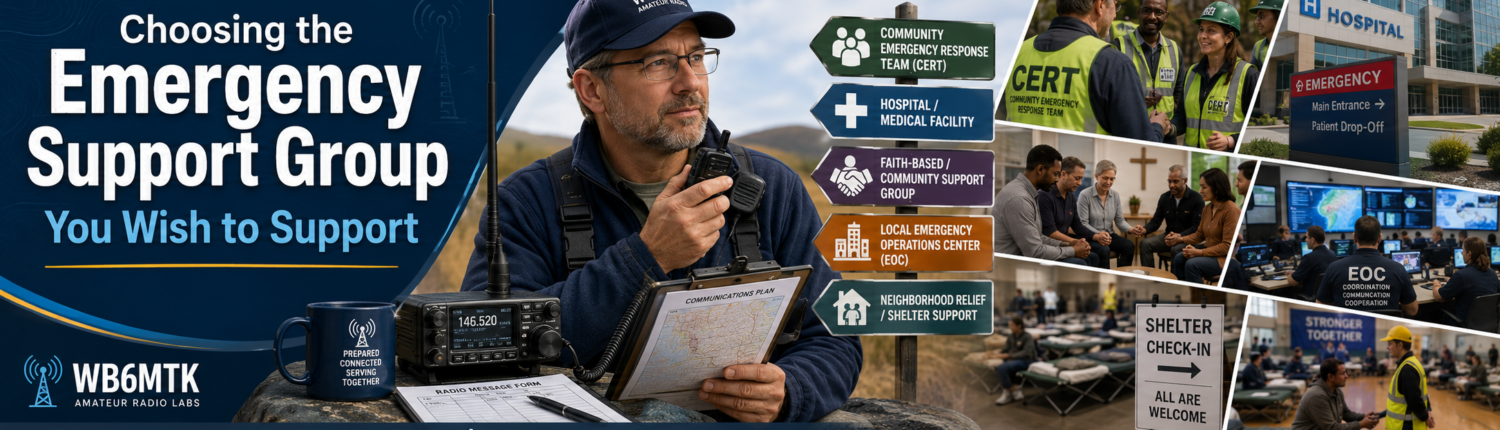
One of the most important decisions an emergency-minded amateur radio operator must make is determining which agency, organization, church, neighborhood, or community group to support.
This decision should not be made casually. Different organizations have different missions, operational procedures, leadership structures, expectations, and communications requirements. An operator who performs well in a neighborhood preparedness program may not enjoy working in a government emergency operations center. Someone who prefers technical fieldwork may be better suited for a communications unit, shelter assignment, hospital network, or mobile deployment team. Another operator may be most effective serving a congregation, community organization, or local relief agency.
The goal is not simply to join a group. The goal is to find the setting in which your skills, personality, equipment, experience, and availability can provide the greatest benefit.
Begin With the Purpose of Emergency Communications
Emergency communications exists to support the operational needs of others. Amateur radio operators are not normally the incident commanders, emergency managers, law-enforcement officers, firefighters, medical personnel, or relief-agency directors. Their role is to provide communications support when requested and authorized.
That support may include:
- Relaying health-and-welfare information
- Connecting shelters with coordination centers
- Reporting resource needs
- Supporting damage-assessment teams
- Providing backup communications between facilities
- Transmitting weather observations
- Maintaining communications during power or telecommunications failures
- Supporting search, logistics, transportation, or recovery operations
- Connecting community leaders when normal systems are unavailable
The message and the mission belong to the organization being served. The radio operator provides the dependable path over which the information travels.
This service-oriented perspective is essential when choosing a support group. The question is not merely, “Which group will let me use my radio?” The better question is, “Which organization has a mission I am willing and able to support consistently?”
Understand the Available Organizations
Emergency communications opportunities vary by location. Some communities have highly developed amateur radio programs, while others rely on informal partnerships or regional resources. Operators should investigate the organizations active in their own county, city, state, or service area.
Amateur Radio Emergency Service
The Amateur Radio Emergency Service, commonly known as ARES, consists of licensed amateur radio operators who volunteer their communications skills and equipment for public service and emergency response.
ARES groups often support emergency management agencies, shelters, hospitals, public events, relief organizations, and other community partners. Participation may include formal training, weekly or monthly nets, exercises, public-service events, and emergency activations.
ARES may be appropriate for operators who want broad emergency communications experience and are willing to work with several served agencies.
Radio Amateur Civil Emergency Service
The Radio Amateur Civil Emergency Service, or RACES, is generally associated with government emergency management and civil-defense communications. Local implementation varies considerably. In some jurisdictions, ARES and RACES functions are closely coordinated. In others, RACES operates as a distinct government-sponsored program.
RACES participation may involve registration, identification credentials, background screening, emergency management training, and specific activation procedures.
This environment may appeal to operators who are comfortable working within a formal government structure and following clearly defined chains of command.
Community Emergency Response Teams
Community Emergency Response Team programs train citizens to assist their neighborhoods and communities following disasters. CERT training commonly addresses preparedness, basic disaster response, fire safety, light search and rescue, organization, and basic medical operations.
Amateur radio operators can provide valuable communications within CERT teams, particularly when neighborhoods become isolated or normal communications fail.
CERT may be an excellent choice for operators who prefer local, neighborhood-level service and want emergency communications to be part of a broader preparedness role.
Emergency Management Agencies
City, county, tribal, regional, and state emergency management agencies may use trained amateur radio volunteers as backup communicators, auxiliary communications personnel, radio-room operators, field communicators, or technical advisors.
Work within an emergency operations center can be demanding. Operators may need to function in a structured environment, maintain accurate logs, handle confidential or sensitive information appropriately, and communicate without interfering with command personnel.
Operators interested in emergency management should be willing to learn incident-management principles and understand that radio communications are only one part of a much larger response system.
Hospitals and Healthcare Networks
Hospitals, clinics, care centers, and public-health organizations may need backup communications during disasters, telephone outages, power failures, evacuations, or mass-casualty incidents.
Healthcare communications can require precision, confidentiality awareness, calm behavior, and the ability to operate in stressful surroundings. Messages may involve staffing, supplies, patient transportation, facility status, or coordination with emergency management.
Operators who support healthcare organizations must recognize that amateur radio should not be used to transmit protected or personally identifiable medical information unless the information is properly handled and legally appropriate for the communications system being used. Sensitive details should be minimized, coded only under authorized procedures, or moved through a more suitable communications channel.
Relief and Humanitarian Organizations
Organizations such as the American Red Cross, The Salvation Army, food-distribution groups, shelter organizations, and other humanitarian agencies may use volunteer communicators during major incidents.
Assignments may involve shelters, supply centers, feeding operations, distribution points, temporary facilities, or coordination offices.
Relief work often requires flexibility. Communications needs may change rapidly, and operators may be asked to work long shifts in unfamiliar locations. A service-oriented personality, patience, and the ability to work respectfully with distressed members of the public are especially important.
Faith-Based Organizations
Churches and other faith-based organizations frequently maintain preparedness, welfare, relief, or emergency communications plans. Amateur radio operators may help connect congregations, local leaders, welfare facilities, shelters, or regional coordination points.
Faith-based communications may include health-and-welfare reporting, leadership coordination, resource requests, family status information, and support for relief activities.
Operators serving a faith-based group should understand the organization’s leadership structure and reporting procedures. They must also remain aware that amateur radio regulations still apply. Messages involving ordinary organizational business, confidential counseling, financial matters, or information inappropriate for amateur frequencies should be handled through other communications systems.
Faith-based service may be a strong fit for operators who already understand the organization, know its leaders, and are committed to helping its members and surrounding community.
Neighborhood and Community Preparedness Groups
A neighborhood communications program may use amateur radio, General Mobile Radio Service, Family Radio Service, telephone trees, runners, and internet-based tools.
Amateur operators can provide the longer-range link between neighborhood teams and outside coordination points. This role is especially valuable when local residents are trained to collect standardized information and pass it to a neighborhood radio operator.
Neighborhood service can be highly effective because the operator understands the local geography, residents, hazards, and available resources.
Weather and Observation Programs
Some amateur radio operators are particularly interested in severe-weather observation and reporting. Programs such as SKYWARN may provide training for volunteers who report significant weather conditions to appropriate authorities.
Weather-support operators must understand the difference between useful observations and speculation. Reports should be accurate, concise, timely, and based on established reporting criteria.
This type of service may be well suited to operators who enjoy field observation, meteorology, mobile operation, and disciplined reporting.
Public-Service and Event Communications Groups
Parades, marathons, bicycle races, community celebrations, charity events, and similar activities provide excellent training opportunities. Although these are usually planned events rather than emergencies, they help operators practice net procedures, deployment, message handling, teamwork, logging, and equipment setup.
An organization that regularly supports public events may provide one of the best entry points for a new emergency communicator. Operators can develop competence in a controlled environment before being asked to serve during a serious incident.
Evaluate the Organization’s Mission
Before joining, learn what the organization actually does. Do not rely only on its name, reputation, or promotional materials.
Ask practical questions:
- Who does the group support?
- What types of emergencies does it prepare for?
- Who activates the group?
- What assignments are commonly given to radio operators?
- How frequently does the group train?
- What equipment is expected?
- Are members required to complete emergency management courses?
- Are background checks or identification credentials required?
- Does the group participate in realistic exercises?
- Is there a written communications plan?
- How are members notified during an activation?
- What level of availability is expected?
- Does the group have clear leadership and accountability?
A credible organization should be able to explain its purpose, activation authority, training standards, and relationship with served agencies.
Be cautious of groups that appear to exist primarily for titles, uniforms, authority, or personal recognition. Effective emergency communications organizations emphasize service, competence, teamwork, and accountability.
Match the Mission to Your Interests
Volunteers are more likely to remain active when they believe in the mission.
Consider what type of service interests you most. You may prefer:
- Supporting government emergency management
- Helping families and neighborhoods
- Assisting hospitals or care facilities
- Working with shelters and humanitarian agencies
- Supporting your church or religious community
- Deploying to field locations
- Operating from a fixed radio room
- Providing technical equipment support
- Relaying formal written traffic
- Monitoring weather conditions
- Training new communicators
- Building portable communications systems
- Supporting leadership coordination
There is no single correct choice. The right organization is the one in which you can contribute effectively and remain committed over time.
Consider Your Skills and Experience
Different assignments require different capabilities.
A highly experienced technical operator may be valuable in designing antennas, repairing equipment, solving interference problems, or establishing long-distance communications. A less technical operator with excellent organizational skills may be more valuable as a net-control operator, logger, message clerk, scheduler, or liaison.
Useful emergency communications skills include:
- Clear voice operating
- Net-control procedures
- Formal message handling
- Accurate logging
- Digital communications
- Portable station setup
- Antenna installation
- Battery and backup-power management
- Computer networking
- Radio programming
- Troubleshooting
- Mapping and navigation
- Public interaction
- Teaching and mentoring
- Calm decision-making
Do not underestimate nontechnical abilities. Reliability, patience, listening, punctuality, and respect for leadership are often more important than owning expensive equipment.
Consider Your Physical Capabilities
Some assignments require lifting, walking, climbing, driving, outdoor exposure, or working long hours. Others can be performed from a home station, communications room, shelter desk, or emergency operations center.
Operators should honestly evaluate their physical condition. A volunteer should not accept an assignment that creates unnecessary danger for themselves or others.
An operator with limited mobility may still provide exceptional service as:
- A home-based relay station
- Net-control operator
- Message logger
- Digital communications operator
- Scheduler or coordinator
- Documentation specialist
- Trainer
- Technical advisor
- Remote liaison station
Emergency service should make use of a volunteer’s strengths without placing the individual in an unsuitable assignment.
Evaluate Your Equipment
Do not choose an organization solely because your current equipment appears to match its operations. Equipment can be acquired or improved over time. Nevertheless, it is important to understand the group’s communications systems.
Determine whether the organization primarily uses:
- VHF or UHF repeaters
- Simplex channels
- High-frequency communications
- Digital messaging systems
- Winlink
- Packet radio
- Mesh networking
- Satellite communications
- GMRS or FRS for neighborhood links
- Public-safety or commercial radio systems under authorized conditions
- Internet-connected coordination tools
Ask whether the group expects members to provide their own radios, antennas, batteries, computers, cables, headsets, identification, food, water, transportation, or personal protective equipment.
An operator should gradually build a practical communications kit based on actual mission requirements rather than purchasing equipment without a defined purpose.
Examine the Group’s Training Culture
Training reveals whether an organization is serious about preparedness.
A capable group should do more than hold social meetings or informal radio conversations. It should provide opportunities to practice realistic tasks, including:
- Activation and check-in procedures
- Directed nets
- Tactical call signs
- Formal message handling
- Message prioritization
- Deployment
- Radio-room operations
- Equipment failure
- Repeater loss
- Simplex operations
- Backup power
- Shift changes
- Documentation
- Demobilization
- After-action review
Exercises should identify weaknesses without humiliating participants. The purpose of training is to improve the team, not to prove who knows the most.
Look for an organization whose leaders correct mistakes professionally, encourage questions, and help members develop competence.
Understand Leadership and Chain of Command
Emergency response requires organization. A radio operator must know who is authorized to provide instructions and where communications information should be delivered.
Before joining, determine:
- Who leads the communications group?
- Who activates members?
- Who assigns operators?
- Who represents the served agency?
- Who approves frequencies and communications plans?
- Who receives reports?
- How are disputes resolved?
- How are safety concerns reported?
Avoid creating your own mission during an incident. Self-deployment can create confusion, congestion, duplication, and safety problems.
A trained volunteer waits for an authorized assignment or reports through an established volunteer-management process.
Determine Whether the Group Respects Its Volunteers
Volunteers should expect accountability, but they should also expect professional treatment.
A healthy organization:
- Communicates expectations clearly
- Provides meaningful training
- Uses volunteers’ time responsibly
- Assigns roles based on capability
- Corrects errors respectfully
- Maintains accurate rosters
- Recognizes limitations
- Encourages improvement
- Protects confidential information
- Addresses unsafe behavior
- Conducts after-action reviews
- Values dependable service over personal status
A dysfunctional organization may suffer from poor communication, favoritism, unclear authority, lack of training, personality conflicts, or leadership that does not respond to its members.
No organization will be perfect. However, repeated disrespect, unsafe practices, or lack of operational purpose may indicate that another group would be a better fit.
Choose a Primary Organization
An experienced operator may support several groups, but new emergency communicators should generally begin with one primary organization.
Serving one principal group allows the operator to learn its procedures, develop trust, understand its mission, and become part of its operational structure.
Joining too many groups can create conflicting obligations. During a widespread emergency, several organizations may activate simultaneously. The operator must know which assignment takes priority.
Before accepting multiple memberships, clarify:
- Which organization is your primary commitment?
- Who has activation priority?
- How will you notify other groups if unavailable?
- Are there agreements between the organizations?
- Can one assignment serve multiple partners without creating conflicts?
A volunteer who promises availability to everyone may ultimately be dependable to no one.
Build a Relationship Before the Emergency
The worst time to introduce yourself to an organization is after the disaster has already occurred.
Effective emergency communicators build relationships in advance. They attend meetings, participate in nets, complete training, learn procedures, and become familiar with the people they may support.
Trust develops through consistent performance.
Show up when promised. Bring working equipment. Follow instructions. Submit required documentation. Participate in exercises. Accept constructive correction. Help other volunteers. Maintain a professional attitude.
Over time, the organization will learn that you are someone who can be depended upon when conditions become difficult.
Avoid the “Freelance Rescuer” Mentality
The desire to help is admirable, but uncoordinated action can interfere with emergency operations.
Do not travel to a disaster area without authorization. Do not enter restricted locations. Do not claim to represent an agency unless officially assigned. Do not transmit rumors, unverified damage reports, or sensitive information. Do not establish a competing net on a frequency already being used for emergency traffic.
Emergency communications is not about being the loudest station or the first person to arrive. It is about becoming a disciplined part of an organized response.
The most effective operator may be the person quietly maintaining a communications link, accurately recording messages, and following the communications plan.
Conduct a Personal Readiness Assessment
Before committing to a group, evaluate your own readiness.
Ask yourself:
- Can I participate in regular training?
- Can I follow instructions under pressure?
- Can I remain calm when others are distressed?
- Can I communicate clearly and briefly?
- Can I accept correction?
- Can I work with people whose personalities differ from mine?
- Can I maintain confidentiality?
- Can I serve without seeking recognition?
- Is my household prepared for my absence?
- Do I have reliable transportation?
- Can I sustain myself during an assignment?
- Is my equipment tested and organized?
- Do I understand the limits of my license and authority?
Emergency service begins with personal and family preparedness. An operator who must immediately leave an assignment because of preventable problems at home cannot provide dependable support.
Start With Training and Observation
You do not have to make a permanent commitment immediately.
Attend a meeting. Check into a net. Participate in a public-service event. Observe an exercise. Speak with current members. Ask about typical assignments. Review the group’s communications plan.
This allows you to evaluate the organization while the organization evaluates you.
A trial period can reveal whether the group’s mission, culture, expectations, and leadership are compatible with your goals.
Become Valuable Through Consistency
Organizations do not need volunteers who appear only when an event is exciting. They need people who train when conditions are normal.
Consistency includes:
- Participating in scheduled nets
- Maintaining current contact information
- Keeping equipment operational
- Completing required courses
- Practicing message handling
- Updating go-kits
- Attending exercises
- Learning backup procedures
- Supporting routine public-service activities
- Helping train others
The dependable operator who attends regularly and performs basic tasks correctly is often more valuable than the highly technical operator who cannot be reached when needed.
Know When to Reevaluate
Your circumstances may change. Health, family responsibilities, employment, transportation, or organizational leadership may affect your ability to serve.
Periodically ask whether your current group remains the right fit.
Reevaluation does not necessarily mean abandoning the organization. It may mean moving to a different assignment, reducing your availability, becoming a trainer, operating from home, or serving in an advisory capacity.
A mature volunteer communicates changes honestly rather than remaining on a roster while being unable or unwilling to respond.
Conclusion
Choosing an emergency support group is one of the most important decisions an amateur radio operator can make. The right choice creates a pathway for meaningful training, trusted relationships, and effective community service.
Examine the organization’s mission, leadership, training, expectations, and relationship with the community. Consider your own interests, skills, equipment, physical abilities, availability, and willingness to follow established procedures.
Do not choose a group merely because it offers a title, uniform, identification card, or opportunity to display equipment. Choose an organization whose mission you believe in and whose needs match the service you are prepared to provide.
Then commit to becoming reliable.
Train before the emergency. Learn the procedures. Build relationships. Maintain your equipment. Support the chain of command. Communicate accurately. Serve with humility.
A radio operator becomes a true community asset not simply by joining an emergency organization, but by becoming someone that organization can trust when ordinary communications and ordinary routines have failed.
Key Principle
Choose the organization whose mission you can support consistently, then train until that organization can depend on you.
