
Understand Antenna Feedlines
Bringing RF from the antenna to the station without wasting the signal
A radio station is only as good as the path between the transmitter, receiver, and antenna. Many operators spend considerable money on a new transceiver, antenna tuner, amplifier, or antenna, yet treat the feed line as an afterthought. That is a mistake. The feed line is not just a piece of cable. It is part of the RF system. It determines how much transmitted power actually reaches the antenna, how much received signal makes it back to the receiver, how much unwanted noise enters the station, and how stable the system remains in weather, wind, and long-term outdoor use.
For most amateur radio stations, the most common feed line is coaxial cable. It is convenient, shielded, easy to route, compatible with modern radios, and works well when properly selected and installed. However, coax is not the only feed line available. Ladder line, open-wire line, twin-lead, hardline, and specialty window feed-through jumpers all have a place when used correctly.
The goal is simple: move RF energy from the radio to the antenna with the least practical loss, the least noise pickup, the least weather-related failure, and the least damage to the building.
What a Feed Line Actually Does
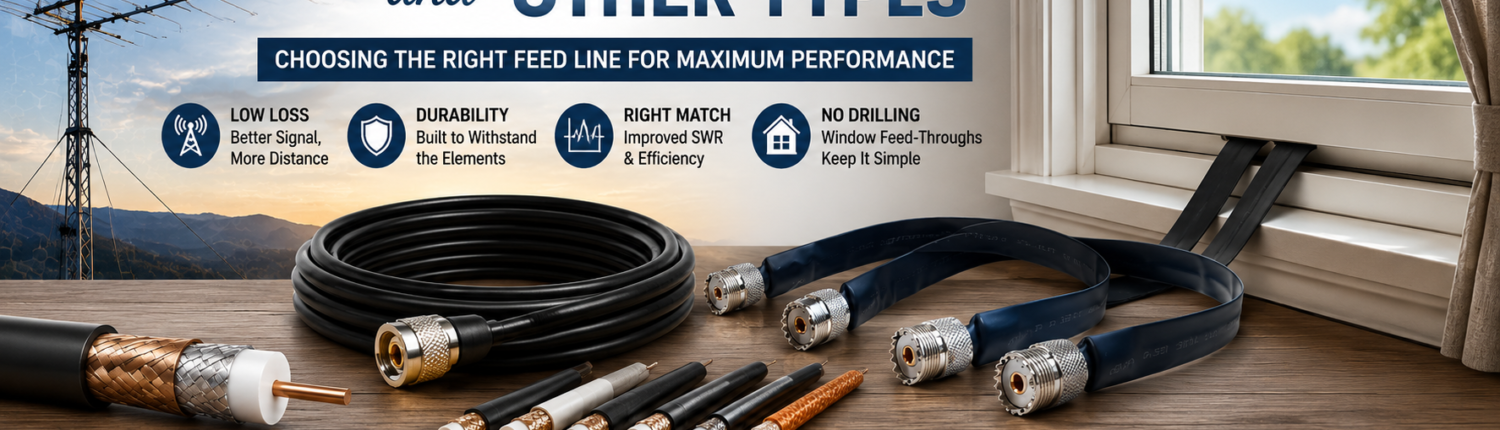
Article image: a practical home station layout with coax and flat feed-through jumpers ready for installation.
A feed line carries radio-frequency energy between the transmitter or receiver and the antenna system. On transmit, it delivers RF power from the radio to the antenna. On receive, it carries very weak signals from the antenna back to the receiver.
A good feed line should do several things well. It should have low loss at the frequency being used. It should handle the transmitter power without overheating or arcing. It should maintain a stable impedance. It should resist water intrusion, UV damage, and mechanical stress. It should be properly matched to the antenna system or used with the correct matching equipment. It should also be routed in a way that avoids common-mode current, noise pickup, and safety problems.
The feed line is not where station performance should be sacrificed. A poor feed line can turn a good antenna into an average antenna, and a bad installation can make even expensive equipment perform poorly.
Coaxial Cable: The Most Common Amateur Radio Feed Line
Coaxial cable, usually called coax, is the standard feed line for most amateur radio installations. It is called “coaxial” because the center conductor and outer shield share the same axis. The center conductor carries the RF signal, while the surrounding shield provides the return path and helps contain the RF field inside the cable.
A typical coaxial cable has four main parts:
- The center conductor carries RF current.
- The dielectric insulation separates the center conductor from the shield and determines much of the cable’s impedance and loss.
- The shield, usually braid, foil, or both, provides the outer conductor and reduces radiation or pickup.
- The outer jacket protects the cable from weather, abrasion, sunlight, and physical damage.
Most amateur radio coax is 50-ohm cable. Most amateur radios, amplifiers, wattmeters, antenna analyzers, dummy loads, and many commercial antennas are designed around a 50-ohm system. This does not mean every antenna is exactly 50 ohms. It means the station equipment expects to operate into a system that can be transformed or matched to approximately 50 ohms.
Why Feed Line Loss Matters
“The longer the run and the higher the frequency, the more important low-loss cable becomes.”
Feed line loss converts RF energy into heat. On transmit, loss reduces the power reaching the antenna. On receive, loss weakens the signal before it reaches the receiver. Loss increases as frequency increases, which means a cable that works acceptably on HF may be very inefficient on VHF or UHF.
For example, a modest cable run of RG-58 may be usable for a short HF jumper, but it is usually a poor choice for a long run on 2 meters or 70 centimeters. At UHF, poor coax can waste a major portion of the transmitter’s power before it ever reaches the antenna.
Loss is affected by cable type, cable length, frequency, cable quality, connector quality, water intrusion, and standing wave ratio. High SWR increases effective loss because power reflects back and forth through the cable, causing the cable loss to be encountered more than once.
The rule is straightforward: the longer the run and the higher the frequency, the more important low-loss cable becomes.
Common Coaxial Cable Types
RG-58
RG-58 is small, flexible, and inexpensive. It is often used for short jumpers, mobile installations, temporary setups, and low-power HF use. It is not ideal for long runs or higher-frequency work because its loss becomes significant.
Best use: short HF jumpers, mobile wiring, low-power temporary stations.
Avoid: long VHF/UHF runs, high-power installations, permanent outdoor runs unless absolutely necessary.
RG-8X / Mini-8
RG-8X, often called Mini-8, is larger and lower-loss than RG-58 but still flexible and easy to handle. It is a practical choice for many HF stations where cable runs are moderate. It can also work for short VHF runs, but it is not the best choice for long 2-meter or 70-centimeter feed lines.
Best use: general HF stations, moderate-length runs, portable work, and jumpers.
Avoid: long UHF runs and high-power installations where cable heating or loss becomes a concern.
RG-213 / RG-8 Type Cable
RG-213 is a larger, rugged 50-ohm coax that has been used for decades in amateur and commercial radio. It has lower loss than RG-58 and RG-8X and handles more power. It is physically larger, less flexible, and more expensive, but it is a solid choice for HF and some VHF installations.
Best use: permanent HF stations, higher power, outdoor runs, and moderate VHF service.
Avoid: long UHF runs where lower-loss cable such as LMR-400 or hardline would be better.
LMR-400 Type Cable
LMR-400 and similar low-loss cables are very popular for VHF and UHF installations. They provide significantly lower loss than smaller coax types and are a strong choice for base station feed lines. They are stiffer than RG-8X or RG-58, so routing must be planned carefully.
Best use: VHF/UHF base antennas, longer cable runs, dual-band verticals, repeater-style installations, and serious station builds.
Avoid: tight bends, repeated flexing, or rotor loops unless using a more flexible version.
LMR-240 Type Cable
LMR-240 is smaller and more flexible than LMR-400 while still offering better performance than RG-58. It is useful where space is limited and flexibility matters, but a lower-loss cable is still desired.
Best use: mobile, portable, short-to-medium VHF/UHF runs, and jumpers where RG-58 would be too lossy.
Avoid: long UHF runs where LMR-400 or hardline is more appropriate.
75-Ohm RG-6
RG-6 is common television and satellite cable. It is usually 75 ohms, not 50 ohms. Many hams use it successfully for receive antennas, scanner antennas, low-power applications, and some HF antennas where the impedance mismatch is acceptable or can be matched.
The caution is that RG-6 usually uses F connectors, may have a copper-clad steel center conductor, and may not be ideal for repeated flexing or high-current RF use. It can be useful, but it should be used intentionally, not accidentally.
Best use: receive antennas, low-cost long runs, some HF applications, and experimental antennas.
Avoid: high-power transmitting unless the cable and connectors are known to be suitable.
Hardline
Hardline is a very low-loss feed line used in commercial, repeater, contest, and high-performance stations. It may have a solid or corrugated outer conductor and is much less flexible than ordinary coax. It is excellent where long runs and high frequencies demand low loss.
Best use: repeaters, towers, high-performance VHF/UHF stations, long cable runs, and permanent installations.
Avoid: casual temporary setups or installations where repeated movement is required.
Approximate Feed Line Selection Guide
| Feed Line Type | Best Use | Strengths | Cautions |
| RG-58 | Short jumpers, mobile, temporary HF | Flexible, inexpensive, easy to route | High loss on VHF/UHF; not ideal for long runs |
| RG-8X / Mini-8 | General HF, portable, moderate runs | Better than RG-58, still flexible | Not ideal for long UHF runs |
| RG-213 | Permanent HF, higher power | Rugged, good power handling | Larger, heavier, moderate VHF/UHF loss |
| LMR-240 | Short-to-medium VHF/UHF | Lower loss than RG-58, manageable size | Not as low-loss as LMR-400 |
| LMR-400 | VHF/UHF base antennas, longer runs | Low loss, good for serious stations | Stiffer, needs careful bend radius |
| RG-6 | Receive antennas, low-cost runs | Low cost, widely available | 75 ohms, connector and power limitations |
| Hardline | Repeaters, towers, long VHF/UHF runs | Very low loss, high performance | Expensive, stiff, more difficult to install |
| Ladder Line / Window Line | Multiband HF wire antennas | Very low loss, efficient with mismatch | Must be kept away from metal; needs balanced tuner or balun |
| Open-Wire Line | High-efficiency HF systems | Extremely low loss | Requires careful physical installation |
Other Feed Line Types
Ladder Line and Window Line
Ladder line and window line are balanced feed lines. They usually consist of two parallel conductors separated by insulating material. The spacing between the conductors helps determine the impedance, often around 300, 450, or 600 ohms depending on the design.
The major advantage of ladder line is low loss, especially on HF. Even when the antenna has a high SWR, ladder line can often deliver RF efficiently if used with a proper balanced antenna tuner or matching system. This is why it is popular with multiband dipoles and doublets.
However, ladder line must be installed correctly. It should not be taped to metal masts, run against gutters, laid across metal roofing, or routed beside wiring. It needs spacing from conductive objects. If it is brought into the station, it must be transitioned carefully through a balanced tuner, current balun, or proper feed-through system.
Best use: HF multiband wire antennas, doublets, high-efficiency installations.
Avoid: careless routing near metal, sharp bends, and unbalanced transitions without proper matching.
Open-Wire Line
Open-wire line is similar in concept to ladder line but usually uses wider spacing and more rigid construction. It can have extremely low loss and excellent high-power capability. Many experienced HF operators consider it one of the most efficient feed line systems available.
Its disadvantage is mechanical complexity. It must be kept clear of metal, requires proper support, and is less convenient than coax. For the operator willing to build and maintain it correctly, open-wire line can be outstanding.
Best use: serious HF wire antenna systems, high-efficiency multiband installations.
Avoid: installations where the line must be hidden, tightly routed, or run close to metal surfaces.
Twin-Lead
Twin-lead was once common for television antennas and is sometimes used in amateur radio receiving or experimental work. It is lightweight and inexpensive but less rugged than most modern coax or ladder line. It is also more affected by nearby objects and weather.
Best use: receiving, experiments, low-power balanced antennas.
Avoid: permanent exposed installations unless protected and properly supported.
Coax Versus Ladder Line: Which Is Better?
The answer depends on the antenna system.
Coax is usually the best choice when the antenna is close to 50 ohms, the run is not excessive, and convenience matters. It is also the practical choice for most verticals, beams, mobile antennas, VHF/UHF antennas, and commercially made antennas designed for coax feed.
Ladder line is often better when feeding a non-resonant or multiband HF wire antenna. It can tolerate high SWR with much less loss than coax, but it requires a tuner or matching network and more careful installation.
A useful way to think about it is this: coax is easier to install, while ladder line is often more efficient under difficult impedance conditions. The best feed line is the one that matches the antenna design, frequency, power level, and physical installation.
SWR and Feed Line Loss
Many operators focus only on SWR, but SWR alone does not tell the whole story. A low SWR at the radio does not always mean the antenna is efficient. A lossy feed line can make a poor antenna look better because the reflected power is being dissipated as heat in the cable.
This is why antenna analyzers and wattmeters should be used intelligently. Measure at the antenna when possible. Know the expected performance of the cable. A perfect-looking match at the radio may hide feed line loss, especially on VHF and UHF.
The better goal is not merely “low SWR.” The better goal is efficient transfer of RF energy to an effective antenna.
Connector Choices Matter
A good feed line can be ruined by poor connectors. The most common amateur radio connectors include PL-259/SO-239, N-type, BNC, SMA, and F connectors.
The PL-259 is widely used in HF amateur radio. It is rugged and common, but it is not waterproof by itself and is not the best connector at UHF. The N-type connector is better suited for VHF/UHF and outdoor service when properly installed. BNC connectors are convenient for test equipment, QRP equipment, and quick disconnects. SMA connectors are common on handheld radios and compact devices, but they are not ideal for heavy cable strain. F connectors are common with RG-6 and television-style coax.
Every outdoor connector should be weatherproofed. Water entering coax can destroy its performance. Once water gets inside the shield and dielectric, the cable may become lossy, unstable, and difficult to diagnose.
A proper outdoor connection should usually include a drip loop, high-quality electrical tape or self-amalgamating tape, UV-resistant outer wrap, and strain relief. The cable should not hang by the connector.
Routing Feed Lines Correctly
Feed line routing affects station performance and safety. Avoid sharp bends, crushed cable, door pinches, and repeated flexing. Follow the manufacturer’s bend radius recommendations. Do not staple coax tightly. Do not run coax where people will trip over it or where lawn equipment will cut it.
Outdoor runs should be supported, protected from abrasion, and routed with drip loops before entering enclosures or the building. Keep feed lines away from power wiring where practical. Avoid running feed lines parallel to house electrical wiring for long distances. When crossing power wiring, cross at right angles when possible.
For station cleanliness and troubleshooting, label both ends of every feed line. A simple label showing antenna name, band, and cable type can save hours of confusion later.
Common-Mode Current and RF in the Shack
A feed line should carry RF inside the cable, not on the outside of the shield. When RF current flows on the outside of the coax shield, the feed line itself can become part of the antenna. This is called common-mode current.
Common-mode current can cause RF burns, distorted audio, computer interference, unstable SWR readings, microphone problems, tuner problems, and noise pickup on receive.
The usual solution is a proper current choke or common-mode choke placed at the correct location. Many coax-fed antennas benefit from a choke near the feed point. Some installations may also need a choke near the station entrance. Ferrite chokes, coaxial air-wound chokes, or commercial current baluns can all be used, but they must be appropriate for the frequency and power level.
Bringing Feed Lines Into the House
One of the most practical challenges for home amateur radio operators is getting the feed line from outside to inside. The traditional method is to drill a hole through the exterior wall and install a proper entrance panel or bulkhead. That can be the best permanent solution, but it is not always possible.
Some operators rent their homes. Others live in HOA-controlled neighborhoods. Some do not want to drill into stucco, brick, siding, or masonry. In those cases, a window feed-through can be a useful solution.
Window Feed-Throughs: No-Hole Feed Line Entry
“A window feed-through solves the building-entry problem, but it does not replace proper weatherproofing, strain relief, grounding, or lightning safety.”
A window feed-through allows coax or other conductors to pass through a window opening without drilling a hole through an exterior wall. These devices are especially useful for renters, apartment operators, temporary stations, emergency setups, seasonal antennas, and operators who want to avoid permanent building modifications.
There are several styles.
Flat Coax Window Feed-Throughs
A flat coax feed-through is a short, flattened section of coaxial cable with connectors on both ends. It is designed to pass through a partially closed window or door. The flat section is thin enough to fit through the gap while preserving enough RF continuity for practical use.
These are convenient, but they have limitations. They are not usually intended for high power, extreme weather exposure, or heavy mechanical stress. They may also have more loss than regular coax, especially at higher frequencies. They should be treated as a convenience device, not as a substitute for a high-performance permanent entrance panel.
Best use: temporary stations, low-to-moderate power, portable antennas, apartment operation, receive antennas, and emergency deployment.
Important cautions: do not crush the feed-through, do not sharply bend it, do not slam the window on it, and do not exceed the manufacturer’s power rating.
Window Bulkhead Panels
A better approach for a more permanent no-drill installation is a window bulkhead panel. This is usually a removable panel that fits into the lower portion of a sliding or double-hung window. The panel may contain coax bulkhead connectors, ground terminals, power pole connectors, rotor cable pass-throughs, or balanced-line terminals.
The window closes against the panel, and weather stripping is used to seal the remaining gaps. This allows a cleaner and more durable installation than simply pinching a cable through the window.
A good window panel can include:
- Coax bulkhead connectors for HF, VHF, or UHF antennas.
- A ground bonding point.
- Weather stripping around the panel.
- Strain relief for outside cables.
- A removable design for temporary use.
- Space for future antenna connections.
This type of panel is often the best compromise between performance, convenience, and avoiding wall damage.
Feed-Throughs for Ladder Line or Balanced Line
Balanced feed line can also be brought through a window, but it should not be crushed or routed casually. Ladder line and open-wire line depend on spacing and balance. If the two conductors are squeezed together, run against metal, or routed through a poor transition, performance can suffer.
A proper balanced-line window feed-through may use insulated standoff terminals mounted through a nonconductive panel. The goal is to maintain conductor spacing, avoid nearby metal, and transition cleanly to a balanced tuner or balun inside the station.
For HF doublets and ladder-line-fed antennas, this type of arrangement is often better than trying to force ladder line through a narrow window gap.
Weatherproofing a Window Feed-Through
A window feed-through must be sealed carefully. Gaps can let in rain, dust, insects, hot air, cold air, and moisture. A poor seal can also create a security concern.
Useful materials include adhesive weather stripping, foam window seal, removable caulk, rubber grommets, and nonconductive panel material such as acrylic, PVC board, or composite board.
The outside cable should always have a drip loop before it reaches the window. This prevents rainwater from following the cable into the house. The cable should be supported so the connector or flat feed-through is not carrying the weight of the outside feed line.
The inside cable should also be routed with strain relief. A window feed-through should not be pulled, twisted, stepped on, or bent sharply.
Security Concerns With Window Feed-Throughs
Any window opening can affect home security. A window feed-through panel should allow the window to be locked or otherwise secured. For temporary use, a removable locking bar or window stop can be used. For longer-term use, the panel should be strong enough that it cannot be easily pushed out.
Do not leave a window unsecured simply because the station feed line needs to pass through it. Amateur radio convenience should not compromise home safety.
Lightning and Grounding Considerations
A window feed-through is convenient, but it does not eliminate the need for proper lightning protection and grounding. Any outdoor antenna system can bring dangerous voltage into the station from lightning, nearby strikes, static buildup, or power-line contact.
A proper station entrance should include grounding and bonding. Ideally, coaxial feed lines should pass through a grounded entrance panel with lightning arresters before entering the building. The entrance ground should be bonded to the building’s electrical grounding system to reduce dangerous voltage differences.
For window installations, the operator should still consider an outside ground point, surge protection, and a method to disconnect and move feed lines away from equipment when storms approach. Disconnecting coax inside the shack is not the same as proper lightning protection. The safest approach is to disconnect outside and keep the line away from equipment and people.
No window feed-through should be considered lightning protection by itself.
Temporary Versus Permanent Installations
Temporary installations can use simpler methods, but permanent installations need better mechanical support, weatherproofing, grounding, and cable quality.
For a temporary operating event, a flat coax through a window may be acceptable. For a long-term home station, a window panel with bulkhead connectors, weather stripping, strain relief, and grounding provisions is a much better solution.
For a serious permanent station, a properly installed exterior entrance panel remains the preferred method when building conditions allow it.
Choosing the Right Feed Line by Frequency
HF: 160 through 10 meters
For HF, coax losses are usually manageable if the cable run is reasonable and the antenna is close to resonance. RG-8X, RG-213, and LMR-400 type cable are common choices. For multiband wire antennas with high SWR on some bands, ladder line or open-wire line may be more efficient than coax.
For a simple coax-fed dipole, vertical, or beam, use good-quality 50-ohm coax and keep the run as short as practical. For a multiband doublet, consider balanced line and a proper tuner.
6 meters
Six meters is where feed line quality begins to matter more. Short runs of good coax may work fine, but longer runs should use lower-loss cable. RG-8X may be acceptable for short runs, while LMR-400 or equivalent is better for longer runs.
2 meters
At 144 MHz, coax loss becomes important. Avoid long runs of RG-58. LMR-400 type cable, quality RG-213, or hardline should be considered for base station antennas. For mobile installations, shorter cable lengths help reduce the penalty of smaller coax.
70 centimeters
At 440 MHz, feed line loss can become severe. Low-loss coax is strongly recommended for base antennas. Long runs of small coax can waste a large amount of transmitter power and weaken received signals.
For a serious UHF base station, LMR-400, better low-loss coax, or hardline is usually appropriate.
Power Handling
Feed line power handling depends on frequency, SWR, cable size, dielectric type, connector quality, ventilation, and installation conditions. A cable that handles high power on HF may not handle the same power as efficiently at VHF or UHF. High SWR also increases stress on the cable.
Never assume all coax of the same name has the same power rating. Quality varies. Foam dielectric cables, stranded center conductors, copper-clad conductors, and shield construction all matter.
Before running high power, check the manufacturer’s ratings for the exact cable and connectors being used.
Outdoor Durability
Outdoor cable must survive sun, rain, heat, cold, wind, abrasion, and movement. UV-resistant jackets are important. Water-blocking construction may be desirable for tower runs. Connectors must be sealed. Cables should be supported so they do not swing, rub, or pull on connectors.
A feed line failure may not be obvious at first. Water intrusion can slowly increase loss. A cable can still show continuity and still perform poorly at RF. Periodic inspection is part of responsible station maintenance.
Look for jacket cracking, green corrosion, loose connectors, water stains, crushed sections, sharp bends, animal damage, and changes in SWR after rain.
Avoid Copper-Clad Aluminum for Serious RF Work
Some inexpensive cables use copper-clad aluminum conductors or light shielding. These may be acceptable for certain receive-only or consumer applications, but they are often a poor choice for serious transmitting stations. Amateur radio feed lines should be selected for RF performance, mechanical durability, and known specifications, not merely low price.
Cheap coax is rarely cheap after it causes station problems.
Practical Feed Line Recommendations
For short HF jumpers inside the shack, use flexible, good-quality coax with properly installed connectors.
For general HF outdoor runs, RG-8X may be acceptable for moderate lengths, while RG-213 or LMR-400 type cable is better for longer runs or higher power.
For VHF and UHF base antennas, use low-loss cable. LMR-400 or equivalent is a common starting point for serious installations.
For long UHF runs, consider even lower-loss cable or hardline.
For multiband HF wire antennas, consider ladder line or open-wire line with a proper tuner.
For apartment, rental, or no-drill installations, use a window feed-through or removable window panel, but do not ignore grounding, weatherproofing, or power limits.
The Best Installation Is the One You Can Maintain
A station feed line system should be understandable, inspectable, and serviceable. Avoid hidden splices, mystery cables, unlabeled lines, poor adapters, and inaccessible connectors. Every adapter adds another possible failure point. Every outdoor connection needs protection.
The feed line should be treated as permanent station infrastructure. Install it cleanly, label it clearly, protect it from weather, and test it periodically.
Final Thoughts
Coaxial feed line is one of the most important parts of an amateur radio station. It determines how efficiently RF energy moves between the radio and the antenna. Good coax, properly installed, can provide years of reliable service. Poor coax, bad connectors, water intrusion, excessive length, or careless routing can reduce performance and create frustrating station problems.
Other feed line types, such as ladder line and open-wire line, can be extremely efficient when used correctly. They are especially useful for multiband HF wire antennas, but they require proper spacing, routing, and matching.
Window feed-throughs are a valuable solution for operators who cannot or do not want to drill through an exterior wall. They make amateur radio more practical for renters, HOA-restricted homes, apartments, temporary stations, and emergency setups. However, they must be installed with attention to weather sealing, cable strain relief, security, grounding, and lightning safety.
The feed line is not just a cable. It is the lifeline between the station and the antenna. Choose it carefully, install it correctly, and the entire station will perform better.