
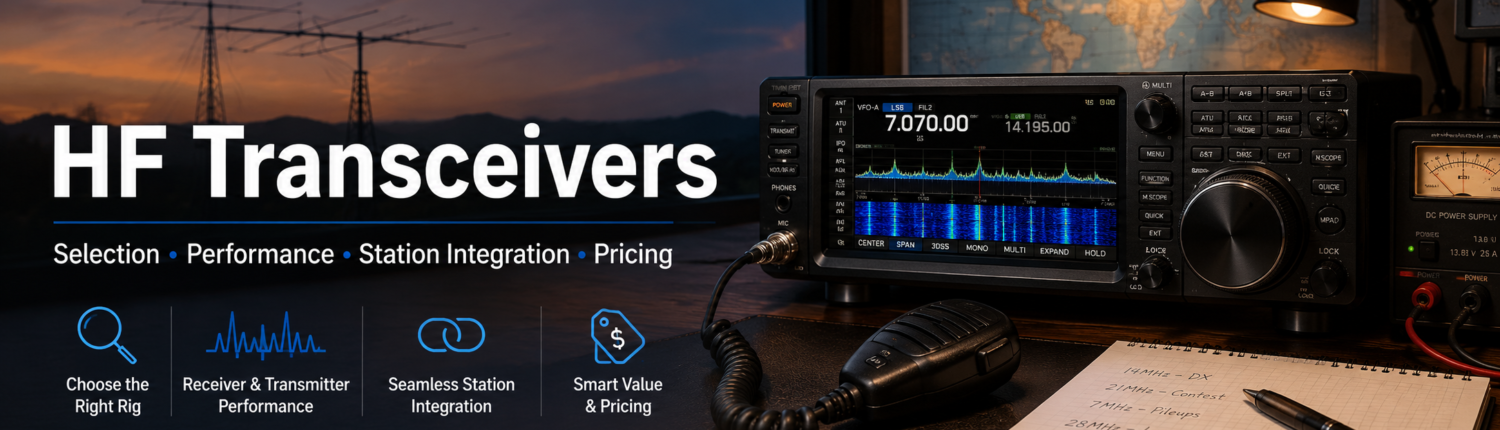
HF Transceivers: Selection, Performance,
Pricing, and Station Integration
Introduction
The HF transceiver is the operating center of an amateur radio station. Antennas, feed lines, grounding, power supplies, amplifiers, computers, tuners, microphones, keys, and digital-mode interfaces all matter, but the transceiver is where the operator directly controls the station. It determines how well weak signals are heard, how cleanly transmitted audio or CW is generated, how easily digital modes are used, and how effectively the station can be integrated into emergency communications, contesting, DXing, nets, portable operation, or technical experimentation.
Selecting an HF transceiver should never be based only on brand loyalty, display size, or advertised output power. A good selection requires understanding receiver performance, transmitter cleanliness, ergonomics, antenna system compatibility, digital-mode support, long-term serviceability, and total station cost. The best radio is not always the most expensive one. The best radio is the one that matches the operator’s mission, skill level, antennas, operating environment, and future growth.
What an HF Transceiver Does
An HF transceiver combines a receiver and transmitter in one unit. Most modern amateur HF transceivers cover the amateur bands from 160 meters through 10 meters, and many also include 6 meters. Some include VHF/UHF capability, internal antenna tuners, spectrum displays, digital signal processing, USB audio, computer control, CW keying, built-in sound-card interfaces, and advanced filtering.
The word “transceiver” should not cause the operator to forget that the radio contains two equally important systems: the receiver and the transmitter. A poor receiver can make a good antenna seem weak. A noisy transmitter can create interference and distort audio. A difficult control layout can slow emergency or contest operation. A radio that lacks proper computer integration can limit digital-mode operation. The station must be judged as a complete system.
Defining the Mission Before Buying
Before selecting an HF transceiver, the operator should define the mission of the station. A casual operator who checks into weekly nets has different needs than a weak-signal DXer, an emergency communicator, a contester, a CW operator, or a digital-mode experimenter.
A basic HF station may only need reliable SSB, CW, and digital-mode capability with 100 watts of output. A field operator may care more about low current draw, compact size, battery operation, and physical durability. A contester may need excellent close-in dynamic range, fast band changes, clean audio, and integration with logging software. A weak-signal operator may need quiet receiver performance, stable frequency control, narrow filters, and strong digital-mode support. An emergency communicator may need simplicity, reliability, compatibility with multiple antennas, and operation from backup power.
The correct first question is not, “What is the best radio?” The correct question is, “What must this station accomplish?”
Major Classes of HF Transceivers
Entry-Level HF Transceivers
Entry-level HF transceivers are usually compact, affordable, and capable of full-power operation on the HF bands. Many provide 100 watts, general SSB/CW/digital operation, USB computer connection, and a basic internal tuner or tuner support.
These radios are excellent for new General Class operators, emergency communicators, portable stations, and operators who want strong basic capability without spending premium money. Their limitations may include smaller displays, fewer dedicated controls, less advanced filtering, lower receiver performance in crowded band conditions, and fewer antenna ports.
A well-chosen entry-level HF radio can serve an operator for many years. The key is not to confuse “entry-level” with “poor quality.” Many modern entry-level transceivers are highly capable when connected to a good antenna system.
Mid-Range HF Transceivers
Mid-range HF transceivers usually add better receiver performance, improved displays, superior filtering, more controls, better ergonomics, more antenna options, stronger digital-mode integration, and better overall station management.
This class is often the best value for serious operators. A mid-range radio may provide a large spectrum scope, touchscreen interface, advanced DSP, roofing filters, cleaner transmit audio control, better CW features, and improved computer integration. For many amateurs, this is the point where the radio stops being merely adequate and becomes a serious station platform.
Mid-range radios are commonly used by DXers, contesters, digital-mode operators, net control stations, and technically focused amateurs who want strong capability without entering the highest price tier.
Premium HF Transceivers
Premium HF transceivers are designed for operators who need high-end receiver performance, exceptional filtering, strong-signal handling, multiple receivers, superior transmit audio control, advanced station integration, and heavy-duty operating capability.
These radios may include dual independent receivers, multiple antenna ports, advanced preselector systems, high-resolution spectrum displays, external display options, precision frequency references, extensive control customization, and high-quality construction. They are often used by serious contesters, DXers, weak-signal operators, and advanced station builders.
A premium radio can be impressive, but it should not be purchased as a substitute for station fundamentals. A poor antenna, high noise floor, bad grounding, weak power supply, and poor feed-line system will limit even the most expensive transceiver.
QRP and Portable HF Transceivers
QRP transceivers generally operate at lower power levels, often 5 to 20 watts. They are popular for portable operation, hiking, emergency field deployment, battery operation, Parks on the Air, Summits on the Air, and minimalist stations.
The attraction of QRP is not only low power. It forces the operator to improve antenna efficiency, operating skill, propagation awareness, and station discipline. A QRP transceiver with a good antenna can produce excellent results, but it is less forgiving than a 100-watt station.
For emergency work, QRP can be valuable when power is limited, but it should be used with realistic expectations. Low power requires efficient antennas, favorable propagation, disciplined operating procedures, and skilled operators.
Receiver Performance: The Heart of HF Operation
The receiver is often the most important part of an HF transceiver. Many operators focus on transmit power, but most HF contacts are won or lost in the receiver.
Sensitivity
Sensitivity describes the receiver’s ability to detect weak signals. On HF, however, extreme sensitivity is not always the most important specification because atmospheric noise often dominates the band. A receiver that is “sensitive enough” may perform very well if it has good filtering, dynamic range, and noise handling.
Selectivity
Selectivity is the receiver’s ability to separate the desired signal from nearby signals. This is critical during contests, pileups, emergency nets, and crowded band conditions. Good selectivity allows the operator to reduce interference from adjacent signals while preserving intelligibility.
Modern radios use DSP filtering, roofing filters, or a combination of both. Adjustable filter width, passband tuning, notch filtering, and noise reduction can greatly improve copy when used correctly.
Dynamic Range
Dynamic range is one of the most important receiver specifications. It describes how well the receiver handles strong nearby signals while still receiving weak signals. A receiver with poor dynamic range may overload, produce distortion, or bury weak signals when strong stations are nearby.
Close-in dynamic range is especially important for contesters and DXers because strong signals may be only a few kilohertz away from the desired signal.
Phase Noise
Phase noise affects how cleanly the receiver and transmitter operate around a signal. Poor phase noise can make nearby signals seem broader or noisier than they really are. In crowded band conditions, low phase noise helps preserve weak-signal copy.
Noise Reduction and Noise Blanking
Modern DSP noise reduction can make listening more comfortable, but it must be used carefully. Too much noise reduction can create watery, distorted audio and reduce speech clarity. Noise blankers can help with pulse-type noise such as ignition noise or electric fence noise, but they may distort strong signals if overused.
A skilled operator learns to use RF gain, attenuation, preamps, filters, notch controls, AGC, and DSP as a complete receiver-management system.
Transmitter Performance
A clean transmitter is essential to responsible amateur operation. The goal is not merely to be heard; the goal is to be heard clearly without causing unnecessary interference.
Output Power
Most base HF transceivers produce approximately 100 watts. This is enough power for a very large percentage of amateur HF operation when paired with an effective antenna. Some compact or portable radios produce 5 to 20 watts, while some larger radios may produce 200 watts.
Power should be viewed realistically. Increasing from 100 watts to 200 watts is only a 3 dB increase, roughly half an S-unit under ideal conditions. Improving the antenna system often produces more practical benefit than adding power.
Transmit Audio
Good SSB audio depends on microphone quality, microphone gain, compression, equalization, ALC behavior, and operator technique. Excessive microphone gain or compression can make a signal sound loud but dirty. Clean, intelligible audio is more valuable than wide, bass-heavy audio that wastes bandwidth.
For emergency communications, the priority is clarity, not broadcast-style audio. The transmitted signal should be easy to copy under poor conditions.
CW Performance
CW operators should examine keying characteristics, sidetone quality, full break-in capability, QSK performance, keyer memories, filtering, and receive recovery. A radio that is excellent for SSB may not be equally satisfying for serious CW work.
Digital-Mode Linearity
Digital modes such as FT8, JS8Call, RTTY, and other sound-card modes require clean audio drive and careful transmit-level adjustment. The operator should avoid overdriving the transmitter. A clean digital signal usually requires reduced power, proper audio levels, little or no ALC action, and adequate cooling.
Digital modes can be demanding because they often involve high-duty-cycle transmission. A radio that can transmit 100 watts on SSB may need to be operated at lower power during digital modes to prevent overheating and distortion.
Spectrum Displays and Waterfalls
Modern HF transceivers often include spectrum scopes and waterfall displays. These tools allow the operator to see band activity, locate signals quickly, identify interference, and understand how signals occupy bandwidth.
A spectrum display is especially useful for digital modes, contesting, DX hunting, and weak-signal monitoring. However, the display should support operating skill, not replace it. The operator still needs to understand propagation, signal quality, receiver settings, and proper tuning.
Important display features include refresh speed, resolution, span control, waterfall history, touch tuning, and the ability to monitor signals while transmitting or using split operation.
Internal Antenna Tuners
Many HF transceivers include an internal automatic antenna tuner. These tuners are convenient, but they usually have a limited matching range. They are designed to fine-tune antennas that are already close to resonance, not to make any random wire or poor antenna system efficient.
An internal tuner may match the radio to the feed line, but it does not eliminate feed-line loss or make a bad antenna good. For wide-range matching, balanced antennas, ladder line, or non-resonant antennas, an external tuner may be required.
The tuner should be viewed as part of the station integration system, not as a cure-all.
Computer and Digital-Mode Integration
Modern HF operation often depends on computer integration. A good HF transceiver should provide reliable CAT control, USB audio, PTT control, firmware update support, and compatibility with logging and digital-mode software.
Important integration questions include:
Can the radio connect to a computer with a single USB cable?
Does it provide built-in USB audio input and output?
Can software control frequency, mode, filters, and PTT?
Is the radio compatible with popular logging programs?
Can it support digital modes without external audio interfaces?
Does it support remote operation or network control?
Are drivers stable and well documented?
For digital operation, the station must be adjusted carefully. The operator should set receive audio levels correctly, set transmit audio drive properly, avoid excessive ALC, and verify that transmitted signals are clean.
Station Integration: Building the Complete HF System
An HF transceiver is only one part of a station. Proper integration determines whether the station performs reliably.
Power Supply
A 100-watt HF transceiver commonly requires a 13.8-volt DC power supply capable of delivering sufficient current, often around 20 to 25 amps or more depending on the radio. The power supply should be well regulated, quiet, and properly fused.
Switching power supplies can work well, but poor-quality units may generate RF noise. A noisy power supply can raise the station noise floor and interfere with reception.
Antenna System
The antenna system is often more important than the radio itself. A modest transceiver connected to an efficient antenna can outperform an expensive radio connected to a poor antenna.
The operator should consider band coverage, antenna efficiency, feed-line loss, grounding, common-mode current, radiation pattern, height, polarization, and local noise sources. HF station performance depends heavily on antenna design and installation.
Feed Line
Coaxial cable losses increase with frequency, cable length, and mismatch. Poor feed line can waste transmit power and weaken received signals. Quality coax, proper connectors, waterproofing, strain relief, and good routing are essential.
For some antenna systems, ladder line or open-wire feed line may provide lower loss, but it requires proper matching and routing.
Grounding and Bonding
Grounding and bonding affect safety, lightning protection, RF behavior, and noise control. A station should have a well-planned grounding system that bonds equipment together and ties into the electrical safety ground according to applicable codes and best practices.
RF in the shack is often caused by common-mode current on feed lines, poor bonding, unbalanced antennas, or inadequate choking. Ferrite chokes, proper cable routing, and antenna system corrections can greatly improve station behavior.
External Amplifiers
An amplifier should not be the first solution to poor station performance. Before adding an amplifier, the operator should improve antennas, feed lines, receive noise control, and operating skill.
When an amplifier is used, the transceiver must interface properly with it. Keying voltage, ALC behavior, drive level, tuner rating, coax rating, antenna power handling, and cooling must all be considered. The amplifier also increases the importance of clean audio and proper station grounding.
Logging and Station Control
For serious operation, logging software becomes part of the station. It can track contacts, control the radio, manage awards, upload logs, support contesting, and coordinate digital modes. The best HF station is one where radio, computer, logging software, digital-mode software, and operator workflow are integrated cleanly.
Ergonomics and Operator Control
A radio that performs well on paper may still be frustrating if it is difficult to use. Control layout matters. Menu depth matters. Display visibility matters. Knob feel matters. Audio quality matters. The operator should be able to change frequency, adjust filters, control RF gain, change bands, manage split operation, and adjust transmit settings without confusion.
Emergency communications and contesting both reward radios that are fast and intuitive. In stressful conditions, simple controls can be more valuable than complex features.
Reliability and Serviceability
A transceiver is a long-term station investment. Reliability, firmware support, manufacturer service, parts availability, user community support, and documentation should all be considered.
Used radios may offer excellent value, but they should be evaluated carefully. Important concerns include display condition, encoder wear, relay condition, transmit power, receiver sensitivity, finals health, internal modifications, tuner operation, connector condition, and whether smoke, moisture, or lightning damage is present.
Older radios may perform well, but they may lack USB integration, modern DSP, parts support, and clean digital-mode convenience.
New Versus Used HF Transceivers
Buying new provides warranty protection, current firmware, dealer support, and lower risk. Buying used can save money, but it requires more technical caution.
A used HF transceiver should ideally be tested on receive and transmit across multiple bands. The buyer should check power output, audio quality, frequency stability, display condition, controls, tuner operation, fan noise, and computer connectivity. A radio that appears inexpensive can become costly if it needs factory repair.
For a technically capable operator, used equipment can be an excellent value. For a new operator, buying from a reputable dealer or trusted local amateur may reduce risk.
Pricing Considerations
HF transceiver pricing varies widely by brand, model, features, age, and market conditions. As a general guide, compact or entry-level HF radios may fall into the lower price range, mid-range radios occupy the center of the market, and premium radios can cost several times more.
A practical general pricing framework is:
Entry-level HF transceivers: often around several hundred dollars to roughly $1,200 new, depending on features and availability.
Mid-range HF transceivers: often around $1,200 to $3,000 new.
Premium HF transceivers: often around $3,000 to $8,000 or more.
Used HF transceivers: prices vary heavily, but older working radios may be found below the cost of new entry-level equipment, while high-end used radios may still command strong prices.
Portable QRP radios: may range from modest kit-level pricing to well over $1,000 for advanced portable systems.
The purchase price of the transceiver is not the total station cost. The operator must also budget for a power supply, antenna, feed line, connectors, grounding materials, ferrites, microphone or headset, key or paddle, tuner, computer cables, digital-mode accessories, logging software needs, backup power, and possibly an antenna analyzer.
A balanced station budget is usually wiser than spending nearly everything on the radio. A $1,000 radio connected to a strong antenna system may outperform a $5,000 radio connected to a poor antenna.
Matching the Radio to the Operator
For the New General Class Operator
A reliable 100-watt HF transceiver with USB connectivity, built-in tuner, good documentation, and simple controls is usually ideal. The operator should invest heavily in antenna learning and basic station setup.
For the Emergency Communicator
The best choice is a radio that is reliable, easy to operate, power efficient, and compatible with backup power. It should support SSB, digital modes, and local emergency operating procedures. Simplicity and reliability matter more than luxury features.
For the DXer
Receiver performance, filtering, split operation, spectrum display quality, and antenna switching become important. The radio should handle crowded band conditions and support precise tuning.
For the Contester
Close-in dynamic range, fast band changes, multiple antenna ports, ergonomic controls, logging integration, CW performance, and receiver overload resistance are critical.
For the Digital-Mode Operator
USB audio, stable frequency control, CAT reliability, clean transmit audio, duty-cycle tolerance, cooling, and easy level adjustment are essential.
For the Experimenter
The experimenter may value open control interfaces, transverter support, external reference input, IF output, SDR features, accessory ports, and detailed technical documentation.
Common Buying Mistakes
One common mistake is buying more radio than the station can support. A high-end transceiver will not solve a high noise floor, poor antenna, bad coax, or weak operating skill.
Another mistake is focusing only on transmit power. HF success depends heavily on receiving ability, antenna efficiency, propagation, and operator discipline.
A third mistake is ignoring integration. A radio that lacks good computer support, tuner compatibility, antenna switching, or clean power arrangements may become frustrating.
A fourth mistake is assuming that internal tuners can fix all antenna problems. They cannot.
A fifth mistake is buying used equipment without verifying condition. Repairs can quickly erase the savings.
Recommended Selection Process
The best selection process begins with the station mission. Identify the bands, modes, antennas, operating location, budget, and future goals. Then compare radios based on receiver performance, transmitter cleanliness, integration features, ergonomics, reliability, and total station cost.
A disciplined buyer should ask:
What bands and modes will I actually use?
Will I operate mostly from home, portable, mobile, or emergency locations?
What antennas will I use now and later?
Is my local noise floor high or low?
Do I need a large spectrum display?
Will I use digital modes?
Will I integrate logging and CAT control?
Do I need an internal tuner?
Will I add an amplifier later?
Can I service and support this radio long term?
Does the radio match my skill level and operating goals?
The right HF transceiver should support growth without creating unnecessary complexity.
Final Thoughts
An HF transceiver is not just a radio; it is the control center of the station. Good selection requires understanding how receiver performance, transmitter quality, digital integration, antenna systems, power systems, grounding, ergonomics, and operator goals fit together.
The strongest HF stations are not always the most expensive. They are the stations where the radio, antenna, power, grounding, feed line, software, and operator skill have been integrated intelligently. A good transceiver helps, but the operator’s knowledge and station design determine the final result.
A wise amateur radio operator buys the transceiver as part of a complete station plan, not as an isolated piece of equipment. When the radio is selected carefully and integrated properly, the station becomes more than a collection of parts. It becomes a dependable communications system.