
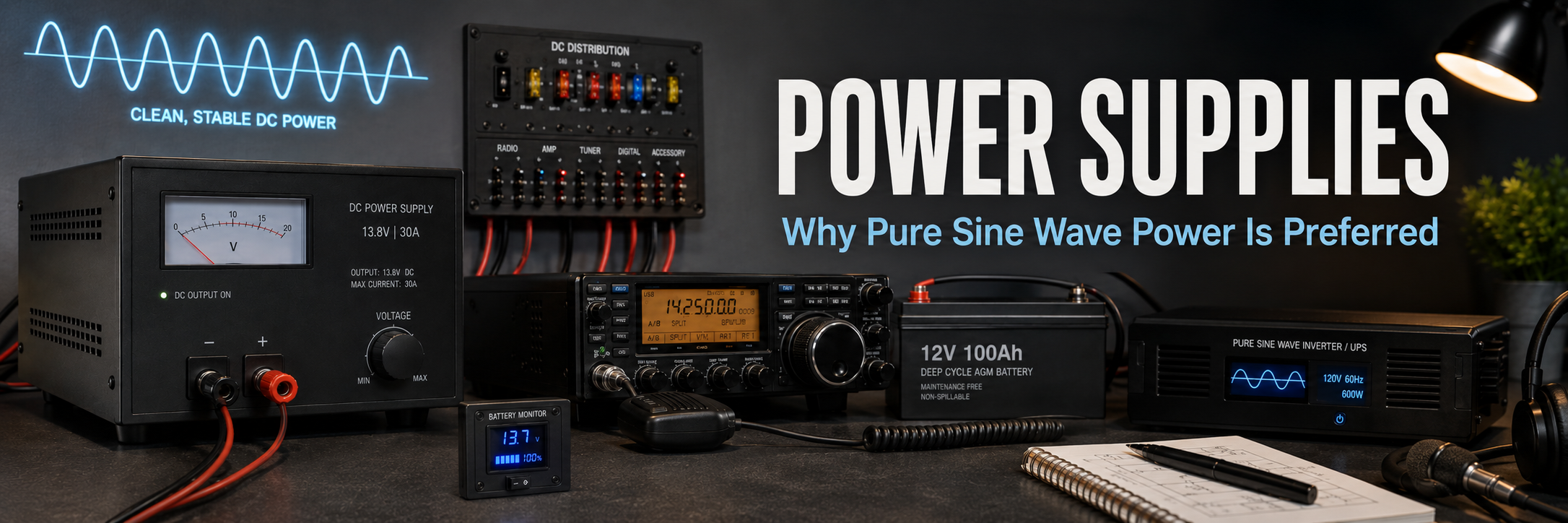
Power Supplies in Amateur Radio: Why Clean, Stable Power Matters and Why Pure Sine Wave Power Is Preferred
Introduction
A radio station is only as dependable as the power system behind it. Many amateur radio operators spend considerable time choosing transceivers, antennas, coaxial cable, microphones, tuners, and digital interfaces, but the power supply is often treated as an afterthought. That is a mistake.
A poor power supply can introduce noise into the receiver, cause unstable transmitter output, create hum or distortion in the transmitted audio, interfere with digital modes, damage equipment, or fail during emergency operation. A good power supply provides clean, stable, properly regulated power that allows the radio equipment to perform as designed.
In amateur radio, power quality is not a luxury. It is part of station performance.
When operators discuss a “sine wave power supply,” they are usually referring to a pure sine wave AC power source, such as an inverter, UPS, or generator output, that is used to power the station’s DC power supply. Most amateur radio transceivers do not run directly on household AC power. They typically require 13.8 volts DC. However, when that DC supply is powered from backup AC equipment, the quality of the AC waveform becomes very important.
A pure sine wave power source is preferred because it more closely matches normal utility power and is much friendlier to radio power supplies, battery chargers, computers, tuners, monitors, and other station accessories.
What a Power Supply Actually Does
Most modern amateur radio equipment, especially VHF/UHF mobile radios and many HF transceivers, require low-voltage DC power. A common standard is approximately 13.8 volts DC, which represents the voltage of a typical fully charged automotive electrical system while the vehicle alternator is operating.
A power supply takes incoming power and converts it into the voltage and current required by the radio.
For a home station, that usually means:
120 volts AC input
from household power, generator, inverter, or UPS
converted to:
13.8 volts DC output
for the transceiver and station equipment
The power supply must do more than simply reduce voltage. It must also regulate voltage, provide sufficient current, filter unwanted noise, protect equipment from faults, and maintain stability under changing transmit and receive loads.
When a radio is receiving, current demand may be low. When the operator transmits, current demand rises sharply. A good power supply must handle that sudden load without sagging, oscillating, producing noise, or shutting down.
Why Amateur Radios Commonly Use 13.8 Volts DC
Many amateur radio transceivers are designed around mobile operation. Since a vehicle electrical system is nominally 12 volts but often operates around 13.8 to 14.4 volts when charging, manufacturers commonly design radios for 13.8 volts DC operation.
This makes the same radio usable in:
- A vehicle
- A home station
- A portable field station
- An emergency communications setup
- A battery-powered go-kit
- A solar-charged station
- A generator-backed station
This flexibility is one of the strengths of amateur radio equipment. However, it also places responsibility on the operator to provide the correct power source.
Supplying the wrong voltage, insufficient current, or noisy power can create serious operating problems.
Voltage Regulation: Keeping the Radio Stable
Voltage regulation is one of the most important functions of a power supply. The radio expects a stable voltage. If the voltage drops too low during transmit, the radio may reduce power, distort audio, shut down, or behave unpredictably.
A properly regulated power supply maintains the correct output voltage as current demand changes.
For example, an HF transceiver may draw only a small amount of current while receiving. When transmitting at full power, it may suddenly require 20 amps or more. A VHF/UHF mobile radio may draw 10 to 15 amps on high power. A station with accessories may draw even more.
If the power supply cannot respond properly, the voltage may sag.
Voltage sag can cause:
- Reduced transmitter output power
- Distorted transmitted audio
- Digital mode instability
- Radio resets
- Display dimming
- Relay chatter
- Computer interface problems
- Data errors
- Overheating
- General station unreliability
A stable power supply keeps the station predictable.
Current Capacity: Amps Matter
A power supply must provide enough current for the equipment connected to it. Current is measured in amperes, or amps.
A common mistake is buying a power supply that barely meets the radio’s published current requirement. A better practice is to choose a supply with a comfortable safety margin.
For example:
| Equipment Type | Typical Current Requirement |
|---|---|
| Handheld radio charger | Less than 2 amps |
| VHF/UHF mobile radio, medium power | 5–10 amps |
| VHF/UHF mobile radio, high power | 10–15 amps |
| 100-watt HF transceiver | 20–25 amps |
| HF radio plus accessories | 25–35 amps or more |
| Larger station with multiple devices | 40 amps or more |
A 100-watt HF transceiver should usually be powered by a supply rated around 25 to 30 amps continuous duty. If accessories are added, more capacity may be required.
The key rating is continuous current, not just peak or surge current. Some supplies advertise impressive peak numbers but cannot deliver that current continuously without overheating or shutting down.
For serious amateur radio use, continuous-duty capability matters.
Linear Power Supplies
A linear power supply uses a transformer, rectifier, filter capacitors, and regulation circuitry to produce DC output. Linear supplies have been used in radio stations for many years and are valued for their electrical quietness.
Advantages of linear power supplies include:
- Very low RF noise
- Smooth DC output
- Excellent compatibility with sensitive receivers
- Simple operating behavior
- Good isolation from AC line noise
- Long service life when well built
Disadvantages include:
- Large size
- Heavy weight
- Heat generation
- Lower efficiency
- Higher shipping cost
- Often higher cost for high-current models
A quality linear supply can be excellent for a fixed base station, especially where receiver noise is a major concern. Many experienced operators still prefer linear supplies because they are quiet and predictable.
However, a linear supply can be bulky. A high-current linear supply for an HF station may be quite heavy because of the transformer.
Switching Power Supplies
A switching power supply, often called a switch-mode supply, converts power using high-frequency switching circuits. These supplies are common today because they are compact, lightweight, efficient, and relatively affordable.
Advantages of switching supplies include:
- Small size
- Light weight
- High efficiency
- Less heat
- Lower cost per amp
- Easier portability
- Good performance when properly designed
Disadvantages include:
- Potential RF noise
- Possible birdies or hash in the receiver
- Greater dependence on filtering and shielding quality
- Some models are poorly suited for radio use
Not all switching supplies are bad. Many modern switching supplies are specifically designed for communications use and perform very well. The problem is that cheap, poorly filtered switching supplies can generate noise across HF, VHF, or UHF bands.
For amateur radio, the issue is not whether a supply is linear or switching. The issue is whether it is clean, stable, properly filtered, and designed for radio service.
Noise: The Hidden Enemy
Noise from a power supply can enter the station in several ways. It may travel through the DC power cable, radiate from the power supply itself, enter through the AC line, or couple into nearby audio, USB, antenna, or control cables.
Power supply noise may sound like:
- Buzzing
- Hash
- Whining
- Clicking
- Birdies
- Digital tones
- Raised noise floor
- Interference that changes with load
- Interference that appears only when the supply is connected
For HF operation, power supply noise can be especially damaging. A receiver trying to hear weak signals cannot perform well if the local power system is creating interference. On VHF and UHF, noise can also reduce weak-signal reception, interfere with data modes, or affect repeaters and digital systems.
A quiet receiver begins with a quiet station power system.
What “Pure Sine Wave” Means
The term “sine wave” refers to the shape of normal AC power. Utility power is designed to approximate a smooth sine wave. Many electrical devices are built with the expectation that AC input will be a clean, smooth waveform.
A pure sine wave inverter produces AC power that closely resembles utility power.
A modified sine wave inverter produces a stepped or blocky approximation of AC power.
A square wave inverter produces an even rougher waveform and is usually not appropriate for sensitive electronics.
This distinction matters because many radio stations use backup power systems. During field operation, emergency communication, portable operation, or power outages, the station may be powered from batteries through an inverter, a generator, a UPS, or solar equipment.
If that AC source is poor quality, everything connected to it may suffer.
Why Pure Sine Wave Power Is Preferred
Pure sine wave power is preferred because it is cleaner, smoother, and more compatible with sensitive electronics.
Amateur radio stations often include:
- HF transceivers
- VHF/UHF mobile radios
- DC power supplies
- Battery chargers
- Computers
- Digital mode interfaces
- External monitors
- Antenna tuners
- Rotator controllers
- Audio equipment
- Network equipment
- USB hubs
- SDR receivers
- Test equipment
These devices generally operate best when powered from clean AC or clean DC. A pure sine wave inverter or UPS reduces stress on the equipment and helps prevent unwanted electrical noise.
Modified sine wave power may work with some devices, but it can cause problems.
Possible problems from modified sine wave power include:
- Increased RF noise
- Power supply heating
- Transformer buzzing
- Poor battery charger performance
- Audio hum
- Computer power supply stress
- Reduced efficiency
- Unstable operation
- Higher current draw
- Interference in receivers
- Shortened equipment life
For emergency communications, the goal is not merely to make equipment turn on. The goal is to make the station operate reliably, cleanly, and without creating interference.
That is why pure sine wave backup power is strongly preferred.
Important Clarification: Radios Need DC, Not AC Sine Wave
It is important to be technically accurate. Most amateur radios do not directly use sine wave power. They require DC power.
The sine wave issue applies to the AC power source feeding the station power supply, charger, UPS, or inverter-connected equipment.
A typical chain may look like this:
Battery bank → pure sine wave inverter → 120V AC → 13.8V DC power supply → radio
Or:
Generator → pure sine wave AC output → 13.8V DC power supply → radio
Or:
Utility power → UPS → 13.8V DC power supply → radio
In each case, the radio ultimately wants clean DC. The pure sine wave source helps the power supply and other AC-powered equipment operate properly.
In many cases, an even better emergency setup is to avoid unnecessary AC conversion and power the radio directly from a properly protected 12-volt battery system. However, when AC is required for computers, chargers, monitors, or other accessories, pure sine wave equipment is preferred.
Modified Sine Wave vs. Pure Sine Wave
A modified sine wave inverter may be acceptable for simple loads such as some lights or basic appliances. However, it is not the best choice for a radio station.
| Feature | Modified Sine Wave | Pure Sine Wave |
| Waveform quality | Stepped or rough | Smooth and utility-like |
| RF noise risk | Higher | Lower |
| Equipment compatibility | Mixed | Excellent |
| Battery charger behavior | Can be poor | Usually normal |
| Transformer heating | More likely | Less likely |
| Audio hum | More likely | Less likely |
| Computer compatibility | Variable | Better |
| Radio station suitability | Not preferred | Preferred |
| Emergency communications reliability | Lower | Higher |
A modified sine wave inverter may seem attractive because it is cheaper. But if it causes receiver noise, charger problems, overheating, or interference, the savings disappear quickly.
For amateur radio use, especially emergency communications, a pure sine wave inverter is the better investment.
Power Supply Ripple
Ripple is unwanted AC variation that remains on the DC output of a power supply. Ideally, DC should be smooth and steady. In reality, a poorly filtered supply may allow ripple to ride on the DC output.
Ripple can cause:
- Hum in transmitted audio
- Receiver noise
- Digital mode problems
- Poor regulation
- Reduced performance
- Stress on equipment
A good power supply has proper filtering to reduce ripple to a very low level. This is one reason why communications-grade supplies are preferred over generic low-cost supplies.
The radio should receive clean DC, not DC with unwanted AC riding on it.
Voltage Adjustment and Metering
Many amateur radio power supplies provide adjustable voltage and built-in meters. These features are useful, but they must be used correctly.
A supply used for most amateur radio transceivers should normally be set close to 13.8 volts DC, unless the equipment manual specifies otherwise.
Useful front-panel features include:
- Voltage meter
- Current meter
- Adjustable voltage
- Over-voltage protection
- Current limiting
- Power switch
- Anderson Powerpole connectors
- Binding posts
- Cooling fan
- Noise offset control on some switching supplies
A current meter is especially useful because it allows the operator to see how much current the station is actually drawing during receive and transmit. This can help identify problems such as poor coax, high SWR, transmitter foldback, excessive accessory load, or failing equipment.
Protection Features to Look For
A good power supply should protect both itself and the connected equipment.
Important protection features include:
- Over-voltage protection
- Over-current protection
- Short-circuit protection
- Thermal shutdown
- Current limiting
- Reverse polarity protection where applicable
- Proper fusing
- Surge protection
- Grounding terminal
- Fan cooling or adequate heat sinking
Over-voltage protection is especially important. A failed supply that sends excessive voltage to a radio can cause expensive damage.
Do not trust valuable radio equipment to an unknown, poorly protected supply.
Connectors and Cabling
The power supply is only part of the system. Power cables, connectors, and fusing matter.
Poor power cabling can cause voltage drop, heating, intermittent operation, and station failures.
Good practices include:
- Use proper wire gauge for the current
- Keep DC cable runs reasonably short
- Use properly crimped or soldered connectors
- Use fuses near the power source
- Avoid loose binding posts
- Use Anderson Powerpole connectors where appropriate
- Label cables clearly
- Avoid overloading one output terminal
- Inspect cables regularly
A 30-amp power supply does not help if the radio is connected through undersized wire or poor connectors.
Why Powerpole Connectors Are Common
Anderson Powerpole connectors are widely used in amateur radio, especially for emergency communications and portable stations. They provide a standardized DC power connection and allow equipment to be connected quickly and safely.
Advantages include:
- Standardized polarity when assembled correctly
- Quick connection and disconnection
- Good current capacity when properly sized
- Easy field replacement
- Compatibility with many emergency communications groups
- Convenient distribution panels
Powerpole connectors are not magic. They must still be properly crimped, assembled, and fused. But they are very useful for organizing a clean radio power system.
Power Distribution in the Station
A station may include more than one DC-powered device. Instead of stacking multiple wires on the power supply terminals, it is often better to use a fused DC distribution panel.
A DC distribution panel allows power to be routed safely to:
- HF transceiver
- VHF/UHF transceiver
- Tuner
- Audio interface
- SDR receiver
- Packet TNC
- External speaker amplifier
- LED lighting
- Network equipment
- Battery charger controller
- Accessory equipment
Each circuit should be fused appropriately. This protects the wiring and equipment if a fault occurs.
A clean power distribution system improves reliability and makes troubleshooting easier.
Backup Power: Batteries, Inverters, UPS Units, and Generators
A serious amateur radio station should have backup power. Local communications are often most valuable when commercial power fails.
Common backup power options include:
Battery Backup
A 12-volt battery can power many radios directly. This is often the most efficient backup method because it avoids converting DC to AC and then back to DC.
Battery options include:
- AGM lead-acid batteries
- Deep-cycle marine batteries
- LiFePO4 batteries
- Portable power stations
- Vehicle battery systems
- Solar-charged battery banks
For radio use, LiFePO4 batteries are increasingly popular because they are lightweight, have good usable capacity, hold voltage well, and provide many charge cycles.
Inverters
An inverter converts DC battery power into AC power. If an inverter is used in a radio station, a pure sine wave inverter is strongly preferred.
Use an inverter when you need to power AC equipment such as:
- Computer monitors
- Laptop chargers
- Desktop computers
- AC-only power supplies
- Printers
- Networking equipment
- Some battery chargers
Avoid using an inverter unnecessarily if the radio can be powered directly from DC.
UPS Units
A UPS can keep station equipment running during short power interruptions. However, not all UPS units produce pure sine wave output. Some lower-cost units produce stepped approximations.
For radio stations and sensitive electronics, a pure sine wave UPS is preferred.
Generators
A generator can run station power supplies and recharge batteries. Inverter generators often produce cleaner power than older conventional generators, but the actual quality depends on the model and design.
When using a generator, consider:
- Voltage stability
- Frequency stability
- Noise level
- Fuel storage
- Grounding
- Carbon monoxide safety
- RF noise
- Distance from antennas and operating position
A generator should be tested with the radio station before an emergency.
Direct DC Operation vs. AC Inverter Operation
Whenever practical, direct DC operation is usually more efficient for radios.
For example:
Battery → radio
is usually more efficient than:
Battery → inverter → AC power supply → radio
Every conversion wastes energy. In emergency operation, wasted energy means shorter battery life.
However, AC power may still be required for computers, chargers, lights, monitors, routers, or other support equipment. When AC power is required, pure sine wave AC is the preferred choice.
The best emergency station often uses both:
- Direct DC for radios
- Pure sine wave AC for accessories that require AC
This gives efficiency and compatibility.
Power Supply Noise Testing
Every amateur operator should know how to test whether a power supply is adding noise to the station.
A simple test can be performed:
- Connect the radio to the normal power supply.
- Tune to a quiet frequency with no signal.
- Listen carefully to the noise floor.
- Switch to battery power.
- Compare the receiver noise.
- Turn accessories on and off one at a time.
- Move cables and observe any changes.
- Check multiple bands.
If the noise drops significantly on battery power, the power supply or AC system may be contributing interference.
A more advanced test may include using an SDR spectrum display, oscilloscope, clamp-on ferrites, and dummy load testing.
The key point is that station noise should be measured, not guessed.
Ferrites, Filtering, and Noise Reduction
If a power supply produces some noise, it may sometimes be reduced with proper filtering and station layout.
Useful steps include:
- Use ferrite chokes on DC output leads
- Use ferrites on AC input leads
- Keep power supplies away from receivers
- Separate power cables from antenna feedlines
- Use proper grounding
- Use short DC cables
- Avoid cable loops
- Use quality coax and connectors
- Bond station equipment properly
- Replace noisy supplies when necessary
Filtering can help, but it should not be used as an excuse to keep a badly designed power supply in service. A quiet supply is always better than trying to fix a noisy one after the fact.
Choosing a Power Supply for an HF Station
A typical 100-watt HF transceiver often requires around 20 to 25 amps at full transmit power. A 30-amp continuous-duty power supply is usually a practical minimum.
Important HF power supply features include:
- 13.8 volt DC output
- 25 to 35 amps continuous duty
- Low ripple
- Low RF noise
- Strong regulation
- Over-voltage protection
- Quiet cooling fan
- Good metering
- Proper connectors
- Reliable brand support
HF receivers are sensitive to noise, so the power supply should be evaluated carefully. A supply that is acceptable for VHF FM operation may be too noisy for weak-signal HF work.
Choosing a Power Supply for VHF/UHF Base Stations
A VHF/UHF mobile radio used as a base station may draw 10 to 15 amps on transmit. A 20-amp supply may work for one radio, but a 25- to 30-amp supply gives better margin.
Important VHF/UHF power supply features include:
- Adequate current capacity
- Stable voltage under transmit load
- Low RF noise
- Good cooling
- External speaker and radio accessory support
- Clean wiring
- Fused output or fused distribution panel
For a base station with both HF and VHF/UHF equipment, it may be better to use a larger supply or separate supplies to prevent one radio’s transmit load from affecting another device.
Choosing a Power Supply for Emergency Communications
Emergency communications places special demands on power systems. Equipment must be simple, rugged, and predictable.
Emergency station power should include:
- Primary AC power supply
- Battery backup
- Charging system
- Proper fusing
- DC distribution
- Spare power cables
- Anderson Powerpole compatibility
- Pure sine wave inverter if AC is needed
- Solar charging if appropriate
- Generator charging plan
- Printed power diagram
- Load test schedule
The station should be tested under realistic conditions. A power system that has never been tested under transmit load is not ready for emergency use.
The Importance of Duty Cycle
Duty cycle refers to how much time a radio or power supply spends transmitting compared with receiving.
Casual voice operation may have a low duty cycle. Digital modes, packet, net control operation, cross-band repeat, or emergency traffic handling may create heavier duty cycles.
A power supply used for high-duty service should have:
- Continuous current rating
- Good cooling
- Thermal protection
- Conservative loading
- Ventilation space
- Reliable fan operation
Do not place a power supply in a closed cabinet or stack equipment on top of it without airflow. Heat shortens component life.
What to Avoid When Buying a Power Supply
Avoid power supplies with unknown specifications, exaggerated current ratings, poor reviews from radio operators, no protection features, or obvious construction weaknesses.
Be cautious of:
- Very cheap switching supplies
- Supplies with no continuous current rating
- Poorly filtered supplies
- Supplies with loud or failing fans
- Units with unstable voltage
- Supplies intended only for LED lighting
- No-name imports with questionable protection
- Modified sine wave inverters for radio stations
- Undersized UPS units
- Poorly regulated generators
A radio station does not need the most expensive power supply available, but it does need one that is electrically clean and properly rated.
Practical Buying Checklist
When choosing a radio power supply, look for the following:
| Feature | Why It Matters |
| 13.8V DC output | Matches most mobile and base radio requirements |
| Adequate continuous current rating | Prevents voltage sag and overheating |
| Low ripple | Reduces hum and instability |
| Low RF noise | Protects receiver performance |
| Good voltage regulation | Keeps radio stable under transmit load |
| Over-voltage protection | Helps protect expensive equipment |
| Over-current protection | Protects supply and wiring |
| Thermal protection | Prevents heat-related failure |
| Quality connectors | Improves reliability |
| Voltage/current meters | Helps monitor station behavior |
| Quiet fan or good heat sinking | Better for operating comfort |
| Communications-grade design | More suitable for radio use |
| Pure sine wave AC source if using backup AC | Reduces noise and equipment stress |
Recommended Power Strategy for a Reliable Station
A strong amateur radio power system should be designed as a complete system, not as a collection of random cables and adapters.
A practical station power plan might include:
- A quality 13.8V DC communications power supply.
- A fused DC distribution panel.
- Proper wire gauge and connectors.
- Battery backup for radios.
- Pure sine wave inverter for AC accessories.
- Solar or generator charging if needed.
- Ferrite filtering where appropriate.
- Printed wiring diagram.
- Regular load testing.
- Spare fuses, cables, and connectors.
This approach gives the operator a station that is clean, organized, and dependable.
Why Clean Power Improves Radio Performance
Clean power improves station performance in several ways.
It helps the receiver hear weak signals without added local noise. It allows the transmitter to produce stable RF output. It reduces the risk of hum, distortion, or digital errors. It helps computers and interfaces operate correctly. It protects equipment from voltage problems. It improves emergency readiness.
A strong power system does not make a poor antenna into a good antenna, but a poor power system can make a good radio station perform badly.
The radio, antenna, coax, grounding, and power system must work together.
Final Thoughts
The power supply is one of the most important components in an amateur radio station. It provides the electrical foundation for every contact, net, digital session, emergency message, and field operation.
A good power supply should provide clean, stable, properly regulated DC power with enough current capacity for the station. It should be quiet, protected, well cooled, and properly connected.
When backup AC power is used, a pure sine wave inverter, UPS, or generator output is preferred because it is cleaner, more compatible with sensitive electronics, and less likely to create RF noise or equipment stress. Modified sine wave power may be acceptable for simple loads, but it is not the best choice for serious radio operation.
For amateur radio, power quality matters. A clean power system lowers the noise floor, improves reliability, protects equipment, and gives the operator confidence that the station will work when needed.
In emergency communications, that confidence is not optional. It is part of being prepared.