
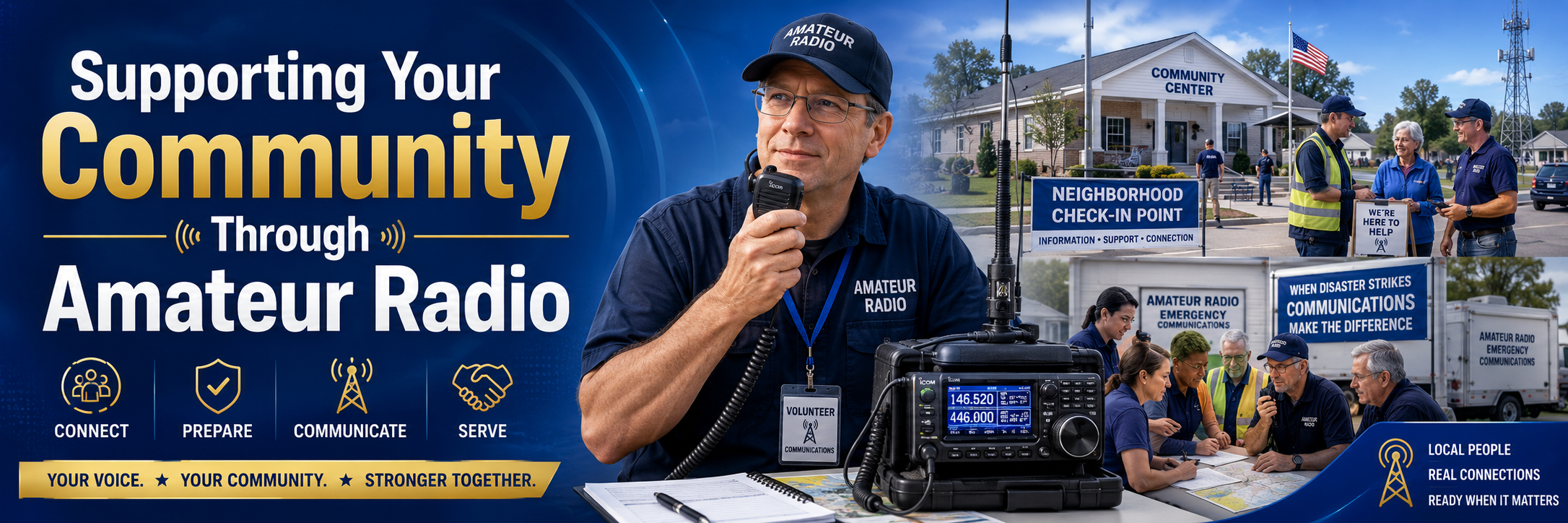
Supporting Your Community Through Amateur Radio
Introduction
Amateur radio is often described as a hobby, but its value extends far beyond personal conversation, technical experimentation, and recreational operating. In communities throughout the world, licensed amateur radio operators provide communications support during emergencies, public events, severe weather, infrastructure failures, and other situations in which dependable information must move between people and locations.
When telephone systems, cellular networks, internet services, and commercial radio systems are functioning normally, amateur radio may appear unnecessary. During a widespread outage or disaster, however, those systems may become overloaded, lose power, suffer physical damage, or become inaccessible to the people who need them.
Amateur radio can help bridge those gaps.
A trained operator with suitable equipment can establish communications from a residence, shelter, neighborhood, hospital, emergency operations center, mobile unit, or temporary field location. The operator may not replace public-safety communications, but can provide an additional pathway for authorized information when ordinary methods are unavailable.
Supporting a community through amateur radio begins long before an emergency. It requires preparation, training, relationships, discipline, and a genuine commitment to service.
Amateur Radio as a Community Resource
The greatest strength of amateur radio is not any single radio, antenna, repeater, or frequency. Its greatest strength is a distributed network of trained people who can adapt their equipment and operating methods to changing conditions.
Amateur stations can operate from homes, vehicles, temporary shelters, portable field locations, emergency coordination centers, and battery-powered communication kits. Operators can communicate across a neighborhood, throughout a county, across a state, or over much greater distances, depending on the frequencies, equipment, antennas, propagation conditions, and operating modes being used.
This flexibility allows amateur radio to support many community needs, including:
- Backup communications during telephone or internet outages
- Health-and-welfare reporting
- Shelter and evacuation coordination
- Neighborhood status reporting
- Hospital and medical-facility support
- Resource and supply requests
- Weather observation and reporting
- Damage-assessment communications
- Public-event safety coordination
- Volunteer and transportation coordination
- Communication between community leaders
- Relay of formal written messages
- Support for relief and recovery operations
The amateur radio operator’s role is usually not to direct the emergency response. The operator supports the mission of the agency, organization, or community group being served.
Service Begins Before the Emergency
An operator who first appears after a disaster may have good intentions, but emergency organizations need more than untested equipment and an unfamiliar volunteer. They need people who already understand the communications plan, leadership structure, operating procedures, and needs of the organization.
Community service should therefore begin during normal conditions.
Operators can prepare by:
- Joining local emergency communications groups
- Participating in weekly or monthly radio nets
- Attending community preparedness meetings
- Supporting public-service events
- Completing emergency management courses
- Practicing formal message handling
- Testing portable equipment
- Learning local repeater and simplex plans
- Developing relationships with served agencies
- Participating in drills and exercises
Routine participation allows both the operator and the organization to develop confidence in one another.
When an emergency occurs, leaders should not have to wonder whether the operator’s radio works, whether the operator understands net procedures, or whether the person will follow instructions. Those questions should be answered through training and consistent involvement.
Identify the Community You Intend to Serve
An amateur radio operator may have several opportunities for community involvement. Possible organizations include:
- Amateur Radio Emergency Service groups
- Radio Amateur Civil Emergency Service units
- Community Emergency Response Teams
- Local emergency management agencies
- Hospitals and healthcare networks
- Relief and humanitarian organizations
- Faith-based organizations
- Neighborhood preparedness groups
- Schools and educational institutions
- Search-and-rescue support organizations
- Weather observation programs
- Public-service event teams
- Amateur radio clubs
- Local volunteer organizations
The best organization is not necessarily the largest or most visible. It is the one whose mission matches the operator’s abilities, interests, availability, equipment, and willingness to train.
Some operators prefer structured government environments. Others are more comfortable supporting neighborhoods, churches, shelters, public events, or healthcare facilities. Some enjoy field deployment, while others provide greater value from a fixed home station or communications room.
Community service becomes more effective when the operator develops a clear primary commitment rather than trying to serve every organization simultaneously.
Understand the Community’s Actual Needs
Emergency communications planning should begin with the needs of the community, not with the equipment owned by the radio operator.
A community may need reliable communications between:
- Neighborhoods and a central coordination point
- Shelters and emergency management
- Hospitals and supply centers
- Congregations and local leadership
- Mobile teams and fixed facilities
- Damage-assessment teams and an emergency operations center
- Remote areas and public-safety agencies
- Volunteer groups and relief coordinators
The operator should determine what information must be transmitted, how frequently it must be reported, who is authorized to send it, who receives it, and what backup methods are available.
A useful communications plan answers several basic questions:
- Who needs to communicate?
- What information must be exchanged?
- Which communication method will be used first?
- What backup method will be used if the primary system fails?
- Who activates the amateur radio operators?
- Which frequencies or systems will be used?
- Where will operators report?
- How will messages be recorded and tracked?
- Who has authority to release information?
- How will operations be concluded and documented?
Without clear answers, radio activity can create more confusion rather than improving communication.
Develop the Skills That Communities Need
Possessing an amateur radio license is an important first step, but licensing knowledge alone does not make someone an effective emergency communicator.
Community-support operators should develop practical skills in several areas.
Clear Voice Communication
Emergency radio traffic should be clear, brief, accurate, and professional. Operators should speak at a measured pace, use plain language when appropriate, and avoid unnecessary conversation.
A good operator listens before transmitting, identifies the station correctly, and understands the difference between emergency, priority, welfare, and routine traffic.
Net Procedures
Directed nets allow multiple stations to communicate in an organized manner. Operators should understand how to:
- Check into a net
- Call net control
- Request permission to send traffic
- Use tactical call signs
- Relay messages
- Report unavailable stations
- Maintain radio discipline
- Close or transfer a station assignment
Net procedures reduce interference and help important information move efficiently.
Formal Message Handling
During an extended incident, verbal information can be forgotten, misunderstood, or changed. Formal written messages create accountability and allow information to be tracked.
Operators should practice recording:
- The originating station or person
- The destination
- Date and time
- Message priority
- Exact message text
- Delivery status
- Operator identification
- Confirmation or reply information
Messages should be transmitted exactly as written unless an authorized person approves a change.
Logging and Documentation
A communications log may later be used to reconstruct events, confirm assignments, verify message delivery, or improve future planning.
Operators should record significant transmissions, frequency changes, equipment problems, staffing changes, messages received, messages sent, and unusual events.
Accurate documentation is an essential part of professional emergency communications.
Equipment Deployment
Operators should be able to establish a station without improvising every step. This includes understanding:
- Radio programming
- Antenna placement
- Feed-line routing
- Battery connections
- Power requirements
- Grounding and electrical safety
- Headset and microphone setup
- Computer interfaces
- Weather protection
- Cable management
- Equipment transportation
A portable communications kit should be tested before it is needed.
Build a Reliable Community Communications Kit
A useful emergency station does not have to be expensive or complicated. It must be dependable, organized, and appropriate for the assignment.
A basic community-support kit may include:
- VHF/UHF handheld or mobile radio
- Spare battery packs
- External power cable
- Portable battery or power station
- Suitable portable antenna
- Coaxial cable and adapters
- Speaker microphone or headset
- Printed frequency plan
- Contact and activation information
- Message forms
- Log sheets
- Pens and permanent markers
- Clipboard
- Local maps
- Flashlight or headlamp
- Basic tools
- Weather protection
- Personal identification
- Water, food, and necessary medications
An operator supporting high-frequency communications, digital messaging, or extended deployments may require additional equipment.
Every item should have a defined purpose. Equipment should be labeled, protected, and stored so that it can be deployed without searching through unrelated supplies.
Prepare for Power Failure
Emergency communications equipment is only useful while it has power.
Operators should plan for the possibility that commercial electricity may be unavailable for hours or days. Backup options may include:
- Deep-cycle batteries
- Lithium iron phosphate batteries
- Portable power stations
- Solar charging systems
- Vehicle power
- Generators
- Replaceable battery packs
- Reduced-power radio operation
Power planning should include the radio, computer, modem, lighting, charging devices, and any support equipment.
Operators should calculate approximate operating time and test the complete system under realistic conditions. A battery that appears adequate on paper may provide less operating time when powering a radio at high transmit power.
Power conservation is also important. Operators should use only the transmitter power necessary to maintain reliable communication.
Support Neighborhood-Level Communications
Neighborhood communications may be one of the most practical uses of amateur radio.
During a major incident, emergency services may be overwhelmed. Residents may need a method to report urgent medical needs, fires, blocked roads, damaged utilities, missing people, or requests for assistance.
A neighborhood communication system can use several levels of technology:
- Door-to-door checks
- Runners
- Family Radio Service radios
- General Mobile Radio Service radios
- Telephone or text messaging
- Internet applications
- Amateur radio links
Non-licensed residents may use appropriate unlicensed or licensed personal radio services within legal limits. A local amateur radio operator can then provide a longer-range connection between the neighborhood and an outside coordination point.
The amateur operator should not become the neighborhood’s source of rumors or speculation. Reports should be collected in a standardized format and transmitted only when they are useful, verified, and authorized.
Support Public Events
Public-service events provide valuable training while benefiting the community.
Amateur radio operators frequently assist with:
- Marathons
- Bicycle races
- Parades
- Charity walks
- Community festivals
- Preparedness fairs
- Search exercises
- Volunteer projects
- Large public gatherings
Assignments may include reporting participant progress, requesting medical assistance, coordinating transportation, reporting hazards, staffing checkpoints, and supporting event leadership.
These events help operators practice net discipline, portable operation, logging, teamwork, and problem-solving in a controlled environment.
An operator who performs well during routine events is more likely to be trusted during an actual emergency.
Support Hospitals and Care Facilities
Healthcare organizations depend heavily on commercial communications. A widespread outage can interfere with coordination between hospitals, clinics, care centers, supply locations, public health agencies, and emergency management.
Amateur radio may provide a backup communications pathway for operational information such as:
- Facility status
- Staffing needs
- Supply requests
- Transportation coordination
- Power or utility problems
- Evacuation support
- Communication with emergency management
Operators must protect sensitive information. Amateur radio transmissions are generally not private. Personal medical details, protected health information, and other confidential material should not be transmitted unless legally and operationally appropriate.
Messages should be limited to the minimum information required to accomplish the authorized purpose.
Support Faith-Based and Community Organizations
Churches and community organizations often have strong local networks, meeting facilities, welfare resources, volunteers, and leadership structures. These organizations may provide shelters, food, transportation, family support, and recovery assistance.
Amateur radio operators can help connect local leaders, facilities, neighborhoods, and coordination centers when normal communications fail.
Useful traffic may include:
- General welfare status
- Availability of facilities
- Volunteer staffing
- Resource requests
- Transportation needs
- Supply availability
- Coordination between local leaders
Operators must still comply with amateur radio regulations. Amateur frequencies should not be used for routine organizational business, private counseling, financial transactions, or communications that are inappropriate for the amateur service.
A communications plan should clearly identify what may and may not be transmitted.
Communicate Without Creating Confusion
During emergencies, unverified information can spread rapidly. Radio operators must resist the temptation to transmit every rumor, observation, or social-media report they encounter.
Information should be:
- Relevant
- Accurate
- Timely
- Attributed to a source
- Clearly identified as confirmed or unconfirmed
- Sent to the proper destination
Operators should avoid exaggeration, speculation, political commentary, criticism of responders, and unnecessary descriptions.
A disciplined operator does not attempt to become a broadcaster, reporter, or incident commander. The operator provides a reliable communication path.
Follow the Chain of Command
Community service requires cooperation with leadership.
Operators should know:
- Who activates the communications team
- Who assigns operators
- Who supervises each location
- Who serves as net control
- Who approves messages
- Who receives status reports
- Who authorizes demobilization
Self-deployment can create safety hazards and interfere with organized operations. Volunteers should not travel to restricted areas or disaster locations without authorization.
A trained operator reports through the established system, accepts an appropriate assignment, and communicates changes in availability.
Serve With Professionalism and Humility
Emergency communications is not a competition to determine who owns the best radio or knows the most technical information. It is a service.
Professional operators:
- Arrive prepared
- Follow instructions
- Treat others respectfully
- Keep messages accurate
- Maintain confidentiality
- Avoid unnecessary criticism
- Accept correction
- Assist less-experienced operators
- Remain calm
- Put the mission ahead of recognition
The radio operator may be working with frightened residents, exhausted responders, grieving families, or overwhelmed leaders. Patience and empathy are essential.
Technical knowledge without emotional control can make a difficult situation worse. A calm and respectful operator helps create confidence.
Protect Your Family and Household First
An operator cannot provide dependable community service if their own household is unprepared.
Before committing to emergency service, operators should discuss expectations with family members and prepare for communication outages, power loss, evacuation, and extended absences.
Household preparedness may include:
- Emergency water and food
- Necessary medications
- Backup lighting
- Family communication plans
- Evacuation routes
- Emergency contact information
- Pet arrangements
- Backup power
- Transportation plans
- A designated family meeting location
Family members should know when the operator may deploy, how long the assignment could last, and how they will exchange urgent information.
Community service should not create avoidable danger at home.
Train for Failure, Not Only Success
Exercises often assume that repeaters, radios, batteries, and computers will work. Actual emergencies may produce multiple failures at once.
Training should include:
- Repeater failure
- Internet loss
- Telephone outage
- Dead batteries
- Damaged antennas
- Unavailable operators
- Frequency interference
- Severe weather
- Incomplete messages
- Loss of net control
- Shift changes
- Relocation of a station
Operators should practice moving to simplex, changing frequencies, reducing power consumption, using alternate antennas, relaying through another station, and operating without internet-based references.
The purpose of training is to discover weaknesses before lives or community operations depend on the system.
Conduct After-Action Reviews
After every event, exercise, or activation, operators should evaluate what happened.
A useful review addresses:
- What worked well?
- What failed?
- Which messages were delayed?
- Were frequencies effective?
- Was equipment adequate?
- Did batteries last?
- Were assignments clear?
- Did operators understand procedures?
- Were logs complete?
- What training is needed?
- What changes should be made?
The review should improve the system rather than assign personal blame.
Mistakes are valuable when they lead to better procedures, stronger training, and more dependable equipment.
Become a Trusted Community Asset
Trust is built through consistent behavior.
A community organization is more likely to rely on an operator who:
- Attends training
- Participates in nets
- Maintains current contact information
- Keeps equipment operational
- Completes assigned tasks
- Communicates respectfully
- Documents activity
- Arrives when promised
- Reports limitations honestly
- Supports team decisions
An operator does not become valuable merely by holding a license or purchasing equipment. Value comes from readiness, competence, reliability, and service.
Conclusion
Amateur radio provides communities with an adaptable and independent communications resource. Its effectiveness, however, depends on prepared operators who understand that emergency communications is a public service responsibility.
Supporting your community through amateur radio requires more than responding after disaster strikes. It requires building relationships, learning local needs, practicing communication procedures, maintaining reliable equipment, preparing for power failure, supporting established leadership, and serving without seeking personal recognition.
The most effective amateur radio operator is not necessarily the person with the largest station or the most expensive equipment. It is the person who can be trusted to communicate accurately, remain calm, follow the plan, and continue serving when normal systems have failed.
When amateur radio operators combine technical capability with preparation, discipline, and compassion, they become more than hobbyists.
They become dependable community assets.
Key Principle
Amateur radio serves a community best when trained operators prepare in advance, communicate accurately, and place service ahead of recognition.
