
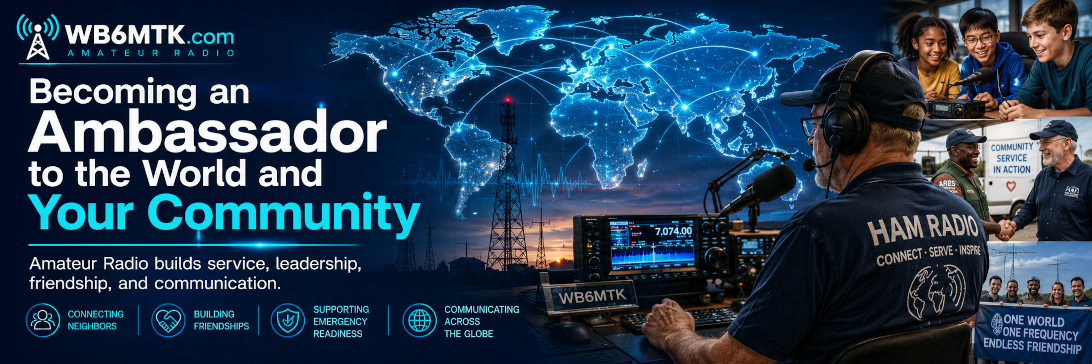
Amateur Radio Operators: Ambassadors to the World
How ham radio builds international goodwill, cultural understanding, emergency service, and human connection across borders
Summary
Amateur radio operators, often called hams, are more than hobbyists using radios to make contacts. At their best, they are informal ambassadors who build goodwill, friendship, understanding, and public service across borders.
Through voice, Morse code, digital modes, satellites, special event stations, DX contacts, emergency communications, and educational programs, amateur radio operators connect people who may never meet in person. A single radio contact can become a small act of cultural exchange. A QSL card can become a personal reminder that people in different nations can communicate with respect and courtesy.
Amateur radio is non-commercial, international, and built on shared operating standards. This makes it uniquely suited for person-to-person communication beyond politics, borders, and commercial platforms.
In simple terms:
Amateur radio turns ordinary licensed operators into global ambassadors through respectful communication, technical skill, public service, and international friendship.
Definition
An amateur radio operator is a licensed individual who uses authorized radio frequencies for non-commercial communication, technical learning, experimentation, public service, and international goodwill.
In the context of global communication, amateur radio operators act as ambassadors when they:
- Communicate respectfully with operators in other countries
- Exchange cultural information
- Promote international friendship
- Support emergency communications
- Mentor new operators
- Participate in international events
- Follow courteous operating practices
- Represent their community and country responsibly on the air
Amateur radio does not require political agreement, commercial purpose, or shared nationality. It requires a license, a station, operating skill, and the willingness to communicate with respect.
1. The Spirit of Amateur Radio
At its core, amateur radio is about communication without borders.
A ham radio operator may use:
- Voice
- Morse code
- Digital modes
- Satellite communication
- Image transmission
- Weak-signal modes
- Emergency nets
- Special event stations
- Shortwave communication
These methods allow licensed operators to reach across cities, states, countries, oceans, and continents.
Unlike commercial communication, amateur radio is not based on advertising, subscriptions, or corporate platforms. Unlike military or government communication, it is not used for official command or state policy. Amateur radio is a voluntary, non-commercial radio service operated by licensed individuals.
This gives amateur radio a special character.
It is technical, but also human.
It is regulated, but also personal.
It is local, but also international.
The amateur radio operator may begin with a call sign, but that call sign becomes a personal identity on the air. It tells others that the operator is part of a worldwide community of communicators.
2. Amateur Radio as Cultural Diplomacy
Every international radio contact is a small form of cultural exchange.
An operator in the United States may speak with an operator in Japan, Germany, Brazil, South Africa, Australia, Canada, or a remote island in the Pacific. The contact may last only a few minutes, but even a brief QSO can share something meaningful.
Operators may exchange:
- Name
- Location
- Signal report
- Weather
- Station equipment
- Antenna type
- Local geography
- Local customs
- Club activity
- Special event information
- Personal greetings
These conversations are often simple, but their value is real. They give each operator a direct human connection to another place.
A person who has spoken directly with people in other countries may understand the world differently than someone who only sees those countries through news headlines or political arguments.
Amateur radio makes the world less abstract.
It turns a distant country into a human voice.
3. DX Contacts and International Friendship
In amateur radio, DX usually refers to long-distance communication, often with stations in other countries.
DX operation is one of the most exciting parts of the hobby because it allows operators to reach across great distances using radio propagation, antennas, timing, and skill.
But DX is not only about distance.
It is also about connection.
A DX contact may be short:
“You are five-nine in Utah. Thank you for the contact. Seventy-three.”
Even that brief exchange can create a small moment of goodwill.
Many operators save QSL cards from other countries. These cards confirm radio contacts, but they also become cultural artifacts. They may show national landmarks, local scenery, call signs, club logos, flags, historical events, or personal station photos.
A wall of QSL cards is more than decoration. It is evidence of peaceful international communication.
4. Special Event Stations and Cultural Recognition
Special event stations are another way amateur radio operators act as ambassadors.
These stations may commemorate:
- Historic events
- National celebrations
- Local festivals
- Military history
- Scientific achievements
- Space missions
- Cultural anniversaries
- Community milestones
- Public-service events
When operators contact a special event station, they often learn something about the event being recognized.
This helps amateur radio promote culture, history, geography, and public memory.
A special event station can turn a local story into an international conversation. Operators in other countries may learn about a town, museum, national park, aviation event, historical anniversary, or emergency service organization they would never otherwise encounter.
In this way, amateur radio becomes an educational bridge.
5. DXpeditions and Remote Places
A DXpedition is an organized amateur radio operation from a rare, remote, or difficult-to-reach location.
DXpeditions often involve significant planning, travel, equipment transport, antenna setup, licensing coordination, safety planning, and operating discipline.
They may operate from:
- Remote islands
- Isolated territories
- Rare countries
- Arctic or Antarctic regions
- Mountain locations
- Special geographic zones
DXpeditions are exciting because they allow operators around the world to contact places that are rarely active on the amateur bands.
But they also have ambassador value.
They introduce the world to remote places, unusual geography, and international cooperation among operators.
A well-run DXpedition demonstrates technical skill, teamwork, courtesy, and respect for both the host location and the global amateur radio community.
6. Neutral Communication During Tense Times
Amateur radio has often provided a neutral person-to-person communication path during periods of international tension.
Even when governments disagree, individual amateur radio operators may still exchange respectful contacts when permitted by law and regulation.
During tense historical periods, including the Cold War era, operators from different political systems sometimes continued to make contacts. These QSOs did not change world policy, but they reminded people that individuals on opposite sides of political divisions could still communicate peacefully.
This is one of amateur radio’s quiet strengths.
It does not require operators to debate politics. In fact, good amateur radio practice generally discourages divisive political arguments on the air.
Instead, operators usually exchange technical information, signal reports, location, weather, and friendly greetings.
That may sound simple.
But in a divided world, simple courtesy can be powerful.
7. Emergency Communications as International Service
Amateur radio also serves humanity through emergency communications.
When normal systems fail, amateur radio operators may provide backup or supplemental communication.
This can happen during:
- Earthquakes
- Hurricanes
- Floods
- Wildfires
- Tsunamis
- Power outages
- Infrastructure failures
- Severe storms
- Search-and-rescue support events
- Public-service emergencies
During major disasters, amateur radio operators may help pass welfare traffic, support shelters, relay situational information, assist relief organizations, and provide communication where infrastructure is damaged or overloaded.
The emergency communications role of amateur radio is not limited to one nation. Around the world, amateur operators have supported disaster communications as volunteers.
This public-service tradition strengthens amateur radio’s ambassador role because it shows that radio communication can serve people beyond borders, language, and politics.
8. The Role of the International Amateur Radio Union
The International Amateur Radio Union, commonly called IARU, represents amateur radio interests internationally and helps coordinate amateur radio activity across national societies and regions.
The IARU supports:
- Amateur radio spectrum protection
- International cooperation
- Emergency communications coordination
- Operating standards
- Regional coordination
- Representation before international telecommunications bodies
This matters because amateur radio depends on shared spectrum and international coordination.
The amateur radio operator on the air may be an individual, but the service itself is part of a worldwide communications community.
International cooperation protects that community.
9. Education and Mentorship
Amateur radio operators also serve as ambassadors to the next generation.
Many hams mentor young people, new operators, students, and technically curious adults.
They teach:
- Electronics
- Antennas
- Propagation
- Radio safety
- Morse code
- Digital communication
- Emergency communication
- Soldering
- Station setup
- Operating procedure
- Public-service values
Programs and activities such as school radio clubs, youth nets, licensing classes, radio merit badge work, and amateur radio demonstrations introduce students to technical communication in a hands-on way.
One of the most powerful educational examples is ARISS, Amateur Radio on the International Space Station. Through ARISS contacts, students can speak with astronauts using amateur radio equipment.
That experience can inspire interest in:
- Science
- Technology
- Engineering
- Mathematics
- Space communication
- Amateur radio
- Public service
- Global citizenship
A good Elmer is more than a teacher. A good Elmer is an ambassador to the future of amateur radio.
10. A Shared Radio Language
Amateur radio operators use a shared operating language that helps communication across cultures.
This includes:
- Call signs
- Q-codes
- Signal reports
- Phonetic alphabet
- UTC time
- Frequency discipline
- QSL procedures
- Common abbreviations
- Standard operating etiquette
Even when operators do not share the same native language, they can often complete a meaningful radio contact because amateur radio has a common structure.
For example, operators can exchange:
- Call sign
- Signal report
- Name
- Location
- Grid square
- Equipment
- Antenna
- QSL information
This shared language creates a sense of worldwide radio culture.
It is one reason amateur radio can feel like a global brotherhood and sisterhood of operators.
11. Courtesy as an Ambassador Skill
A radio operator represents more than a personal station.
On the air, an operator may also represent:
- A call sign
- A community
- A local radio club
- A region
- A country
- The amateur radio service itself
Courtesy matters.
Good ambassador operating includes:
- Listening before transmitting
- Identifying properly
- Using respectful language
- Avoiding unnecessary conflict
- Being patient with accents and language differences
- Helping new operators
- Following band plans
- Avoiding deliberate interference
- Keeping contacts friendly
- Respecting cultural differences
- Avoiding political arguments
- Practicing good radio manners
An operator does not need to be a diplomat to practice diplomacy.
Every courteous QSO strengthens the reputation of amateur radio.
12. QSL Cards: Paper Bridges Across the World
A QSL card confirms a radio contact between stations.
In the digital age, electronic confirmations are common, but paper QSL cards still have special value.
A QSL card may show:
- A station photo
- A national landmark
- A local landscape
- A cultural symbol
- A club logo
- A special event image
- A personal message
- Contact details
- Operator information
For many hams, receiving a QSL card from another country is one of the great pleasures of amateur radio.
A card from across the world is more than proof of contact.
It is a physical reminder that two people, separated by distance, successfully communicated through radio.
That is why QSL cards remain part of amateur radio’s ambassador tradition.
13. Amateur Radio in a Digital World
Today, people can communicate instantly through smartphones, video calls, email, messaging apps, and social media.
So why does amateur radio still matter?
It matters because amateur radio is different.
Social media often depends on algorithms, platforms, advertising, and commercial control. Amateur radio depends on operators, antennas, propagation, skill, and shared spectrum.
Digital platforms can connect people, but they can also isolate them into groups, arguments, and artificial feeds.
Amateur radio is direct.
A signal leaves one station and reaches another.
The operator hears another person, copies another call sign, and participates in a communication tradition that is technical, personal, and international.
That kind of connection still matters.
14. Practical Example: A Simple International QSO
A simple international contact might sound like this:
“CQ DX, CQ DX, this is Whiskey Bravo Six Mike Tango Kilo, WB6MTK, calling CQ DX and standing by.”
A distant station replies.
The operators exchange:
- Call signs
- Signal reports
- Names
- Locations
- Weather
- Equipment
- Antennas
- Thank-you and 73
The contact may last only two minutes.
But in those two minutes, two operators have created a peaceful international exchange using radio waves, skill, and courtesy.
That is the ambassador role in its simplest form.
15. Practical Example: Special Event Ambassador Station
A radio club may operate a special event station for a historical anniversary in its community.
Operators call CQ and explain the event to stations around the world.
A station in another country contacts the special event station and learns about the event, the town, and the reason for the commemoration.
The club may send a special QSL card or certificate.
This simple activity helps preserve history, promote community identity, and share culture internationally.
Amateur radio becomes both communication and education.
16. Best Practices for Radio Ambassadors
Operators who want to represent amateur radio well should practice disciplined and respectful communication.
Recommended practices include:
- Listen before transmitting
- Use your call sign properly
- Speak clearly and calmly
- Use standard phonetics when needed
- Be patient with language differences
- Avoid political arguments on the air
- Respect other countries and cultures
- Keep DX contacts efficient during pileups
- Send QSL cards or electronic confirmations when possible
- Help new operators learn good manners
- Support public-service communication
- Participate in international events respectfully
- Learn basic geography and world regions
- Keep emergency communication professional
- Remember that your signal represents you
A good amateur radio ambassador is not loud, arrogant, or careless.
A good ambassador is clear, courteous, helpful, and reliable.
Conclusion
Amateur radio operators are ambassadors to the world because they build bridges through direct human communication.
They connect across nations, cultures, languages, disasters, and distances. They promote friendship through DX contacts, cultural recognition through special event stations, technical learning through mentorship, public service through emergency communications, and global cooperation through shared radio practice.
In a world where digital platforms often divide people into isolated groups, amateur radio remains a direct and personal form of connection.
A call sign, a radio, an antenna, and a respectful voice can still reach across the world.
The contact may begin with signal reports and station information, but it can leave behind something greater: goodwill.
Amateur radio is not only about making contacts.
It is about making connections.
Frequently Asked Questions
Why are amateur radio operators called ambassadors to the world?
Amateur radio operators are called ambassadors because they communicate directly with people in other countries, promote goodwill, share culture, support public service, and represent their communities through respectful radio operation.
How does amateur radio promote international friendship?
Amateur radio promotes international friendship by allowing licensed operators from different countries to communicate directly, exchange greetings, share local information, and confirm contacts through QSL cards or electronic logs.
What is a DX contact?
A DX contact is a long-distance radio contact, often with a station in another country. DX contacts are one of the most popular ways amateur radio operators build international connections.
What is a QSL card?
A QSL card is a confirmation card exchanged between amateur radio operators after a contact. It often includes call signs, date, time, frequency, mode, signal report, and station information.
Can amateur radio help during international disasters?
Yes. Amateur radio operators may support emergency communications when normal infrastructure is damaged or unavailable. International and local amateur radio organizations may help coordinate disaster communication support.
What is the IARU?
The International Amateur Radio Union, or IARU, represents amateur radio internationally and helps coordinate amateur radio interests, emergency communication support, and spectrum protection.
How does amateur radio help young people?
Amateur radio helps young people learn electronics, communication, geography, emergency service, STEM subjects, and global awareness. Programs such as school radio clubs and ARISS contacts can inspire technical curiosity.
Do amateur radio operators need to speak the same language?
Not always. Amateur radio uses shared tools such as call signs, signal reports, Q-codes, phonetics, and standard operating procedures that help operators communicate across language barriers.
What makes a good amateur radio ambassador?
A good amateur radio ambassador is courteous, clear, patient, technically responsible, respectful of other cultures, and committed to good operating practice.
Why does amateur radio still matter in the age of the internet?
Amateur radio still matters because it provides direct, skill-based, non-commercial communication that can operate independently of commercial platforms and infrastructure.
References and Further Reading
The following resources are useful references for amateur radio, international goodwill, public service, education, and emergency communications:
- Federal Communications Commission, 47 CFR Part 97 — Amateur Radio Service
- American Radio Relay League, What Is Amateur Radio?
- American Radio Relay League, DX and International Operating Resources
- American Radio Relay League, ARES Field Resources Manual
- International Amateur Radio Union, Emergency Telecommunications and International Amateur Radio Resources
- ARISS, Amateur Radio on the International Space Station
- American Radio Relay League, School Club Roundup Resources
- American Radio Relay League, QSLing and Awards Resources
- FEMA, Community Emergency Response Team Basic Training Materials
- Local amateur radio club education, mentoring, and public-service programs
