
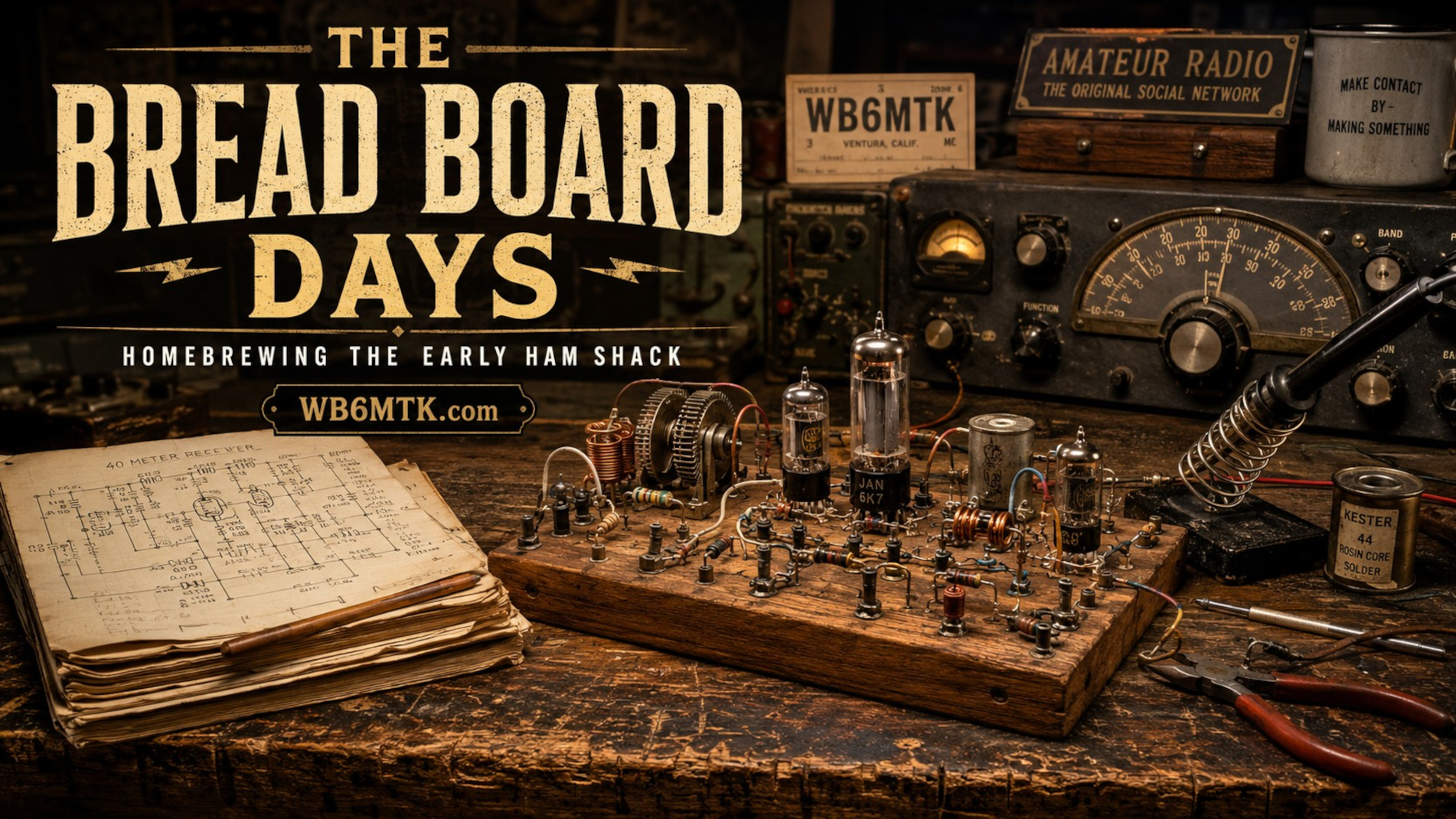
What Happened to the Breadboard Days of Building Your Own Radio Rigs?
Why hands-on radio building still matters in modern amateur radio
|
Author: |
Eric Werny, WB6MTK |
|
Publisher: |
WB6MTK.com |
|
Topic: |
Amateur Radio, Artificial Intelligence, Emergency |
|
Recommended audience: |
Amateur radio operators, emergency communications |
|
Last reviewed: |
May 2026 |
Summary
There was a time when amateur radio was not only about operating a station. It was about building the station.
Many amateur radio operators once built their own transmitters, receivers, power supplies, antenna tuners, keyers, test equipment, accessories, and station improvements. They learned radio by handling components, winding coils, reading schematics, burning fingers with solder, troubleshooting unstable circuits, and discovering why a circuit that looked correct on paper did not always work in real life.
That was the age of the breadboard rig.
Modern amateur radio now includes factory-built transceivers, software-defined radios, digital modes, automatic antenna tuners, waterfall displays, computer logging, and highly capable commercial equipment. These tools are powerful and useful, but they have also weakened one of amateur radio’s most important traditions: the direct connection between the operator and the radio.
The breadboard days are not completely gone. They have changed form. Today, the same spirit can return through kit building, antenna projects, baluns, filters, QRP transmitters, SDR experimentation, Arduino and Raspberry Pi projects, emergency station accessories, and club workshops.
The future of amateur radio should not be only about buying equipment. It should also be about understanding, building, testing, and learning.
Definition
A breadboard radio rig is a homemade radio circuit or station project built in an open, experimental form, often with visible components mounted on a board or simple chassis so the builder can test, modify, and understand the circuit.
In early radio experimentation, the term “breadboard” came from the practice of mounting radio components on wooden boards. Tubes, coils, capacitors, resistors, transformers, terminals, and wires were arranged openly so the builder could see the circuit and make changes easily.
A breadboard rig was not always neat or beautiful, but it was educational. Every wire had a purpose. Every component taught a lesson. Every mistake became part of the operator’s training.
Why the Breadboard Days Matter
The breadboard days matter because they represent one of the most important traditions in amateur radio: learning by building.
Amateur radio has never been only about talking on the air. It has also been about self-training, experimentation, technical improvement, and understanding how communications actually work.
A person who only purchases equipment may become a good operator. But a person who builds, measures, repairs, and modifies equipment often develops a deeper understanding of radio.
Building teaches lessons that operating alone may not teach:
- Why grounding matters
- Why shielding matters
- Why lead length matters
- Why power supply filtering matters
- Why antenna matching matters
- Why RF feedback occurs
- Why oscillators drift
- Why transmitters chirp
- Why receivers overload
- Why a circuit can fail even when the schematic appears correct
The value of breadboarding was not only the finished transmitter or receiver. The value was the operator it created.
1. When the Ham Shack Was Also a Workshop
In earlier decades, many amateur radio stations looked like a combination of communications center, electronics lab, and repair bench.
A typical ham shack might have included:
- Receiver
- Transmitter
- Code key
- Microphone
- Meters
- Soldering iron
- Parts drawers
- Tube manuals
- Hand-drawn schematics
- Half-finished projects
- Coils, capacitors, resistors, and transformers
- Test equipment
- Antenna experiments
The amateur radio operator was not only an operator. He or she was often a builder, troubleshooter, experimenter, and student of radio physics.
A simple CW transmitter might begin with:
- A crystal oscillator
- A tube or transistor final amplifier
- A hand-wound coil
- A variable capacitor
- A power supply
- A simple antenna matching network
A receiver might be a regenerative receiver, a direct-conversion receiver, or a superheterodyne circuit that improved over time as the builder gained experience.
That kind of building produced practical knowledge. Someone who built a transmitter from parts understood radio differently than someone who only selected a band from a menu.
2. Why Homebrewing Was So Common
The breadboard and homebrew era did not exist only because operators were more adventurous. In many cases, building was necessary.
Commercial amateur radio equipment was expensive. Many operators could not afford a complete station. After World War II, surplus military equipment became available, but even that equipment often needed to be modified, repaired, or converted for amateur radio use.
Parts were often easier to obtain than finished equipment. A capable operator could build a workable transmitter or station accessory for far less than the cost of buying one.
Radio publications played an important role.
Magazines and manuals such as:
- QST
- CQ
- 73 Magazine
- ARRL Handbook
- Radio construction manuals
- Tube manuals
- Project books
provided schematics, construction articles, coil-winding instructions, power supply designs, tube data, station projects, and troubleshooting guidance.
These publications did not merely review equipment. They taught operators how radio worked.
Local Elmers also played a major role. A new ham could visit an experienced operator’s shack and see a project under construction. The Elmer might explain why an oscillator was unstable, why the final amplifier was not loading, why the receiver drifted, or why a power supply had hum.
That was amateur radio education at its best: knowledge passed from bench to bench.
3. What Changed?
The decline of breadboard building did not happen all at once. It happened slowly as technology, manufacturing, and operator expectations changed.
Several major changes contributed to the decline.
Commercial Equipment Became Better and More Affordable
Modern commercial amateur radio equipment became reliable, compact, and highly capable.
Factory-built radios offered features such as:
- Multi-band coverage
- Stable VFOs
- Digital frequency displays
- Good filtering
- Clean transmit audio
- Memory channels
- Built-in keyers
- Automatic antenna tuners
- Computer control
- Digital signal processing
- Software-defined features
For many operators, buying a finished radio became easier, safer, and more effective than building one from scratch.
This was not a bad development. Modern radios are remarkable achievements. But convenience changed the culture.
Electronics Became Smaller and Harder to Modify
Early radio circuits used larger components that were easier to see, handle, and replace. Tubes, terminal strips, point-to-point wiring, air-variable capacitors, plug-in coils, and larger resistors made the circuit visible.
Modern electronics use:
- Transistors
- Integrated circuits
- Microprocessors
- Surface-mount components
- Multilayer circuit boards
- Firmware
- Digital signal processing
- Proprietary software
Modern radios are powerful, but they are often difficult for the average operator to repair or modify. The circuit is no longer spread out on a board where every component can be easily observed.
As electronics became smaller, radio became more capable but less transparent.
Experimentation Shifted Toward Software
Experimentation did not disappear from amateur radio. It changed form.
Modern operators now experiment with:
- Software-defined radio
- FT8
- JS8Call
- WSPR
- Digital voice
- APRS
- Mesh networking
- Computer logging
- Remote station control
- Digital audio interfaces
- SDR waterfalls
- Raspberry Pi projects
- Arduino station control
- Emergency communication networks
This is real experimentation, but it is often less visible. Instead of winding coils and drilling chassis, operators configure software, decode signals, build interfaces, write scripts, and integrate radio with computers.
The danger is not software experimentation itself. The danger is when operators use software without understanding the radio principles underneath it.
Expectations Changed
Many modern operators expect equipment to work immediately.
A new radio is expected to be:
- Stable
- Clean
- Compact
- Reliable
- Menu-driven
- Computer-compatible
- Ready to operate out of the box
That expectation is understandable. Operators want to communicate, not spend months troubleshooting a homemade rig.
But convenience can weaken the building culture.
When everything works automatically, fewer operators are forced to ask:
Why does this work?
That question is where real technical learning begins.
4. The Rise of the “Appliance Operator”
Some older operators use the term appliance operator to describe a ham who buys equipment and operates it without understanding how it works.
The term can be unfair when used as an insult. Amateur radio includes many valid interests. Not every operator wants to build transmitters or repair radios.
Some operators focus on:
- Emergency communications
- Public service
- Contesting
- DX
- Digital modes
- Satellites
- Traffic handling
- Antennas
- Mentoring
- Portable operation
- Club service
Those are legitimate parts of amateur radio.
Still, the concern behind the phrase is real.
If amateur radio becomes primarily a consumer activity, where operators only buy equipment and use it with little technical understanding, then part of the service’s foundation erodes.
Amateur radio is not defined only by communication. It is also defined by self-training, experimentation, and technical learning.
A person does not need to design a complete HF transceiver from scratch to be a serious operator. But every operator should have some curiosity about what happens inside the box.
5. Breadboarding Taught More Than Electronics
The breadboard days taught far more than circuit theory.
They taught patience.
A homemade rig did not always work the first time. In fact, it often did not.
The builder might discover:
- The oscillator would not start
- The receiver howled
- The transmitter chirped
- The signal drifted
- The power supply hummed
- The antenna tuner arced
- The final amplifier refused to load
- The keying waveform sounded rough
- The RF output was lower than expected
That was not failure.
That was education.
The builder learned to observe, measure, adjust, and think.
Breadboarding taught that radio is not magic. Radio is physics, design, construction, testing, correction, and patience.
It also taught humility. RF has a way of proving that confidence is not the same thing as competence.
Breadboarding created troubleshooters. It created operators who understood cause and effect. It created people who could solve problems instead of only replacing equipment.
It also created pride.
A contact made with a store-bought radio is enjoyable.
A contact made with a transmitter you built yourself is unforgettable.
6. Can We Bring the Breadboard Spirit Back?
Yes, but probably not in exactly the same form.
Most operators today are not going to build a complete modern HF transceiver from raw parts. Modern radios are too complex for that to become a common entry point.
But the spirit of the breadboard days can return through smaller, useful, achievable projects.
The goal is not to return to the past for nostalgia. The goal is to restore hands-on learning.
The breadboard spirit can return through projects such as:
- Antenna tuners
- Filters
- Baluns
- End-fed matching units
- Audio interfaces
- Power distribution panels
- Dummy loads
- RF samplers
- Field-strength meters
- Test fixtures
- Crystal radios
- Direct-conversion receivers
- QRP transmitters
- Raspberry Pi projects
- Arduino projects
- SDR experiments
- Digital mode interfaces
- Station automation
- Emergency power systems
The specific technology is not the key issue.
The key issue is whether the operator builds, tests, measures, and understands.
7. Practical Beginner Projects That Restore Building Skills
A modern amateur radio operator does not need to begin with a full transceiver. The best starting projects are useful, safe, and achievable.
Build a Dummy Load
A dummy load allows an operator to test a transmitter without radiating a signal through an antenna.
This project teaches:
- RF power handling
- Heat dissipation
- Resistance
- Connectors
- Safe transmitter testing
- Basic measurement
A dummy load is one of the most useful first projects for any station.
Build a Simple Wire Antenna
A basic dipole, end-fed wire, or random wire antenna teaches more than many menu settings on a radio.
This project teaches:
- Resonance
- Frequency and wavelength
- Feed points
- SWR
- Height above ground
- Radiation patterns
- Feed line effects
- Antenna trimming
An operator who builds antennas begins to understand how radio signals actually leave the station.
Build a 1:1 Current Balun
A current balun helps reduce common-mode current and can improve antenna system behavior.
This project teaches:
- Ferrite materials
- Common-mode current
- Balanced and unbalanced systems
- Feed line behavior
- Choking impedance
- Station noise issues
This is one of the best projects for connecting theory to real station performance.
Build a Basic Audio Interface
A simple radio-to-computer audio interface can support digital modes and teach the relationship between radio audio and software.
This project teaches:
- Audio levels
- Isolation
- Ground loops
- Transmit audio quality
- Receive decoding
- Digital mode setup
- Computer-radio integration
This is especially useful for operators using FT8, JS8Call, and other digital modes.
Build a Crystal Radio or Direct-Conversion Receiver
A simple receiver teaches the magic of radio in a way that software alone cannot.
This project teaches:
- Detection
- Tuning
- Resonant circuits
- Audio recovery
- Band activity
- Sensitivity
- Selectivity
- Receiver limitations
Hearing a signal from a receiver you built is one of the most powerful learning moments in radio.
Build a QRP CW Transmitter
A low-power CW transmitter is a classic amateur radio project.
This project teaches:
- Oscillators
- Keying
- RF amplification
- Harmonic filtering
- Output matching
- Signal reports
- Legal operation
- Efficient communication
Making a contact with a homemade QRP transmitter connects the operator directly to the tradition of amateur radio experimentation.
Build an RF Field-Strength Meter
A field-strength meter helps compare antenna performance and detect radiated RF energy.
This project teaches:
- RF detection
- Relative measurement
- Antenna comparison
- Radiation behavior
- Troubleshooting
- Experimentation
It also helps operators see that small station changes can produce measurable differences.
Build a Band-Pass Filter
A band-pass filter can improve receiver performance and reduce unwanted signals.
This project teaches:
- Inductance
- Capacitance
- Resonance
- Selectivity
- Insertion loss
- Receiver overload
- Interference reduction
Filters are excellent projects because they connect component values directly to frequency behavior.
8. What Radio Clubs Can Do
Radio clubs can play a major role in restoring the building culture.
A club does not need to create complex engineering courses. It can begin with simple, practical workshops.
Good club workshop ideas include:
- Soldering basics
- Coax connector installation
- Build a dummy load night
- Build a simple antenna day
- Balun and choke workshop
- Powerpole connector workshop
- Emergency power box build
- Simple receiver demonstration
- QRP kit-building session
- SDR waterfall demonstration
- Test equipment basics
- Troubleshooting night
- Bring-your-project mentoring session
The most important part is not the project itself. The most important part is creating an environment where operators can learn without embarrassment.
An experienced Elmer can make the difference between a new operator quitting and a new operator becoming technically confident.
9. Why Building Still Matters in the Age of SDR and Digital Modes
Some operators may ask why building still matters when modern radios and SDR systems are so advanced.
The answer is simple:
Advanced equipment does not remove the need for understanding.
Modern radios still depend on the same principles:
- Voltage
- Current
- Impedance
- Resonance
- Filtering
- Modulation
- Propagation
- Antenna efficiency
- Signal-to-noise ratio
- Grounding
- Shielding
- Interference control
Software-defined radio changes how signals are processed, but it does not eliminate RF physics.
Digital modes change how information is encoded, but they still depend on antennas, propagation, audio levels, time synchronization, and signal quality.
A modern operator who understands hardware, software, and RF will be far more capable than one who only follows menu instructions.
10. The Real Question
So, whatever happened to the breadboard days of building your own rigs?
They were pushed aside by:
- Convenience
- Commercial equipment
- Miniaturization
- Software
- Surface-mount electronics
- Higher equipment expectations
- Reduced repairability
- Less hands-on mentoring
But they are not gone.
They are waiting on the workbench.
They are in the parts drawer.
They are in the old ARRL Handbook.
They are in the smell of solder smoke.
They are in the first moment a new ham realizes that a radio signal can be created by a handful of parts, a power source, an antenna, and a mind willing to learn.
The breadboard days do not need to remain history.
They can become part of amateur radio’s future again.
Practical Example: A Modern Breadboard Learning Path
A new amateur radio operator who wants to restore the breadboard spirit could follow this path:
- Build or repair a simple wire antenna
- Install coax connectors correctly
- Build a dummy load
- Build a 1:1 choke or current balun
- Build a small power distribution box
- Build a simple audio interface for digital modes
- Build a field-strength meter
- Build a direct-conversion receiver
- Build a QRP CW transmitter
- Make a contact using something personally built
This learning path does not require a full engineering lab. It requires curiosity, patience, basic tools, and a willingness to learn from mistakes.
Each project restores a piece of the old skill set.
Each project gives the operator more confidence.
Each project turns amateur radio from a purchased product back into a personal technical craft.
Best Practices for New Builders
New builders should begin with safe, simple, low-voltage projects before attempting high-power transmitters or power supply work.
Recommended practices include:
- Start with small projects
- Use proven designs
- Read the schematic before building
- Learn resistor and capacitor codes
- Practice soldering on scrap parts
- Use proper ventilation when soldering
- Avoid high voltage until properly trained
- Test each stage as you build
- Keep notes
- Ask experienced operators for help
- Use a dummy load when testing transmitters
- Verify legal operating requirements before transmitting
- Learn basic RF safety
Building should be challenging, but it should also be safe and responsible.
Closing Thought
Amateur radio should never become only a hobby of purchasing equipment.
Buying good equipment is not wrong. Modern radios are remarkable achievements. Factory-built transceivers, SDR receivers, digital modes, and automatic tuners have expanded what amateur operators can do.
But the soul of amateur radio is not found only in the finished product.
It is found in the curiosity that asks:
How does this work?
And in the courage that says:
I think I can build that.
The breadboard days remind us that amateur radio is not just about making contacts.
It is about making operators.
Frequently Asked Questions
What were the breadboard days of amateur radio?
The breadboard days refer to an earlier period of amateur radio when many operators built transmitters, receivers, power supplies, tuners, and station accessories by hand. Components were often mounted openly on boards or simple chassis for testing and experimentation.
Why did amateur radio operators build their own rigs?
Operators built their own rigs because commercial equipment was expensive, surplus equipment often needed modification, and building was one of the best ways to learn radio. Magazines, handbooks, and Elmers provided schematics and guidance.
Are homemade radio rigs still practical today?
Yes, but usually in different forms. Few operators build complete modern HF transceivers from scratch, but many can still build antennas, baluns, filters, audio interfaces, QRP transmitters, SDR projects, dummy loads, and emergency station accessories.
What is homebrewing in amateur radio?
Homebrewing means building amateur radio equipment or accessories yourself instead of buying everything commercially. This may include transmitters, receivers, antennas, tuners, power systems, test equipment, or station improvements.
Is an operator less serious if they do not build radios?
No. Amateur radio has many valid areas of interest, including emergency communications, digital modes, public service, contesting, DX, satellites, traffic handling, and mentoring. However, every operator benefits from understanding the technical basics behind the equipment.
What is a good first project for a new ham?
Good first projects include a dummy load, simple wire antenna, coax jumper, Powerpole cable, 1:1 current balun, RF field-strength meter, or small audio interface. These projects are useful and teach practical station skills.
Why is building important if modern radios work so well?
Building is important because it teaches how radio works. Modern radios are powerful, but they do not automatically teach grounding, impedance, resonance, filtering, RF safety, propagation, troubleshooting, or antenna behavior.
Can software-defined radio replace hands-on building?
No. Software-defined radio is a powerful form of experimentation, but it still depends on antennas, RF signals, filtering, sampling, propagation, and station design. SDR should expand technical learning, not replace it.
How can radio clubs bring back building culture?
Clubs can offer workshops on soldering, antennas, coax connectors, dummy loads, baluns, emergency power boxes, QRP kits, SDR demonstrations, and troubleshooting. Hands-on mentoring is one of the best ways to keep amateur radio technically strong.
What is the main lesson of the breadboard era?
The main lesson is that amateur radio is not only about making contacts. It is about learning, building, experimenting, troubleshooting, and becoming a more capable operator.
References and Further Reading
The following sources are useful general references for amateur radio construction, homebrewing, and technical learning:
- American Radio Relay League, The ARRL Handbook for Radio Communications
- American Radio Relay League, ARRL Antenna Book
- American Radio Relay League, QST Magazine construction articles
- Federal Communications Commission, 47 CFR Part 97 — Amateur Radio Service
- CQ Magazine historical construction articles
- 73 Magazine archives and amateur radio construction projects
- Radio Society of Great Britain, Radio Communication Handbook
- Amateur radio kit-building resources and QRP construction manuals
- Manufacturer application notes for RF components, ferrites, connectors, and filters
- Local amateur radio club technical workshops and Elmer mentoring resources
