
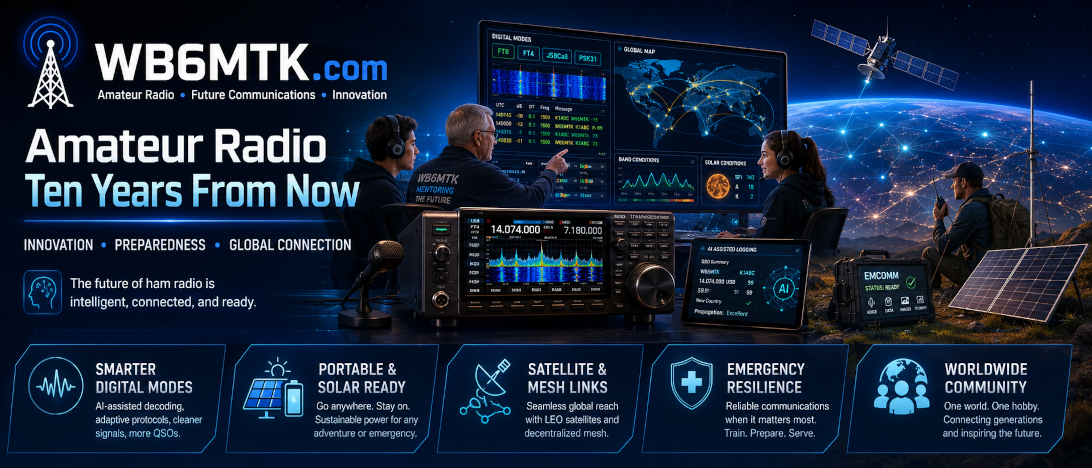
The Future of Amateur Radio: A 2035 Outlook
How Technology, Emergency Readiness, AI, and Spectrum Pressure Will Shape the Next Era of Ham Radio
| Author: | Eric Werny, WB6MTK |
| Publisher: | WB6MTK.com |
| Topic: | Amateur Radio Future, Emergency Communications, SDR, AI, Digital Modes, Spectrum Protection |
| Target Audience: | Amateur radio operators, new hams, emergency communicators, radio clubs, educators, and technically curious readers |
Summary
Amateur radio in 2035 will not be a hobby frozen in the past. It will be a communications discipline shaped by artificial intelligence, software-defined radio, digital weak-signal modes, emergency preparedness, satellite access, portable power systems, and continued spectrum defense.
Traditional operating will not disappear. CW, HF voice, ragchews, contesting, repeaters, and local clubs will still matter. But they will exist alongside AI-assisted receivers, smarter digital modes, automated logging, remote stations, emergency data networks, satellite links, mesh systems, and portable field communication kits.
The future of amateur radio will belong to operators who understand both tradition and innovation.
Direct Definition
The amateur radio of 2035 will be a hybrid communications environment combining traditional RF operating skills with digital signal processing, software-defined radios, emergency messaging systems, satellite communications, artificial intelligence, and independent infrastructure capability.
At its best, amateur radio will remain what it has always been: a hands-on service of experimenters, public-service communicators, builders, operators, and problem solvers.
1. Amateur Radio Is Not Dying — It Is Changing
For more than a century, amateur radio has adapted to every major communications revolution. It survived the transition from spark-gap transmitters to vacuum tubes, from tubes to transistors, from analog equipment to microprocessors, and from paper logs to computer-assisted operation.
Every generation has believed it was witnessing the end of “real radio.” Yet amateur radio has continued because its real value is not tied to one mode, one type of radio, or one style of operating.
Its value comes from five enduring strengths:
- Independent communication
- Technical experimentation
- Public service
- Operator skill
- A worldwide community of radio-minded people
By 2035, amateur radio will look different, but its core purpose will remain recognizable.
The amateur radio operator of the future may use an SDR instead of a large analog transceiver, digital messaging instead of only voice, AI-assisted decoding instead of manual tuning alone, and a portable solar kit instead of a permanent station. But the essential mission will remain the same: communicating by radio when it matters, learning by doing, and preserving technical independence.
2. Digital Modes Will Continue to Expand
Digital communication has already changed amateur radio. Modes such as FT8, FT4, JS8Call, Winlink, VARA, D-STAR, DMR, Fusion, and other digital systems have shown that radio can do far more than simple voice communication.
By 2035, digital modes will likely become even more efficient, more automated, and more integrated into ordinary ham operation.
Why Digital Modes Will Grow
Digital modes offer several major advantages:
- They can copy weak signals below normal voice readability.
- They use bandwidth efficiently.
- They allow structured message handling.
- They support automated logging and station control.
- They work well with portable and low-power stations.
- They can move information when voice traffic becomes inefficient.
For many operators, digital modes will not replace voice or CW. Instead, they will become another essential tool in the station.
Weak-Signal Operation Will Become More Advanced
FT8 proved that weak-signal digital operation could become mainstream. By 2035, we should expect even more advanced weak-signal techniques using improved timing, better synchronization, forward error correction, coherent signal processing, and adaptive decoding.
This means that future operators may be able to complete contacts under conditions that today would be considered nearly impossible.
That does not make operator skill less important. It changes the kind of skill required. The future operator will need to understand audio levels, timing, signal reports, propagation, antennas, software settings, noise sources, and station integration.
The radio operator of 2035 will be part operator, part technician, part network manager, and part signal analyst.
3. Software-Defined Radio Will Become the Normal Radio
Software-defined radios are already common, but by 2035 they will likely become the standard form of amateur radio equipment.
A traditional radio depends heavily on fixed hardware circuits. An SDR shifts much of the filtering, demodulation, decoding, spectrum display, and signal processing into software.
That shift is important because software can be updated, improved, customized, and integrated with other systems.
What Future SDRs Will Offer
By 2035, the typical amateur SDR may include:
- Wideband spectrum displays
- AI-assisted noise reduction
- Automatic signal identification
- Built-in digital mode support
- Remote operation
- Cloud-assisted logging
- Touchscreen interfaces
- Adaptive filters
- Integrated antenna analysis
- Real-time propagation suggestions
- Digital voice and data support
- Automatic station health monitoring
The future ham shack may have fewer large boxes and more integrated systems. A radio may look less like a classic transceiver and more like a communications platform.
However, the danger is that operators may become button-pushers without understanding the RF path. The best operators of 2035 will still understand antennas, grounding, feed lines, propagation, interference, power, and operating discipline.
Technology will help the operator, but it should not replace the operator’s knowledge.
4. Artificial Intelligence Will Enter the Ham Shack
Artificial intelligence will have a growing role in amateur radio. Some operators will resist this, while others will welcome it. Either way, AI-assisted radio operation is likely to become common.
AI will not need to “take over” the station to be useful. Its strongest value will be assisting the operator.
Possible AI Uses in Amateur Radio
AI may help with:
- Noise reduction
- Speech enhancement
- Signal identification
- Automatic logging
- Propagation prediction
- Band condition analysis
- Spotting unusual signals
- Translating foreign-language QSOs
- Organizing emergency traffic
- Summarizing net activity
- Detecting interference patterns
- Helping new operators learn procedures
Imagine an HF station that can identify a weak signal on the waterfall, suggest the likely mode, adjust filtering, decode the transmission, log the contact, and provide the operator with real-time propagation context.
That is not science fiction. It is a logical extension of technologies already developing in signal processing, machine learning, and software-defined radio.
The Risk of Over-Automation
AI also creates a serious question: how much automation is too much?
Amateur radio is supposed to be a service of learning, experimentation, and operator participation. If AI turns radio into a fully automated contact machine, the human skill element could be weakened.
The future challenge will be balance.
AI should assist the operator, not replace the operator. It should improve learning, not eliminate it. It should help decode difficult signals, not remove the need to understand radio.
The strongest amateur radio operators of 2035 will use AI as a tool while still preserving technical competence.
5. Emergency Communications Will Become More Important
One of amateur radio’s strongest future roles will be emergency communication.
Modern society depends on fragile systems: cellular networks, internet services, commercial power, satellite links, fiber routes, cloud platforms, and centralized infrastructure. When these systems fail, most people have no backup communication method.
Amateur radio remains different because it can operate independently.
A properly equipped amateur station can communicate with:
- Local neighborhoods
- Emergency operations centers
- Regional radio nets
- Statewide systems
- HF emergency networks
- Digital message gateways
- Portable field stations
- Battery and solar-powered stations
By 2035, this independence may become more valuable, not less.
The Emergency Communications Station of 2035
A serious emergency communications station may include:
- VHF/UHF voice capability
- HF voice capability
- Winlink or similar digital messaging
- VARA or other high-performance data modes
- Portable battery power
- Solar charging
- Field antennas
- Printed frequency plans
- Local repeater lists
- Simplex procedures
- Message forms
- Network maps
- Go-kit documentation
- Trained operators
The strongest emergency stations will not simply own radios. They will have tested systems, practiced procedures, reliable power, and trained people.
Digital Emergency Messaging Will Expand
Voice is useful, but voice is not always the best way to move detailed information. Emergency communication often requires exact names, addresses, medical supply lists, shelter counts, damage reports, and logistical requests.
Digital messaging systems are better suited for that kind of traffic.
By 2035, systems such as Winlink and VARA-style transport methods may become standard parts of local emergency planning. The ability to send structured information without depending entirely on internet service will be one of amateur radio’s most valuable public-service contributions.
6. Portable and Field Radio Will Grow
Portable operation has already become one of the most active parts of amateur radio. Programs such as Parks on the Air, Summits on the Air, field deployments, emergency exercises, and outdoor operating events have made radio more visible, active, and attractive.
By 2035, portable operation will likely be one of the main entry points into the hobby.
Why Portable Radio Appeals to New Operators
Portable radio is attractive because it is:
- Hands-on
- Outdoor-focused
- Relatively affordable
- Socially shareable
- Technically interesting
- Useful for emergency practice
- Less dependent on large home antennas
- Compatible with small radios and battery power
For operators restricted by HOAs, apartments, or limited property, portable operation may become the primary way to enjoy HF radio.
The Future Go-Kit
The future amateur radio go-kit may include:
- Compact HF/VHF/UHF radio
- Digital interface
- Tablet or small laptop
- Lightweight antenna system
- Battery pack
- Solar panel
- Headset
- Coax and adapters
- Printed operating guide
- Local emergency frequency list
- Digital message forms
- Weatherproof case
The best operators will not wait for an emergency to test this equipment. They will use it regularly during field events and practice deployments.
7. The Operator Community Will Change
The amateur radio population has aged in many areas, but that does not mean the hobby has no future. The next generation may not enter amateur radio in the same way previous generations did.
Many younger operators will come through:
- STEM education
- Robotics
- Drones
- Satellites
- Maker culture
- Emergency preparedness
- Cybersecurity interest
- Off-grid technology
- Outdoor radio events
- Digital communication experiments
- Space and balloon projects
The old idea that every new ham starts by wanting to talk on a local repeater may no longer be true. Some will come through FT8. Some through SDR. Some through satellites. Some through emergency preparedness. Some through school programs. Some through remote receivers and signal analysis.
The hobby must make room for these different entry points.
The Importance of Elmers
The future of amateur radio will still depend on Elmers — experienced operators who help others learn.
However, the Elmer of 2035 will need to understand more than how to tune an analog rig or build a dipole. The future Elmer may need to help with:
- Software setup
- Digital modes
- Sound card configuration
- USB drivers
- SDR settings
- Remote operation
- Logging software
- Hotspots
- Mesh networks
- Portable power
- Emergency forms
- Antenna compromises
- HOA-limited stations
Good mentoring will be one of the most important factors in keeping amateur radio healthy.
The wrong attitude can drive people away. The right attitude can build a new generation of capable operators.
8. Satellites, Balloons, and Space-Based Amateur Radio Will Expand
Amateur radio has always had a place in space. Amateur satellites, the International Space Station, CubeSats, and Earth-Moon-Earth communication have shown that radio experimentation does not stop at the atmosphere.
By 2035, space-related amateur radio may become more accessible.
Amateur Satellites
CubeSats and low-cost satellite platforms have made small satellite projects more realistic for universities, clubs, and technical groups. Future amateur satellites may provide more opportunities for voice, digital, telemetry, and experimental communication.
Operators who once thought satellites were too difficult may find that better software, improved tracking tools, and more capable radios make satellite operation easier.
Earth-Moon-Earth
Earth-Moon-Earth communication, also known as moonbounce, has traditionally required serious antennas, power, patience, and skill. Digital weak-signal modes have already made EME more approachable than it once was.
By 2035, improved decoding and better station integration may allow more operators to experiment with moonbounce.
Balloons, Drones, and Temporary Relays
High-altitude balloons, drone-assisted relays, and temporary airborne repeaters may also become more common in experimentation and emergency exercises.
These systems could be used for:
- STEM education
- Telemetry experiments
- Emergency coverage testing
- Remote sensor links
- Temporary communication relays
- Propagation studies
This kind of experimentation keeps amateur radio connected to engineering, science, and public service.
9. Mesh Networks and Local Data Systems Will Matter
One of the most important future areas for amateur radio may be local independent networking.
Mesh networks allow radio-linked nodes to pass data across a region without relying entirely on commercial internet infrastructure. While not a replacement for the public internet, amateur radio mesh systems can support emergency communications, local services, cameras, forms, maps, chat systems, and served-agency tools.
By 2035, local amateur radio groups may build more serious regional data networks.
Possible Uses of Amateur Mesh Systems
A local amateur radio mesh system could support:
- Emergency operations centers
- Shelter communication
- Neighborhood status reports
- Local file sharing
- Situational awareness maps
- Field-deployed cameras
- Text messaging
- Digital forms
- VoIP extensions
- Training exercises
The important point is not that mesh networks replace HF, repeaters, or Winlink. They add another layer to the communication stack.
The future emergency communicator will need to think in layers: voice, data, local, regional, HF, satellite, portable, and off-grid power.
10. Spectrum Pressure Will Increase
The greatest long-term threat to amateur radio may not be lack of interest. It may be loss of spectrum.
Commercial wireless providers, government agencies, satellite companies, broadband services, and technology firms all want access to radio spectrum. Amateur radio allocations are valuable because spectrum itself is valuable.
By 2035, amateur radio operators should expect continued pressure on VHF, UHF, microwave, and possibly other allocations.
Why Spectrum Defense Matters
Amateur radio must be able to show public value.
That value includes:
- Emergency communication
- Technical education
- STEM development
- Radio experimentation
- Public service
- Disaster readiness
- International goodwill
- Spectrum research
- Training future RF professionals
If amateur radio becomes only a private hobby with no visible public benefit, defending spectrum becomes harder.
The amateur community must be able to explain why these frequencies matter.
Operators Must Use the Bands
One of the best ways to defend amateur spectrum is to use it responsibly. Empty bands are easier to challenge. Active, useful, well-managed bands are easier to defend.
This means clubs, emergency groups, experimenters, contesters, digital operators, satellite operators, and technical builders all play a role in preserving amateur radio’s future.
11. Licensing May Evolve
By 2035, amateur radio licensing may change in some countries. Entry-level licensing may become simpler. Testing may become more accessible online. Digital learning systems may replace some traditional classroom methods.
This could be good if it brings more people into the hobby.
However, licensing should not become so simplified that technical understanding disappears. Amateur radio is not just another communications app. It is a licensed radio service with privileges, responsibilities, and technical expectations.
A good future licensing system should do three things:
- Lower unnecessary barriers to entry.
- Preserve technical and operating standards.
- Encourage advancement and real learning.
The goal should not be to make amateur radio effortless. The goal should be to make it accessible, meaningful, and technically responsible.
12. Traditional Amateur Radio Will Still Matter
Despite all the changes coming by 2035, traditional radio will not disappear.
There will still be:
- HF ragchews
- CW contacts
- Local repeaters
- Nets
- DXing
- Contesting
- Antenna building
- Field Day
- Traffic handling
- Club meetings
- Homebrew projects
- Elmering
- Public-service events
These traditions matter because they carry the culture and discipline of amateur radio.
CW will still have value because it is efficient, simple, narrowband, and historically important. Voice will still matter because human conversation builds community. Repeaters will still matter because local communication matters. Clubs will still matter because people learn better when they are connected to other people.
The future of amateur radio should not be a war between old and new. It should be a partnership between proven methods and emerging tools.
13. The Biggest Opportunity: Becoming Relevant Again
The future of amateur radio depends on relevance.
To the public, amateur radio must be more than a nostalgic hobby. It must be seen as a practical, educational, and emergency-capable communications service.
To young people, it must be more than old equipment and confusing procedures. It must connect to technology, exploration, making, satellites, digital communication, emergency readiness, and real-world problem solving.
To emergency managers, it must be more than a group of volunteers with radios. It must be a trained communications resource with procedures, discipline, message-handling capability, and reliable equipment.
To regulators, it must be more than unused spectrum. It must be a national technical resource.
The opportunity is enormous, but it requires action.
14. Practical Recommendations for Amateur Radio Operators
Operators who want to be ready for the 2035 version of amateur radio should begin preparing now.
Learn Digital Modes
Do not stop at voice operation. Learn FT8, JS8Call, Winlink, VARA, and other digital systems. Understand audio levels, timing, interfaces, and message handling.
Understand SDR
Even if you prefer traditional radios, learn how SDR works. Spectrum displays, filters, waterfalls, and digital signal processing are becoming central to modern radio.
Build Emergency Capability
Create a station that can operate without commercial power. Have batteries, solar charging, portable antennas, printed documentation, and a practiced plan.
Get Involved Locally
Join nets, clubs, emergency groups, and training exercises. Amateur radio is strongest when operators know each other before a crisis.
Mentor New Operators
The future of amateur radio depends on how experienced operators treat beginners. Encourage questions. Avoid humiliation. Teach with patience.
Use the Spectrum
Operate. Experiment. Build. Test. Get on the air. A silent amateur radio community is easier to ignore.
15. Final Outlook: Amateur Radio in 2035
The amateur radio station of 2035 may look very different from the classic ham shack. It may include SDRs, AI tools, digital messaging, satellite access, mesh networking, portable solar power, and automated logging.
But the spirit will remain familiar.
There will still be an operator listening through the noise. There will still be someone calling CQ. There will still be a field station running on battery power. There will still be an emergency net passing information when other systems fail. There will still be a mentor helping a new ham make a first contact.
The amateur radio of 2035 will not be defined by whether it uses old technology or new technology. It will be defined by whether operators continue to learn, serve, experiment, communicate, and preserve the freedom to use radio.
If amateur radio embraces both tradition and innovation, it will not merely survive the next decade.
It will become more important.
Frequently Asked Questions
Will amateur radio still exist in 2035?
Yes. Amateur radio will still exist, but it will continue changing. Digital modes, SDRs, AI-assisted tools, portable operation, satellite communication, and emergency messaging will become more common.
Will AI replace amateur radio operators?
No. AI may assist with decoding, logging, filtering, translation, and propagation analysis, but it should not replace the operator. Amateur radio depends on human judgment, technical skill, and responsible operation.
Will CW still matter in the future?
Yes. CW will remain valuable because it is simple, efficient, narrowband, and historically important. It may become a more specialized skill, but it will not disappear.
Will voice communication become obsolete?
No. Voice will remain important for local nets, repeaters, emergency coordination, casual contacts, public-service events, and human connection.
What skills should a future ham learn?
A future-ready operator should understand antennas, grounding, power systems, digital modes, SDRs, emergency procedures, basic networking, propagation, and proper operating practice.
Why will emergency communications matter more by 2035?
Modern infrastructure is increasingly dependent on commercial power, cellular systems, fiber networks, satellites, and internet services. Amateur radio provides an independent communications option when those systems are degraded or unavailable.
What is the biggest threat to amateur radio?
The biggest long-term threat is loss of relevance, followed closely by spectrum pressure. Amateur radio must remain active, useful, technically competent, and publicly visible.
References and Further Reading
For readers who want to study the future direction of amateur radio, the following topics are worth exploring:
- ARRL emergency communications training
- Winlink emergency messaging
- VARA digital modes
- Software-defined radio fundamentals
- FT8 and weak-signal digital operation
- Amateur satellite operation
- Parks on the Air and Summits on the Air
- ARES and RACES public-service communications
- Mesh networking for amateur radio
- FCC amateur radio service rules
- Spectrum allocation and amateur radio advocacy
Closing Statement
Amateur radio has never been only about equipment. It has always been about people using radio knowledge to communicate, experiment, teach, and serve.
By 2035, the tools will be smarter, the signals weaker, the software more powerful, and the infrastructure challenges more serious. But the need for skilled radio operators will remain.
The future belongs to amateur radio operators who are willing to learn both the old ways and the new ones.
