
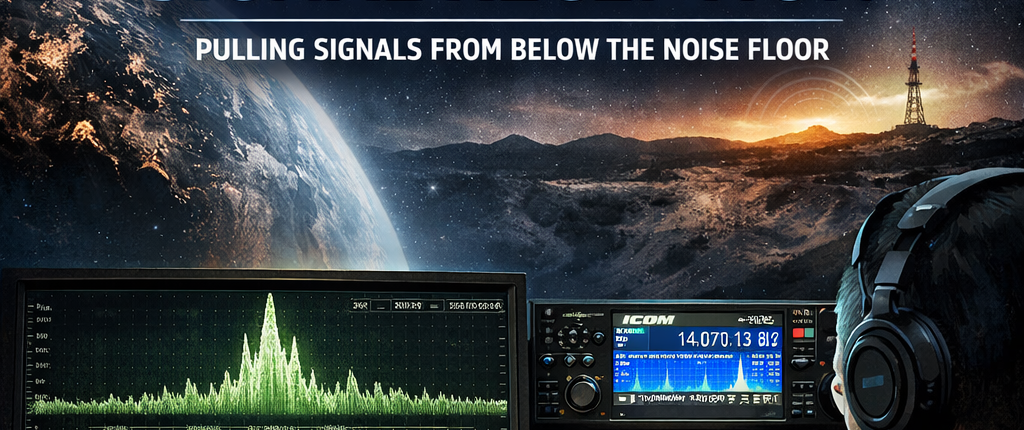
Ultra Weak Signal Reception in Amateur Radio
A plain-English engineering guide to hearing, decoding, and understanding extremely weak radio signals
Author: Eric Werny, WB6MTK
Publisher: WB6MTK.com
Website: www.wb6mtk.com
Topic: Amateur Radio, Weak-Signal Reception, HF Communications, Receiver Performance, Digital Modes, Station Engineering
Recommended audience: Amateur radio operators, weak-signal experimenters, HF operators, SDR users, digital-mode operators, emergency communicators, and technical learners
Last reviewed: May 2026
Summary
Ultra weak signal reception is the practice of recovering usable information from radio signals that are too faint, noisy, unstable, or buried in interference to be easily heard or understood by ordinary listening.
Many operators describe this as “working below the noise floor,” but that phrase is only useful when the operator understands what makes weak-signal communication possible. Extremely weak signals can sometimes be copied because the receiving system preserves enough structure for the operator, receiver, or software decoder to recognize meaningful information.
Weak-signal success is not magic. It is engineering.
It depends on:
- Noise control
- Bandwidth control
- Time integration
- Receiver stability
- Antenna selection
- Feed-line behavior
- Digital signal structure
- Operator discipline
- Measurement and troubleshooting
A weak-signal station should not be viewed as a pile of equipment. It should be viewed as a complete system. The antenna, feed line, receiver, filters, software, power system, operating method, and local noise environment all interact.
The goal is not merely to make the signal louder. The goal is to preserve enough information for the message to survive.
Definition
Ultra weak signal reception is the disciplined recovery of usable information from radio signals that are not plainly audible, visually obvious, or easily readable using ordinary receiver settings.
In amateur radio, ultra weak signal work may include:
- FT8 and other weak-signal digital modes
- CW under poor conditions
- QRP contacts
- EME and moonbounce
- Meteor scatter
- WSPR
- QRSS
- Weak HF DX
- SDR-based signal analysis
- Low-power beacon reception
- Emergency communication under poor signal conditions
The key idea is this:
A weak signal is not defined only by low volume. It is defined by whether usable structure remains after noise, fading, distortion, bandwidth, and receiver behavior are considered.
Core Principle
Ultra weak signal reception is a contest between order and randomness.
The desired signal contains order.
Noise, interference, distortion, drift, and poor operating habits add randomness.
The station’s job is to preserve enough order long enough for the message to be recognized.
That means the operator must ask:
- Where is signal being preserved?
- Where is noise being added?
- Where is bandwidth too wide?
- Where is the receiver being overloaded?
- Where is the antenna collecting unwanted noise?
- Where is software helping?
- Where is software being fed a poor waveform?
- Where is the operator wasting information through poor method?
Weak-signal work rewards disciplined thinking.
1. Rethinking What a Weak Signal Is
Most operators begin with a simple definition of a weak signal:
“A weak signal is something that sounds faint.”
That definition is understandable, but incomplete.
A signal can sound quiet and still be easy to copy if it is clean, stable, and isolated. Another signal can sound stronger but be unreadable if it is buried in noise, smeared by fading, distorted by the receiver, or covered by interference.
In engineering terms, a weak signal is not judged only by loudness. It is judged by how much usable structure remains after the signal passes through the entire receiving system.
That includes:
- Antenna
- Feed line
- Receiver front end
- Filters
- AGC behavior
- Audio chain
- Digital interface
- Software decoder
- Operator judgment
A signal is useful when the receiving system can still recognize its pattern.
This is why a digital mode may decode a signal that a human ear cannot hear. The software is not performing magic. It is searching for known structure in a narrow, timed, predictable signal format.
Why More Power Is Not Always the Answer
When operators struggle with weak signals, the first instinct is often to add more transmit power.
Sometimes more power helps.
But many weak-signal problems are receive-side problems.
The real problem may be:
- Local electrical noise
- Poor antenna placement
- Common-mode current
- Receiver overload
- Too much bandwidth
- Bad audio levels
- Poor grounding or bonding
- Weak filtering
- Poor time synchronization
- Wrong mode for the path
If the receiving station cannot hear clearly, additional transmit power may not solve the problem.
A better strategy is often to reduce noise, improve selectivity, stabilize the signal path, or use a mode designed for weak-signal detection.
2. Noise: The Adversary You Cannot Ignore
All radio communication takes place in the presence of noise.
There is no perfectly silent receiver and no perfectly quiet band.
The weak-signal operator must understand not only that noise exists, but what kind of noise is limiting the station.
Noise may come from:
- Thermal noise
- Atmospheric noise
- Galactic noise
- Power lines
- Switching power supplies
- LED lights
- Solar inverters
- Battery chargers
- Computers
- Routers
- Televisions
- Appliances
- Poorly filtered consumer electronics
For many HF operators, man-made noise is the real limiting factor.
A station in a remote quiet location may hear weak signals clearly. A station in a suburban neighborhood may hear the same band as empty or noisy.
The difference may not be the radio.
It may be the environment.
Noise Is a Budget Item
A serious weak-signal operator should treat noise like a budget.
Every unnecessary decibel of noise consumes part of the margin needed to copy weak signals.
A high local noise floor can erase the benefit of:
- A better receiver
- A larger antenna
- More transmitter power
- Digital-mode software
- Better propagation
Reducing local noise by 6 to 10 dB can be a major station improvement.
Noise reduction may come from:
- Ferrite chokes
- Better bonding
- Removing noisy power supplies
- Relocating antennas
- Using balanced antennas
- Improving feed-line routing
- Turning off noisy devices
- Separating radio equipment from consumer electronics
- Controlling common-mode current
Noise is not background scenery.
Noise is the opponent.
3. Why Bandwidth Changes Everything
Bandwidth is one of the most important controls in weak-signal reception.
A receiver does not only pass signal through a selected bandwidth. It also admits noise through that same bandwidth.
Wider bandwidth admits more noise.
Narrower bandwidth admits less noise.
This is why CW and digital modes can work under conditions where voice fails. They often require far less bandwidth than SSB voice.
A wide SSB signal may occupy roughly 2.4 to 3 kHz. A narrow CW filter may use only a few hundred hertz or less. Some digital modes occupy even narrower or more structured spaces.
The signal may not be stronger.
The receiver is simply admitting less uncertainty.
Bandwidth Is a Tradeoff
Narrow bandwidth improves weak-signal detectability, but it has limits.
If the bandwidth is too narrow:
- Tuning becomes critical
- Drift becomes more serious
- Voice becomes unintelligible
- Data rate decreases
- Signals may be clipped or distorted
- The operator may lose situational awareness
The correct bandwidth depends on the mission.
Emergency voice, CW, FT8, WSPR, JS8Call, and weak-signal beaconing do not require the same bandwidth.
The principle is:
Use enough bandwidth to carry the needed information, but not so much that the receiver admits unnecessary noise.
4. Time, Coherence, and the Gain of Patience
A signal that is too weak to stand out instantly may still be recoverable if the receiving system observes it long enough.
Random noise changes unpredictably.
A real signal contains structure.
If the receiver or decoder can observe the signal over time, the structured part can accumulate while random noise tends to average out.
This is called time integration or processing gain.
That is one reason weak-signal digital modes often use timed transmission cycles. They give the decoder enough time to collect evidence.
Patience as a Form of Gain
Weak-signal operating rewards patience.
An impatient operator may conclude that nothing is there.
A disciplined operator may hold frequency, maintain timing, narrow the bandwidth, reduce local noise, and allow the system to gather enough information.
This applies to digital modes, CW, and even weak voice communication.
Good weak-signal operators understand that detection sometimes builds over time.
In weak-signal work, patience is not merely good manners.
It is a performance tool.
5. Receiver Design: Where Weak Signals Are Preserved or Destroyed
Receiver sensitivity matters, but it is not the only receiver characteristic that matters.
A weak-signal receiver must also preserve faint signals in the presence of stronger signals.
Important receiver characteristics include:
- Sensitivity
- Dynamic range
- Front-end linearity
- Noise figure
- Frequency stability
- Filtering
- AGC behavior
- DSP performance
- Phase noise
- Overload resistance
- Audio cleanliness
- SDR sampling performance
A receiver may be sensitive but still perform poorly if strong nearby signals overload the front end.
A weak signal can be destroyed inside the receiver before it ever reaches the speaker or decoder.
Dynamic Range Matters
Dynamic range describes how well a receiver handles weak signals while strong signals are also present.
On a crowded band, strong signals can cause:
- Intermodulation products
- False signals
- Gain compression
- Overload
- Spurious responses
- General band “mud”
The operator may blame propagation when the real problem is receiver overload.
Good receiver design protects weak signals from being buried by internally created distortion.
Stability Matters
Weak-signal modes often require frequency stability.
If a signal drifts, the receiving system may fail to track it properly.
This is especially important for:
- Narrow CW
- FT8
- WSPR
- QRSS
- EME
- Microwave operation
- SDR analysis
A stable receiver and transmitter preserve coherence.
A drifting system throws away the very gain that time integration is trying to create.
6. Antennas, Feed Lines, and Quiet Signal Capture
The antenna is often called the most important part of the station. In weak-signal work, that is often true.
But the best weak-signal antenna is not always the one that produces the highest S-meter reading.
The better antenna is the one that produces the best signal-to-noise ratio for the desired communication path.
An antenna collects both signal and noise.
That means antenna choice must consider:
- Pattern
- Polarization
- Height
- Directionality
- Local noise pickup
- Common-mode current
- Feed-line loss
- Ground interaction
- Placement
- Proximity to buildings
- Balance
- Choking and isolation
A larger antenna that collects more signal and more noise may not improve actual copy.
A quieter antenna with lower signal strength may produce better weak-signal performance.
Common-Mode Current
Common-mode current is a major weak-signal problem.
If the outside of the coax becomes part of the antenna system, the feed line may bring household noise into the receiver.
This can make a good antenna sound poor.
Common-mode control may require:
- Ferrite chokes
- Current baluns
- Better feed-point design
- Balanced antennas
- Improved bonding
- Better feed-line routing
Ferrite chokes are not just accessories.
They are weak-signal tools.
7. Digital Modes and Why They Seem Almost Supernatural
Modern weak-signal digital modes can decode signals that a human operator may not hear.
This can seem almost supernatural.
It is not.
Digital weak-signal modes work because they exploit structure.
They often use:
- Narrow bandwidth
- Precise timing
- Known symbol patterns
- Error-control coding
- Repetition
- Synchronization
- Matched detection
- Statistical decision-making
The decoder is not trying to understand arbitrary speech. It is trying to detect a known kind of signal.
That makes the problem easier.
The Power and Limit of Digital Modes
Digital modes are powerful when the mission fits the format.
They are excellent for:
- Weak-signal contacts
- Structured exchanges
- Beaconing
- Propagation study
- Low-power operation
- Automated reception reporting
- Marginal paths
They are less ideal for:
- Long conversations
- Tactical voice
- Complex free-form messages
- Fast-changing emergency traffic
- Human tone and judgment
- Situations requiring immediate clarification
Digital modes do not replace operating skill.
They reveal whether the station has been configured and operated properly.
8. Operating Method: The Human Element
Weak-signal work rewards disciplined operators.
Two stations with similar equipment may produce very different results because one operator understands the system and the other does not.
Important operating habits include:
- Choosing the right band
- Selecting the right time of day
- Listening before transmitting
- Narrowing bandwidth properly
- Keeping audio levels clean
- Maintaining timing accuracy
- Watching propagation
- Repeating critical information
- Using structured exchanges
- Avoiding unnecessary transmit time
- Logging changes and results
- Knowing when not to transmit
The operator is part of the detector.
Good operating method is not just etiquette. It is a real performance parameter.
9. Real-World Weak-Signal Scenarios
Weak-signal theory becomes useful when it explains what operators actually experience.
Scenario 1: The Band Sounds Dead, but FT8 Decodes Signals
An operator hears little or nothing on SSB, but FT8 shows many stations.
This does not mean the band was dead and suddenly came alive.
It means the digital mode, narrow bandwidth, timing, and structured signal format were better matched to the available signal margin.
The propagation was there.
The detection method changed.
Scenario 2: More Power Does Not Improve Contacts
An operator adds an amplifier but still fails to complete weak-signal contacts.
The likely problem may be receive-side limitation.
If the local noise floor is high, the operator may be heard by others but unable to copy replies.
The station does not need only more transmit strength.
It needs better receive intelligibility.
Scenario 3: A Bigger Antenna Makes More Noise
An operator installs a larger antenna and sees stronger signals but also much higher noise.
The result may be no real improvement.
The key metric is not raw signal strength.
The key metric is signal-to-noise ratio.
Scenario 4: Receiver Overload Looks Like Poor Propagation
On a crowded band, an operator hears distortion, splatter, phantom signals, or general muddiness.
The cause may be receiver overload, not propagation.
Better filtering, attenuation, front-end control, or band strategy may improve copy.
10. Failure Analysis and Incremental Improvement
A weak-signal station should not be improved randomly.
It should be improved by diagnosis.
The first step is to define the problem.
Do not say:
“The station does not work well.”
Say:
- The receiver noise floor is too high on 40 meters after sunset.
- FT8 decodes are inconsistent.
- The radio transmits but reports are poor.
- The receiver overloads during contests.
- A new antenna increased both signal and noise.
- The station cannot complete contacts even when heard by others.
Precise symptoms lead to useful solutions.
Establish a Baseline
Before changing the station, record current performance.
Track:
- Band
- Time of day
- Noise level
- Antenna used
- Receiver settings
- Filter bandwidth
- Decoder performance
- Signal reports
- Local devices operating
- Weather and propagation notes
- Changes made
Without a baseline, improvement becomes guesswork.
With a baseline, improvement becomes engineering.
Change One Variable at a Time
Good weak-signal improvement is incremental.
Change one thing, then test.
Examples:
- Add ferrite chokes and test.
- Move the feed line and test.
- Change antenna height and test.
- Narrow the filter and test.
- Turn off a noisy power supply and test.
- Compare two antennas at the same time of day.
- Adjust audio levels and test.
If you change five things at once, you may not know which one helped.
11. Why Weak-Signal Principles Matter Beyond Amateur Radio
Weak-signal reception is not only an amateur radio topic.
The same principles appear in:
- Deep-space communication
- Satellite telemetry
- Remote sensing
- Low-power data links
- Passive radar
- Scientific instruments
- Military communication systems
- Emergency communication systems
- Radio astronomy
- Digital signal processing
The amateur radio station is a practical learning platform for real communications engineering.
It teaches:
- Noise budgeting
- Bandwidth control
- Synchronization
- Time integration
- Antenna tradeoffs
- Receiver limitations
- Error control
- Measurement
- Failure analysis
A radio amateur who understands weak-signal operation is learning how communication survives under limits.
That is not nostalgia.
That is practical engineering.
12. Station Improvement Workflow
A disciplined improvement plan may look like this:
Phase 1: Measure the Noise Environment
Record the noise floor by band and time of day.
Identify whether the noise changes when household devices are turned on or off.
Phase 2: Remove or Suppress Local Noise
Look for noisy devices such as:
- LED lights
- Battery chargers
- Computers
- Routers
- Switching supplies
- Solar equipment
- Appliance controllers
Use ferrites, separation, replacement, or relocation where practical.
Phase 3: Control Common-Mode Current
Add chokes or current baluns where needed.
Pay attention to:
- Feed point
- Shack entry
- Power cables
- USB cables
- Speaker lines
- Control cables
Phase 4: Optimize Receiver Settings
Test:
- Bandwidth
- RF gain
- AGC
- Attenuator
- Preamplifier
- Notch filters
- Noise reduction
- DSP settings
- Audio levels
Phase 5: Evaluate Antennas by Signal-to-Noise Ratio
Do not judge only by S-meter strength.
Compare actual readability, decoder success, and contact reliability.
Phase 6: Align Station to Mission
A weak-signal digital HF station may need different compromises than a voice ragchew station or emergency regional station.
The station should be designed for its purpose.
13. Case Study: Suburban Noise Reduction
A suburban operator reports that 40 meters sounds dead after sunset.
The radio is modern and working correctly. The antenna is outside. But the received audio contains broadband hiss and periodic hash.
The operator first assumes poor propagation.
Instead, the operator shuts down household circuits one at a time and discovers several noise sources:
- LED power supplies
- Networking equipment
- Switching power adapters
After adding ferrite chokes, improving feed-line isolation, and reducing common-mode current, the noise floor drops several decibels.
Signals that were barely visible on the waterfall become decodable.
Voice operation improves somewhat, but digital weak-signal operation improves more because the narrow mode benefits strongly from lower noise.
The lesson:
The station was not transmit-limited. It was receive-limited by local noise.
14. Case Study: When More Power Was Not the Answer
An operator pursuing weak overnight HF DX adds an amplifier after repeated failed contacts.
Distant stations report a stronger signal.
But the operator still struggles to copy replies.
A closer review shows that the station’s receive side has not improved. The local noise floor remains high, and the operator is using a wider receive bandwidth than needed.
After cleaning up local noise, narrowing filters, and choosing better operating windows, the contact rate improves more than it did after the power increase.
The amplifier was not useless.
It simply was not the first solution to the real bottleneck.
The lesson:
Communication success depends on two-way information margin, not one-way loudness.
15. Practical Weak-Signal Checklist
Use this checklist when improving a weak-signal station.
- Measure the noise floor by band
- Identify local noise sources
- Turn off suspected devices and compare results
- Add ferrite chokes where needed
- Control common-mode current
- Improve feed-line routing
- Choose antennas by signal-to-noise ratio
- Use appropriate bandwidth
- Avoid receiver overload
- Maintain frequency stability
- Keep digital-mode timing accurate
- Use clean audio levels
- Compare results before and after changes
- Change one variable at a time
- Record station experiments
- Match the mode to the mission
- Listen before transmitting
- Use structured message formats under weak conditions
- Avoid assuming more power is always the solution
- Protect information at every stage
Conclusion
Ultra weak signal reception is not a trick, a software novelty, or a matter of buying the largest possible equipment.
It is a disciplined way of thinking about communication.
The desired signal contains order. The world adds randomness. The station’s job is to preserve enough order for the message to survive.
Noise must be measured and reduced. Bandwidth must be chosen intelligently. Time must be used deliberately. The receiver must remain stable and linear. The antenna must be judged by signal-to-noise ratio. The operator must make informed decisions about mode, timing, message structure, and troubleshooting.
The deepest lesson is this:
Improve the station by protecting information, not merely by pursuing volume.
A station built and operated with that understanding does more than make difficult contacts. It teaches the operator how communication survives at the edge of uncertainty.
That is the real achievement of weak-signal work.
The operator has not merely learned to hear faint signals.
The operator has learned to think like a communications engineer.
Frequently Asked Questions
What is ultra weak signal reception?
Ultra weak signal reception is the recovery of usable information from radio signals that are very faint, noisy, or not obvious through ordinary listening. It depends on noise control, bandwidth, time integration, receiver performance, antenna choice, and operating method.
What does “below the noise floor” mean?
“Below the noise floor” means the signal is not obvious above the random noise in a normal observation. However, if the signal has enough structure and the receiver or decoder can integrate over time, it may still be recoverable.
Is weak-signal reception just about having a better radio?
No. Receiver quality matters, but weak-signal success depends on the entire station: antenna, feed line, local noise, filters, receiver stability, software setup, and operator skill.
Why do digital modes decode signals I cannot hear?
Digital modes use narrow bandwidth, precise timing, known signal structures, and error correction. They are designed to detect structured signals under poor signal-to-noise conditions.
Is more power the best way to improve weak-signal performance?
Not always. If the station is receive-limited by local noise or poor filtering, more transmit power may not solve the problem. Reducing noise and improving receive performance may help more.
Why does narrowing bandwidth help weak signals?
Narrowing bandwidth reduces the amount of noise admitted into the receiver. Less noise makes it easier to detect the desired signal.
What is signal-to-noise ratio?
Signal-to-noise ratio, or SNR, is the relationship between the desired signal and the noise around it. Weak-signal success depends more on SNR than on signal strength alone.
Why can a bigger antenna make reception worse?
A bigger antenna may collect more signal but also more local noise. If noise increases as much as or more than the desired signal, actual readability may not improve.
What is common-mode current?
Common-mode current occurs when the outside of the coax or station wiring becomes part of the antenna system. It can bring household noise into the receiver and reduce weak-signal performance.
How should I improve my weak-signal station first?
Start by measuring and reducing local noise. Then control common-mode current, optimize bandwidth and receiver settings, evaluate antennas by signal-to-noise ratio, and change only one variable at a time.
References and Further Reading
The following sources are useful references for weak-signal reception, HF station engineering, digital modes, and radio communication theory:
- American Radio Relay League, The ARRL Handbook for Radio Communications
- American Radio Relay League, The ARRL Antenna Book
- American Radio Relay League, Grounding and Bonding for the Radio Amateur
- American Radio Relay League, Digital Modes and Weak-Signal Communications Resources
- Federal Communications Commission, 47 CFR Part 97 — Amateur Radio Service
- Joe Taylor, K1JT, and WSJT-X weak-signal digital mode documentation
- Claude Shannon, A Mathematical Theory of Communication
- Radio Society of Great Britain, Radio Communication Handbook
- ON4UN, Low-Band DXing
- Manufacturer documentation for SDR receivers, HF transceivers, filters, preamplifiers, and ferrite materials
- Amateur radio club weak-signal workshops and field test reports
- Propagation and signal-reporting tools such as WSPRnet and PSK Reporter