
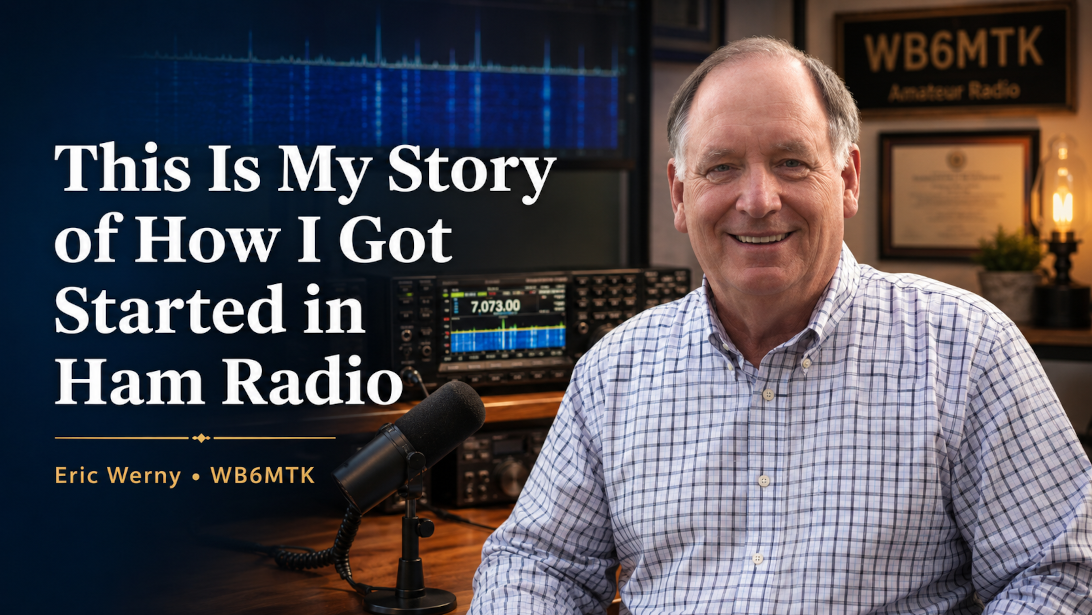
My Adventure Into Ham Radio — The Buick, the Boy Scout Book,
| Author: | Eric Werny, WB6MTK |
| Publisher: | WB6MTK.com |
| Website: | |
| Recommended audience: | New amateur radio operators, young people interested in radio, parents, Elmers, radio clubs, and readers interested in how amateur radio begins in a person’s life |
| Last reviewed: | May 2026 |
Summary
Every amateur radio operator has a beginning. For some, it starts with a family member, a radio club, a school project, a military communications experience, a scanner, a shortwave receiver, or a mysterious signal heard late at night.
For Eric Werny, WB6MTK, the beginning came in 1959 with a Boy Scout book, a Buick, a patient father, and two exciting subjects: Morse code and radio.
What began as a boy’s curiosity about how a voice could travel from a microphone to a tabletop radio became the beginning of a lifelong interest in electronics, communication, shortwave listening, and amateur radio. This story is not only about one young boy learning Morse code. It is about the importance of curiosity, family mentorship, hands-on building, and the wonder that radio can create in a young mind.
Definition
A ham radio origin story is the personal account of how an amateur radio operator first became interested in radio communication, electronics, Morse code, listening, building, or operating.
These stories matter because amateur radio is not only a technical activity. It is also a human journey. Most operators do not enter the hobby because of one single event. They enter because something captures their imagination.
For many operators, that moment begins with a question:
How does this work?
For me, that question began in the backseat of a Buick.
Introduction: The Beginning of a Radio Adventure
In 1959, I received my first scouting book from the Boy Scouts of America. I did not know it at the time, but that book would become one of the first doorways into a lifelong interest in radio.
Later that week, on a quiet afternoon, my parents and I were headed to ESKO Market. I was sitting in the backseat of our Buick while my mother prepared for what seemed to me like her own great expedition: browsing every aisle in the store.
My dad and I knew the routine. She would shop, and we would wait.
As I sat in the car with my scouting book, I began turning the pages. Two chapters immediately caught my attention.
The first was about Morse code.
The second was about radio.
At that age, boys were often fascinated by secret messages, decoder rings, and adventure stories. But Morse code seemed different. It was not just a toy or a trick. It was a real way to communicate.
Radio was even more mysterious.
I had always wondered how a radio announcer could speak into a microphone somewhere far away and have that voice come out of the speaker of our tabletop radio at home. To a young boy, that felt almost impossible.
That afternoon, sitting in the Buick, the adventure began.
1. The Boy Scout Book That Opened the Door
The Boy Scout book introduced me to two ideas that would stay with me for the rest of my life: code and radio.
Morse code was fascinating because it turned letters into sound. A message no longer had to be spoken in ordinary words. It could be sent through dots and dashes, tone and rhythm, timing and memory.
Radio was fascinating because it seemed invisible. There were no wires between the announcer and our home radio. There was no visible path between the microphone and the speaker. Yet the voice arrived.
That mystery created a question in my mind:
How can something invisible carry a voice?
That is one of the most powerful questions a future radio operator can ask.
2. My Father’s Hidden Radio Past
As I talked with my dad about Morse code and the radio kit described in the scouting book, I learned something I had not known before.
My father had once been a ham radio operator.
He had always been interested in radio and electronics. He had even owned a radio repair shop in New York.
That discovery changed everything.
There I was, a young boy excited about radio, sitting beside someone who already understood it. I did not know it at the time, but I had found the kind of teacher every new operator hopes for: someone with knowledge, patience, and experience.
My dad became my first Elmer before I even knew what an Elmer was.
What Is an Elmer?
In amateur radio, an Elmer is an experienced operator who helps a newer person learn radio.
An Elmer may teach:
- Morse code
- Radio operation
- Antenna basics
- Electronics
- Soldering
- Station setup
- Operating manners
- Troubleshooting
- Safety
- Confidence
A good Elmer does more than provide answers. A good Elmer helps the beginner think, build, listen, and learn.
My dad was kind, but he was also challenging. He did not simply do everything for me. He expected me to learn.
That was one of the greatest gifts he gave me.
3. Learning My First Morse Code Letters
As we sat in the car, my dad began teaching me some Morse code letters. He also taught me how to send my first name.
To a young boy, that felt like a major achievement.
I remember feeling like the smartest kid in the class. I had learned something that seemed secret, technical, and important.
That small moment mattered.
Learning even a few letters of Morse code gave me the feeling that radio was not completely beyond my reach. It was something I could begin to understand, one letter at a time.
That is how many technical journeys begin.
Not with mastery.
With one small success.
4. Saving Money for My First Radio Kit
As time went on, my interest did not fade. I saved my money until I was finally able to go to the Scout store in the basement of Hinshaw’s department store and purchase my radio kit.
That kit was more than a box of parts.
To me, it was a doorway.
Inside were pieces that did not look like much by themselves. But under my father’s guidance, each part began to have meaning.
He taught me what the parts were for. He helped me understand that a radio was not magic. It was a system.
There were components that tuned, components that carried current, components that affected sound, and components that made receiving possible.
But it was my radio.
I had to build it.
That was important.
5. Building My First Radio
My dad helped me, but he did not take the project away from me. He made sure I understood that the radio was mine to build.
That kind of teaching stays with a person.
When a child builds something real, the lesson goes deeper than words. The parts, the mistakes, the questions, and the final success all become part of the memory.
The radio worked.
That success gave me joy, confidence, and a stronger desire to learn more.
I had not merely turned on a store-bought receiver. I had helped bring a radio to life.
6. Sunday Morning and Dick Tracy
One of my favorite memories from that first radio was listening early on Sunday mornings.
I could hear the announcer reading the funny papers, and my favorite was Dick Tracy.
That mattered to me because Dick Tracy had something every radio-minded boy could dream about: a wrist radio.
I wanted one.
To a child, the idea of a wrist radio seemed futuristic and amazing. Today, with smartphones, smartwatches, Bluetooth, and digital devices, people may not fully understand how exciting that idea once was.
But back then, the thought of carrying communication on your wrist felt like science fiction.
Radio had already captured my imagination.
7. The Old General Electric Console Radio
As my interest grew, I found my father’s old General Electric console radio in the garage.
I asked him if I could use it.
He said yes.
That was another important moment.
I brought the console radio into my room and connected it to the long wire antenna my dad had placed between the house and the garage.
That long wire opened another world.
The radio was no longer just a box in the room. It became a window into a brand new world, where I could travel the world.
8. Discovering Shortwave Listening
Once I connected the console radio to the long wire antenna, shortwave listening became my hobby.
Shortwave radio was different from ordinary broadcast listening. It carried signals from distant places. It created the feeling that the world was larger than the neighborhood, larger than the city, and larger than anything I could see from my room.
A good shortwave signal could make a young listener feel connected to faraway voices, distant stations, different countries, and unknown places.
That was powerful.
Shortwave listening taught me that radio was not only local. Radio could travel.
It could cross states, oceans, borders, and cultures.
It could make the invisible world of signals feel real.
9. What That First Experience Taught Me
Looking back, that early experience taught several important lessons.
It taught me that curiosity is the beginning of technical learning.
It taught me that a good teacher can change the direction of a young person’s life.
It taught me that building something yourself creates a kind of confidence that buying something cannot replace.
It taught me that radio is not just equipment. It is discovery.
It taught me that Morse code, antennas, receivers, and signals are not only technical subjects. They are gateways into a larger world.
Most of all, it taught me that amateur radio begins with wonder.
Practical Example: How a Young Person Can Start Today
A young person today may not begin with the same Boy Scout book, the same Buick, or the same radio kit. But the path can still begin in a similar way.
A good modern starting path might include:
- Listen to a shortwave receiver or online SDR
- Learn a few Morse code letters
- Build a simple crystal radio or small receiver kit
- Put up a safe receive-only wire antenna
- Visit a local amateur radio club
- Talk with an experienced Elmer
- Study for the Technician license
- Learn how repeaters work
- Try a simple VHF/UHF radio after licensing
- Build a small project and understand how it works
The tools have changed, but the adventure is still available.
The important thing is to help young people experience radio as something they can explore, not merely something they can purchase.
Best Practices for Parents and Elmers
Parents, grandparents, club members, and Elmers can play a major role in bringing young people into amateur radio.
Helpful practices include:
- Encourage curiosity
- Explain without embarrassing
- Let the beginner do the work
- Start with simple projects
- Teach safety early
- Celebrate small successes
- Avoid overwhelming technical language
- Use hands-on demonstrations
- Show how signals travel
- Let the young person listen before transmitting
- Connect radio to adventure, service, and discovery
A young person does not need to understand everything at once.
Sometimes the most important thing is simply to create the first spark.
Why Personal Radio Stories Matter
Personal stories are important because they remind us that amateur radio is not only a collection of rules, frequencies, and equipment.
It is also a chain of human influence.
Someone teaches someone else.
A father teaches a son.
An Elmer teaches a beginner.
A club member helps a new operator.
A radio kit becomes a memory.
A long wire antenna becomes an adventure.
A voice from far away becomes a lifelong question.
That is how amateur radio survives.
Not only through technology, but through stories, mentorship, and shared discovery.
Conclusion
My adventure into ham radio began in 1959 with a Boy Scout book, a Buick, a patient father, and two chapters that captured my imagination: Morse code and radio.
What started as curiosity became a lifelong interest.
I learned that radio was not magic. It was something that could be understood, built, listened to, and explored. I learned that a good teacher can help a young person see possibility in a handful of parts. I learned that a long wire antenna and an old console radio could open the world.
That early experience became part of who I am as an amateur radio operator.
The story is personal, but the lesson is larger.
Amateur radio begins when curiosity meets opportunity.
For me, that opportunity came in the backseat of a Buick, with a Boy Scout book in my hands, and my father beside me ready to teach.
Frequently Asked Questions
How did Eric Werny, WB6MTK, first become interested in ham radio?
Eric Werny first became interested in ham radio in 1959 after receiving a Boy Scout book that included chapters on Morse code and radio. That book sparked his curiosity about how radio communication worked.
What role did Eric’s father play in his radio journey?
Eric’s father played a major role as his first radio teacher. He had been interested in radio, had once been a ham radio operator, and had owned a radio repair shop in New York. He helped Eric learn Morse code and build his first radio kit.
What was Eric’s first radio project?
Eric’s first radio project was a radio kit purchased from the Scout store in the basement of Hinshaw’s department store. With guidance from his father, he built the radio himself and learned what the parts were for.
Why was Morse code important in this story?
Morse code was one of the first radio-related subjects that captured Eric’s attention. Learning even a few letters, including his first name, gave him a sense of accomplishment and opened the door to radio communication.
What was the General Electric console radio?
The General Electric console radio was an older radio Eric found in the garage. After receiving permission from his father, he brought it into his room and connected it to a long wire antenna.
What is shortwave listening?
Shortwave listening is the practice of receiving radio broadcasts and signals over shortwave frequencies, often from distant stations. For many future amateur radio operators, shortwave listening is an early introduction to radio propagation and worldwide communication.
Why are Elmers important in amateur radio?
Elmers are experienced amateur radio operators who help beginners learn. They provide guidance, encouragement, technical explanation, and practical experience. A good Elmer can help a new operator become confident and capable.
Can young people still begin in amateur radio today?
Yes. Young people can begin by listening to radios or online SDRs, learning Morse code, building simple kits, visiting radio clubs, studying for a license, and working with experienced operators.
Why do personal ham radio stories matter?
Personal stories show how amateur radio begins in real life. They preserve the human side of the hobby and show how curiosity, mentorship, and hands-on learning can shape a lifelong interest.
What is the main lesson of this story?
The main lesson is that amateur radio often begins with curiosity and encouragement. A book, a mentor, a simple radio kit, or an old receiver can start a lifelong journey into radio.
References and Further Reading
The following resources are useful for readers interested in amateur radio history, youth radio education, Morse code, and beginning radio projects:
- American Radio Relay League, What Is Amateur Radio?
- American Radio Relay League, ARRL Ham Radio License Manual
- American Radio Relay League, The ARRL Handbook for Radio Communications
- American Radio Relay League, Learning Morse Code Resources
- Boy Scouts of America, Radio Merit Badge Resources
- Federal Communications Commission, 47 CFR Part 97 — Amateur Radio Service
- Radio Society of Great Britain, Amateur Radio Training Resources
- Shortwave listening and beginner radio receiver construction guides
- Local amateur radio club mentoring and youth outreach programs
- Amateur radio kit-building and electronics learning resources
