
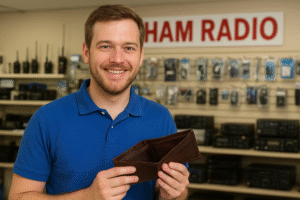
How Much Does It Cost to Get Into Amateur Radio?
For many newcomers, one of the first questions about amateur radio is: How much does it cost to get started? The answer depends on how far you want to go, what equipment you choose, and which license level you aim for. Fortunately, amateur radio is one of the most flexible hobbies—there are affordable entry points for just about anyone.
The License Levels
Before buying equipment, you’ll need a license. In the U.S., the Federal Communications Commission (FCC) issues three classes:
Technician Class
Entry-level license. Requires a 35-question exam. Privileges include access to local VHF/UHF bands (great for handheld radios, repeaters, and short-distance communications) plus some limited HF privileges.
General Class
Intermediate license. Requires passing the Technician test plus a 35-question General exam. Grants access to most HF bands, allowing worldwide communication.
Amateur Extra Class
The top license. Requires passing a 50-question exam after Technician and General. Provides all available amateur privileges on every band.
Cost of licensing: Most exam sessions cost between $15–$20, and the FCC currently charges a $35 application fee (10-year license term).
Entry-Level Equipment Costs
Once licensed, you’ll need a radio and antenna. Prices vary depending on your goals:
Technician Level – Local & Regional Communications
Handheld Transceivers (HTs):
Budget: $35–$60 (brands like Baofeng or Radioddity)
Midrange: $100–$300 (Yaesu, Icom, Kenwood, Anytone)
Mobile Radios (for car or home base):
$150–$350 for a 50-watt dual-band radio with more features.
Antennas:
Handheld whip antennas ($15–$30)
Home vertical VHF/UHF antennas ($50–$150)
Mobile mag-mount antennas ($30–$80)
Expected startup cost: Approximately $75–$400, depending on whether you opt for a handheld device or invest in a mobile setup.
General Class – Talking Around the World
For HF operation, you’ll need different gear:
HF Transceivers:
Entry-level used radios: $300–$500 (older Icom, Kenwood, Yaesu rigs)
New entry models: $600–$1,000 (Icom IC-718, Yaesu FT-710, Xiegu G90)
Antennas:
Wire dipoles or end-fed wires: $30–$150 (often homemade for less)
Vertical antennas: $150–$300
Portable/multi-band options: $200–$400
Accessories:
Power supply: $100–$200
Antenna tuner: $150–$300 (sometimes built into the radio)
Expected startup cost: $600–$1,500 for a capable HF station.
Amateur Extra Class – Full Privileges, Full Investment
Operators at this level often refine their stations:
High-end transceivers: $2,000–$6,000+ (Icom IC-7610, Yaesu FTdx101, FlexRadio SDRs)
Amplifiers: $1,000–$4,000 for more transmitting power
Directional antennas (beams, Yagis): $300–$2,000 depending on size and tower requirements
Expected investment: Easily $2,500–$10,000+, but many Extras continue to use modest General-class setups effectively.
Saving Money – Smart Ways to Start
Buy used equipment through local clubs, swap meets, and online marketplaces.
Build your own antennas—a roll of wire and a few insulators can outperform expensive commercial options.
Join a local ham radio club—many offer loaner radios, hands-on help, and practical advice.
Visual Guide: Startup Costs by License Level
The Bottom Line
Getting into amateur radio doesn’t have to break the bank. A Technician with a basic handheld can be on the air for under $100, while a General class operator can explore HF for under $1,000 with smart choices. At the high end, some enthusiasts spend tens of thousands building dream stations—but you don’t have to.
The beauty of amateur radio is that you can scale your investment over time. Start small, learn, and grow your station as your interests and skills develop.
In conclusion: Don’t be pressured to buy something that is out of your pay grade. Going into debt is not the path to pursue. Amateur Radio is a Hobby, not a career path
ABOUT THE AUTHOR:
Eric Werny, callsign WB6MTK, has dedicated more than six decades to the world of electronics and radio communications. With over 61 years of experience in electronics and 38 years in the professional two-way radio communications industry, Eric brings a depth of technical expertise and historical perspective rarely matched in the field.
His lifelong involvement in amateur radio began in his youth, sparking a passion that led to a distinguished career designing, maintaining, and advancing complex communications systems. Throughout his professional life, Eric has worked extensively with RF systems, infrastructure design, and advanced communications technologies, consistently focusing on reliability and innovation.
As both an amateur radio operator and seasoned communications engineer, Eric continues to advocate for the growth of the amateur service and the importance of technical education in the modern era. His writings reflect a unique blend of technical mastery, historical insight, and a genuine enthusiasm for radio as both a science and an enduring human connection.
© 2025 WB6MTK All Right Reserved