
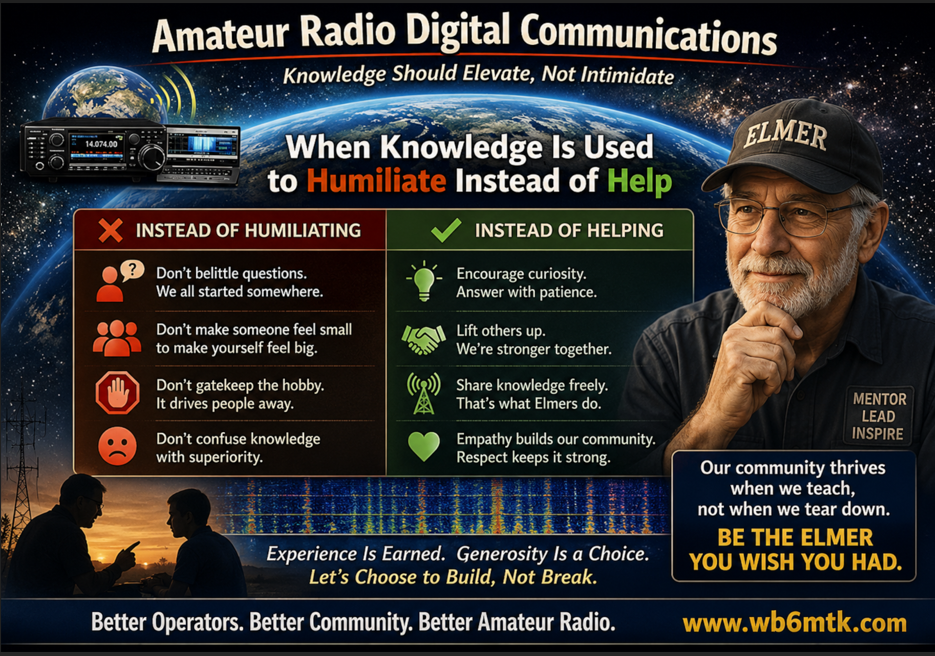
When Knowledge Is Used to Humiliate Instead of Help
Why Real Amateur Radio Expertise Requires Patience, Humility, and Respect
| Author | By Eric Werny, WB6MTK |
| Publisher: | WB6MTK.com |
| Topic: | Amateur Radio Operating Practice, Elmering, Mentoring, On-Air Courtesy |
| Audience: | New and experienced amateur radio operators |
Summary
Amateur radio depends on knowledge sharing. Experienced operators, engineers, technicians, and highly educated people can bring great value to the hobby when they teach with patience and humility. However, knowledge becomes harmful when it is used to embarrass, dominate, or publicly diminish another operator.
This article explains the difference between true mentoring and technical humiliation. It also gives practical, polite ways to respond when another operator turns a friendly QSO into a public critique.
Direct Definition
Using knowledge to humiliate means taking technical information, experience, education, or credentials and using them to make another operator feel foolish, inferior, or publicly embarrassed.
That is not Elmering.
That is not mentoring.
That is not good amateur radio practice.
Real expertise helps others grow. False superiority uses another person’s mistake as a stage.
The Difference Between Helping and Humiliating
Amateur radio has always depended on experienced operators helping newer operators. This tradition is often called Elmering. A good Elmer corrects mistakes, explains procedures, and teaches better habits. But the key difference is attitude.
A helpful operator says, in effect:
“Let me help you understand this better.”
A humiliating operator says, in effect:
“Let me show everyone that I know more than you.”
The first approach strengthens amateur radio.
The second approach damages it.
When Experience Becomes a Weapon
Some difficult operators may have strong academic, engineering, technical, military, commercial radio, or professional backgrounds. That experience can be very valuable. Many of the best amateur radio operators come from technical fields and have a lifetime of knowledge to share.
But problems arise when that knowledge is used to embarrass another operator rather than help them.
An operator may correct someone publicly, interrupt a QSO, lecture unnecessarily, or turn a casual contact into a technical examination. Instead of improving the conversation, they use the moment to dominate it.
The issue is not that they know something.
The issue is how they use what they know.
Insecurity Disguised as Intelligence
In some cases, this behavior may come from insecurity rather than true confidence. A person who lacks self-esteem may use another operator’s mistake as an opportunity to feel superior.
Instead of offering quiet guidance, they may seem to enjoy:
- Correcting someone in front of others
- Making another operator look unprepared
- Turning a small error into a public lesson
- Showing off credentials, degrees, or career experience
- Making the other person feel small
This is especially damaging to new operators. A beginner who is publicly embarrassed may become reluctant to transmit again. That is a serious loss to the hobby.
Schadenfreude: Taking Pleasure in Another Person’s Embarrassment
There is a word for taking pleasure in another person’s embarrassment or misfortune: schadenfreude.
In the amateur radio setting, this can appear when an operator seems to enjoy watching someone struggle, especially if that struggle gives them a chance to appear smarter, more experienced, or more technically advanced.
That attitude has no place in good operating practice.
A knowledgeable operator does not need another person to fail in order to feel successful. True confidence does not require public humiliation.
Real Expertise Carries Responsibility
The more a person knows, the more carefully they should communicate.
A skilled operator should understand that words carry weight. When someone with technical authority speaks harshly, newer operators may take it deeply. A careless correction can do more damage than the original mistake.
Real expertise requires judgment. It asks:
- Is this correction necessary right now?
- Would this be better handled privately?
- Am I helping this operator, or am I performing for others?
- Will my words encourage them to improve, or discourage them from participating?
Technical knowledge should be used to lift others up, not push them down.
What This Behavior Is Not
Public humiliation is not Elmering.
It is not leadership.
It is not technical excellence.
It is not “just being honest.”
It is not protecting the hobby.
It is poor communication wrapped in technical language.
A license, degree, career history, or engineering background does not give anyone permission to belittle another amateur radio operator.
How to Respond Without Feeding the Problem
The best response is usually not to challenge the person’s intelligence, credentials, or technical background. That often gives the difficult operator exactly what they want: a longer argument and a larger audience.
Instead, calmly remove the opportunity for the performance to continue.
You can say:
“I understand your point. I’m not looking for a public critique right now.”
Or:
“Thanks for the information. I prefer to handle corrections privately.”
Or:
“I appreciate your background, but this contact was intended to be friendly, not a technical review.”
Or simply:
“Thanks. I’m going to move on. 73.”
The goal is not to win the argument.
The goal is to end the performance.
Why Calmness Works
A difficult operator often wants an emotional response. They may want frustration, embarrassment, defensiveness, or debate. When you stay calm, you deny them that reward.
A composed operator who refuses to be pulled into public embarrassment often ends the behavior more effectively than direct confrontation.
You do not need to prove yourself.
You do not need to defend every mistake.
You do not need to match their tone.
You can simply remain professional and move on.
A Better Standard for Amateur Radio
The best amateur radio operators understand that intelligence without kindness is not leadership.
Knowing more does not make someone a better operator unless that knowledge is used responsibly. The highest standard in amateur radio is not merely technical skill. It is the ability to help others become better without making them feel smaller.
A good operator improves the band.
A good Elmer improves people.
A good leader protects the spirit of the hobby.
Practical Examples
Poor Response
“You obviously don’t understand how this works.”
This response embarrasses the other operator and creates resentment.
Better Response
“There is a small adjustment that may help your signal. I can explain it after the net if you would like.”
This response preserves dignity and offers useful help.
Poor Response
“I have been doing this for 40 years, and you’re doing it wrong.”
This makes the conversation about status instead of learning.
Better Response
“I have run into that issue before. Here is what usually works better.”
This shares experience without arrogance.
Poor Response
“Everyone on frequency can hear how bad your audio is.”
This publicly humiliates the operator.
Better Response
“Your audio may be a little low. You might want to check your mic gain when you have a chance.”
This gives useful information without ridicule.
Guidance for Experienced Operators
If you are an experienced operator, remember that your tone may shape whether someone stays active in amateur radio.
Before correcting someone, ask yourself:
“Am I trying to help, or am I trying to be seen as correct?”
That question separates mentoring from ego.
The amateur radio community needs knowledgeable operators. But it needs knowledgeable operators who can teach with patience, humility, and respect.
Guidance for New Operators
If you are new and someone embarrasses you on the air, remember this:
One rude operator does not represent the entire hobby.
Most amateur radio operators want to help. Many remember what it felt like to be new, uncertain, or nervous on the microphone. Do not allow one person’s poor behavior to define your confidence.
Learn from correction when it is useful.
Reject humiliation when it is unnecessary.
Keep operating.
Frequently Asked Questions
Is it wrong to correct another operator?
No. Correction is sometimes necessary. The issue is how it is done. Helpful correction is respectful, brief, and appropriate. Humiliating correction is public, excessive, and designed to make someone look inferior.
Should I argue with a difficult operator?
Usually, no. Arguing often gives the person more attention. A calm closing statement and moving on is usually more effective.
What if the person really does know more than I do?
They may know more technically, but that does not give them the right to belittle you. Knowledge and courtesy should go together.
Is this only a problem with highly technical people?
No. Any operator can behave this way. However, strong credentials or technical experience can sometimes be used as a tool to dominate others.
What is the best short response?
A simple and effective response is:
“Thanks. I’m going to move on. 73.”
It is polite, final, and does not invite further debate.
Final Thought
Amateur radio is not only about radios, antennas, frequencies, and technical knowledge. It is also about communication between people.
The operator who knows the most is not always the operator who contributes the most. The greatest contribution comes from those who use their knowledge to encourage, guide, and strengthen others.
Real expertise does not humiliate.
Real expertise helps.
