Emergency Traffic Under the ARRL National Traffic System
How Amateur Radio Operators Move Formal Messages When Normal Communications Fail
Emergency communications is one of the most respected public-service roles in amateur radio. When storms, wildfires, earthquakes, power failures, cyber incidents, or infrastructure outages disrupt normal communications, amateur radio operators may be asked to assist with passing information. In that environment, casual conversation is not enough. Messages must be accurate, brief, traceable, and handled in a disciplined manner.
That is where the ARRL National Traffic System, commonly called NTS, becomes important.
The NTS is a structured method for moving formal written messages by amateur radio. It provides a standard message format, organized nets, trained operators, and a relay system that can move traffic from one local area to another across a region, across a section, or even across the country.
At its best, the NTS is not just a radio procedure. It is a communications discipline.
1. What Is the ARRL National Traffic System?
The ARRL National Traffic System is a formal message-handling system used by amateur radio operators to originate, relay, deliver, and track written messages. These messages are usually called “traffic.”
Traffic may be routine, welfare-related, priority, or emergency. The same basic format is used whether the message says “Happy birthday” or reports an urgent need for medical supplies. The difference is in the precedence assigned to the message and the speed with which it is handled.
The purpose of the NTS is to ensure that messages can be accurately passed through multiple operators without losing meaning, omitting important details, or introducing personal interpretation.
In emergency communications, that matters greatly. A misunderstood message can waste resources, delay response, or create confusion during an already difficult event.
2. Why Formal Traffic Matters in an Emergency
Many new operators assume emergency communications means simply getting on the air and reporting what they see. Sometimes that is useful, especially during local situational awareness nets. However, formal emergency traffic is different.
Formal traffic is used when the message must be:
Accurate enough to be acted upon.
Written in a standard format.
Passed through one or more relay stations.
Delivered to a specific person, agency, office, or organization.
Logged for accountability.
Repeated exactly as originated.
In an emergency, a message such as “We need help” is not enough. A formal message should identify who needs help, where they are, what kind of help is required, how urgent the matter is, and who is responsible for receiving the message.
The NTS system helps remove emotion, confusion, and unnecessary words from the process.
3. The Difference Between Casual Radio Reports and Formal NTS Traffic
Not all radio communication during an emergency is NTS traffic.
A local net may take informal reports such as:
“Power is out on the west side of town.”
“Roadway flooding observed near the bridge.”
“Shelter has opened at the community center.”
These are useful reports, but they may not be considered formal traffic unless they are formatted as a message and assigned for delivery.
Formal NTS traffic differs in that it includes a structured header, an addressee, a message body, a signature, and handling information. It is meant to survive being passed from one operator to another without becoming distorted.
Informal reports help build awareness.
Formal traffic creates a deliverable message.
Both are useful, but they are not the same thing.
4. The Radiogram: The Heart of NTS Message Handling
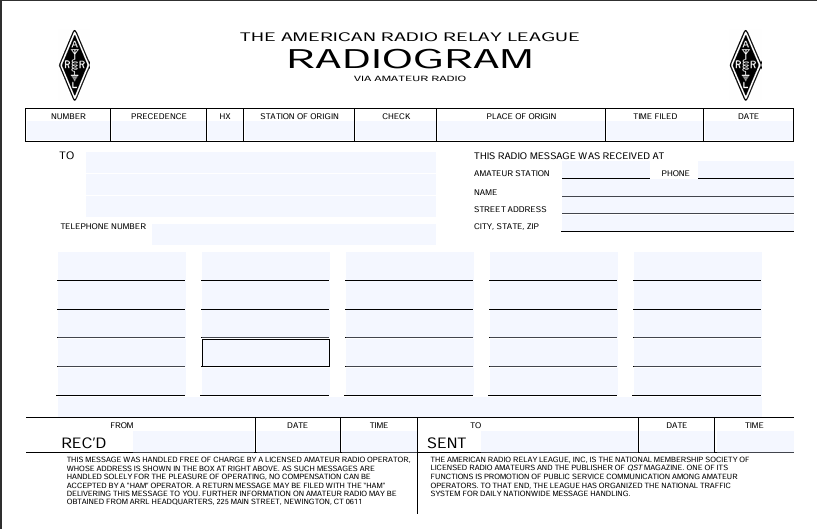
The standard written message used in the NTS is commonly known as an ARRL Radiogram. The radiogram provides a consistent structure so that every trained traffic handler understands where each piece of information belongs.
A typical radiogram includes:
Message number.
Precedence.
Handling instructions, if needed.
Station of origin.
Check.
Place of origin.
Time filed, if used.
Date.
Addressee information.
Message text.
Signature.
Each part has a purpose. The format may look old-fashioned to someone used to email or text messaging, but it exists for one reason: accuracy under difficult conditions.
When signals are weak, operators are tired, noise is high, and relays are necessary, structure becomes your friend.
5. Message Number
Every formal message should have a message number assigned by the originating station. This number helps the operator track the message in the station log.
Example:
NR 12
This means the message number is 12.
The number does not need to be globally unique across the entire country. It is generally unique to the originating station’s message log. The message number allows a station to later confirm whether a specific message was sent, relayed, serviced, or delivered.
In emergency operations, good numbering prevents confusion.
6. Precedence: How Urgent Is the Message?
Precedence tells receiving stations and net control how quickly the message should be handled. In NTS practice, common precedence levels include:
Emergency
Emergency traffic involves a threat to life, serious injury, major property damage, or an urgent public safety situation. This is the highest level of traffic and should be handled immediately.
Emergency traffic should not be used casually. Assigning emergency precedence to a message that is not truly urgent damages trust and disrupts net operations.
Example use:
A request for urgent medical assistance.
A report of trapped persons.
A critical evacuation message.
A life-safety resource request.
Priority
Priority traffic is important and time-sensitive, but not necessarily an immediate life-or-death matter.
Example use:
Shelter supply needs.
Operational messages between emergency management locations.
Important logistical information.
Requests for transportation, equipment, or staffing.
Welfare
Welfare traffic usually concerns the health and welfare of individuals in or near a disaster area. These messages are often used to inquire about or report the condition of a person.
Example use:
“Please advise condition of John Smith after wildfire evacuation.”
“Family safe at Red Cross shelter.”
Routine
Routine traffic is normal message traffic without urgency. It is still handled carefully, but it does not take priority over emergency, priority, or welfare traffic.
Example use:
Training messages.
Administrative messages.
Non-urgent personal messages.
7. Handling Instructions
Handling instructions provide additional guidance on how a message should be delivered or serviced. These are optional but useful when the sender wants a confirmation, delivery notice, or special handling.
For example, an instruction may request that the originating station be notified of delivery. Other instructions may request a reply, limit delivery attempts, or provide guidance on how service messages should be handled.
In emergency use, handling instructions should be used carefully. Do not overload the message with unnecessary instructions. The goal is to move essential information efficiently.
8. Station of Origin
The station of origin is the amateur radio call sign of the station that first placed the message into the NTS system.
Example:
WB6MTK
This does not always mean the person who wrote the message is the radio operator. For example, an emergency manager, shelter supervisor, neighborhood coordinator, or served-agency representative may create the message content. The amateur radio operator may then originate it into the traffic system.
The station of origin accepts responsibility for placing the message into the system in proper format.
9. The Check: A Built-In Accuracy Tool
The “check” is the number of words or word groups in the text portion of the message.
This is one of the most important accuracy safeguards in the radiogram format.
If the message text contains 18 words, the check is 18.
The receiving operator counts the received words and compares that count to the check. If the count does not match, the operator knows something may have been missed, added, or copied incorrectly.
In emergency traffic, the check helps detect errors before they become operational problems.
Example:
NR 12 PRIORITY WB6MTK 18 ST GEORGE UT MAY 7
This means the message text should contain 18 words or groups.
10. Place of Origin, Time, and Date
The place of origin identifies the source of the message. This is usually the city and state.
Example:
ST GEORGE UT
The date tells when the message originated.
Time may be included when needed, especially for emergency or priority traffic. Time is especially useful when the operational situation is changing rapidly.
During a disaster, a message that was accurate six hours ago may no longer be accurate. Including time can prevent outdated information from being mistaken for current information.
11. The Addressee
The addressee is the person, office, agency, or organization to whom the message is directed.
A complete addressee block should include:
Name.
Title or organization, if applicable.
Street address or location, if needed.
City and state.
Telephone number, email, or delivery method, if available.
In emergency communications, the addressee might be:
Emergency Operations Center.
Shelter manager.
Hospital communications unit.
Neighborhood watch captain.
Public works supervisor.
Incident command post.
County emergency manager.
The more precise the addressee, the easier it is to deliver the message correctly.
A message addressed vaguely to “the city” may be difficult to route. A message addressed to “Washington City Emergency Operations Center, Operations Section Chief” is much better.
12. The Message Text
The message text is the body of the radiogram. This is where the actual information appears.
The text should be:
Short.
Clear.
Specific.
Free of unnecessary emotion.
Free of ambiguous wording.
Written so it can be understood by the recipient without extra explanation.
NTS messages traditionally limit the text to a small number of words. This forces discipline. Operators should avoid long paragraphs, unnecessary adjectives, and conversational language.
Poor emergency message:
“Things are really bad over here, and we really need someone to come as soon as possible because people are scared and we do not know what to do.”
Better formal message:
“REQUEST TWO PARAMEDICS AND TRANSPORT FOR THREE INJURED PERSONS AT 455 NORTH MAIN STREET.”
The second message is actionable. It identifies the need, the resource, the number of people, and the location.
13. The Signature
The signature identifies the person or authority responsible for the message content.
This is not always the same as the amateur radio operator.
Example:
JOHN SMITH SHELTER MANAGER
or
WASHINGTON CITY EOC OPERATIONS
In served-agency work, the signature is extremely important. Amateur radio operators should not invent, modify, or authorize operational messages on behalf of an agency unless specifically directed to do so.
The radio operator moves the message.
The responsible official owns the message content.
14. Emergency Traffic Must Be Exact
One of the most important rules in NTS message handling is this:
Do not improve the message while relaying it.
This is difficult for some operators. They may think they are helping by changing a word, correcting grammar, adding a detail, or making the message sound better.
That is dangerous.
The job of the traffic handler is not to rewrite the message. The job is to pass it accurately.
If a message is unclear, the operator should ask the originating party for clarification before sending it. Once the message is released into the traffic system, it should remain intact.
Accuracy is more important than style.
15. Tactical Nets Versus Traffic Nets
During an emergency, different types of nets may operate simultaneously.
A tactical net handles immediate operational communication. This may include field reports, resource coordination, shelter status, road closures, weather observations, or direct support to an incident.
A traffic net handles formal written messages that need to be relayed, logged, and delivered.
Both are important, but they should not be confused.
A tactical net may sound like:
“Net control, this is Shelter Two. We have 43 people checked in and need more blankets.”
A formal NTS message may be created from that information:
“REQUEST FIFTY BLANKETS FOR SHELTER TWO CURRENT OCCUPANCY FORTY THREE PERSONS.”
The tactical net provides immediate awareness.
The traffic system provides formal message movement.
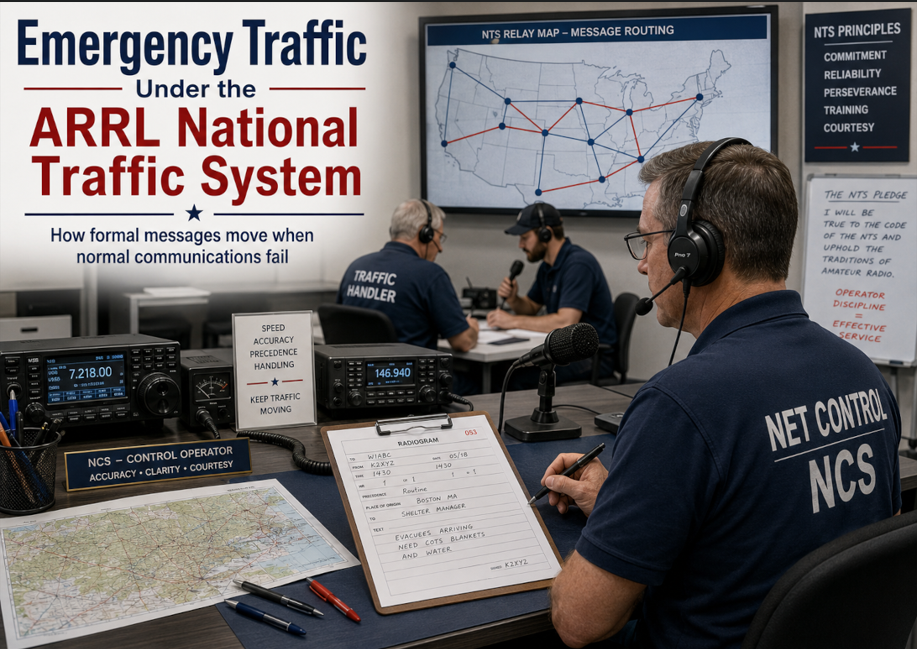
16. Net Control’s Role in Emergency Traffic
Net Control Station, or NCS, manages the flow of communication on a net. During emergency traffic handling, net control must maintain discipline and prioritize traffic properly.
Net control should know:
Who has emergency traffic?
Who has priority traffic?
Which stations can relay?
Which stations are assigned to receive traffic?
Which frequencies or nets are available for movement?
When to move traffic off the main net frequency.
A well-trained net control operator keeps the net from becoming chaotic.
Emergency traffic should usually be moved immediately. Routine and welfare traffic may wait until higher-precedence traffic has been handled.
17. The Role of Liaison Stations
A liaison station connects one net to another. This is one of the key strengths of the NTS system.
For example, a local net may collect messages from operators in a city or county. A liaison station may then take outgoing messages from that local net to a section net. From there, messages can move to region or area nets, eventually reaching another local net near the destination.
Without liaison stations, local nets can become isolated.
With liaison stations, local information can be shared across a wide geographic area even when phones, the internet, or commercial systems are unavailable.
In a post-infrastructure situation, liaison operators become extremely valuable.
18. The Path of a Message Through the NTS
A message may move through several levels:
Local net.
Section net.
Region net.
Area net.
Destination section net.
Destination local net.
Delivery station.
Not every message requires every level. A message within the same county may remain local. A message from Utah to another state may require handling at the section, region, and area levels.
The beauty of the system is that each operator only needs to move the message to the next proper point. No single station must do everything.
This is a relay system.
19. Delivery of Emergency Traffic
A message is not complete until it is delivered or a service message is generated explaining why it could not be delivered.
Delivery may occur by:
Radio.
Telephone.
In person.
Email, if available and appropriate.
Direct handoff to an agency representative.
Runner or courier in extreme cases.
The delivering operator should record when and how the message was delivered. For important traffic, especially priority or emergency traffic, a confirmation may be required.
If delivery cannot be made, the originating station may need to be notified by a service message.
20. Service Messages
A service message reports the status of another message.
For example, a service message may say:
The message was delivered.
The addressee could not be located.
The phone number was invalid.
The recipient requested a reply.
The message was refused.
Service messages are important because they close the loop. In emergency communications, an undelivered message can be just as important as a delivered one.
If a request for help fails to reach the intended recipient, someone needs to know that.
21. Logging and Accountability
Every traffic-handling station should keep a log.
A useful traffic log includes:
Message number.
Date and time received.
Station received from.
Station sent to.
Precedence.
Destination.
Delivery status.
Notes or service action.
In a routine training net, logging may seem tedious. In an actual emergency, it is essential.
Logs help answer critical questions:
Was the message sent?
Who received it?
When was it delivered?
Was it relayed correctly?
Was there a reply?
Was the message duplicated?
Was the message still pending?
Without logs, the system loses accountability.
22. Common Errors in Emergency Traffic Handling
New and experienced operators alike can make mistakes. Some of the most common include:
Changing the wording of a message.
Failing to count the check correctly.
Using emergency precedence for non-emergency traffic.
Sending messages that are too long.
Failing to identify the correct addressee.
Not logging messages.
Not confirming delivery.
Using jargon the recipient may not understand.
Mixing tactical conversation with formal message traffic.
Allowing emotional language to replace clear facts.
The cure for these problems is training, practice, and discipline.
23. Plain Language Is Usually Best
While amateur radio has many abbreviations, Q-signals, and procedural habits, emergency traffic should be understandable to the final recipient.
The person receiving the message may not be a radio operator. They may be a shelter manager, a city official, a nurse, a police dispatcher, or a neighborhood coordinator.
Avoid unnecessary radio slang in the message text.
Instead of:
“QSL needs more ops at QTH ASAP.”
Use:
“REQUEST FOUR ADDITIONAL RADIO OPERATORS AT SHELTER THREE AS SOON AS POSSIBLE.”
Plain language reduces misunderstanding.
24. Emergency Traffic and Served Agencies
When amateur radio operators support emergency management, hospitals, shelters, public safety, or community organizations, they must remember their role.
The operator is not in command unless specifically assigned that role.
The operator should not self-deploy.
The operator should not create official agency messages without authorization.
The operator should not promise resources.
The operator should not change the meaning of a served-agency message.
The professional amateur radio operator supports the communications mission with calm, disciplined service.
The best operators are not the loudest voices on the net. They are the ones who pass accurate traffic under pressure.
25. Message Brevity and Message Quality
A good emergency message should be short, but not vague.
Too short:
“Need water.”
Better:
“REQUEST 200 BOTTLES OF DRINKING WATER FOR SHELTER TWO BY 1800 HOURS.”
This message identifies the resource, quantity, destination, and time needed.
The goal is not merely to reduce words. The goal is to preserve operational meaning with the fewest necessary words.
26. Training With Routine Traffic
Operators should not wait for a disaster to learn traffic handling. The best way to become useful during an emergency is to practice during normal times.
Routine NTS nets are excellent training grounds. Operators learn how to:
Check into a net.
List traffic.
Copy radiograms.
Send messages clearly.
Ask for fills.
Relay traffic.
Count checks.
Deliver messages.
Generate service messages.
Maintain logs.
Training traffic may seem simple, but it builds the habits needed during a real emergency.
A station that cannot handle routine traffic cleanly will struggle with emergency traffic under stress.
27. Voice, CW, and Digital Traffic Handling
NTS traffic can be handled by voice, CW, and digital methods.
Voice is accessible and widely used, especially on VHF and local nets.
CW is highly effective in weak-signal or poor-propagation conditions and remains valuable because it can get through when voice may fail.
Digital methods can be efficient for moving written traffic, especially when accuracy and record-keeping are important.
Each mode has strengths. Emergency planners should not rely on only one method. A robust communications plan should include local VHF/UHF voice, HF voice, CW capability where available, and appropriate digital methods.
The best emergency communications system is layered.
28. Local Emergency Use of NTS Concepts
Even if a local group does not formally activate the full NTS structure, the principles are still valuable.
A neighborhood emergency net can benefit from:
Message numbering.
Written traffic forms.
Clear precedence.
Accurate addressee information.
Word counts.
Station logs.
Delivery confirmation.
Net discipline.
Formal traffic methods can be scaled down for local use. A community does not need a nationwide disaster to benefit from disciplined message handling.
For a place like Southern Utah, where wildfire, power failure, flash flooding, communications outages, and transportation disruptions are realistic concerns, formal message handling can provide a practical local capability.
29. Example Emergency Radiogram
Below is a simplified example of how emergency traffic might look in radiogram form.
Header:
NR 17 EMERGENCY WB6MTK 14 ST GEORGE UT 1530 MAY 7
To:
WASHINGTON CITY EOC OPERATIONS SECTION
Message text:
REQUEST AMBULANCE FOR TWO INJURED PERSONS AT 455 NORTH MAIN STREET, ENTRANCE BLOCKED BY DEBRIS
Signature:
JOHN ADAMS NEIGHBORHOOD WATCH CAPTAIN
In this example:
The message number is 17.
The precedence is Emergency.
The station of origin is WB6MTK.
The check is 14.
The place of origin is St. George, Utah.
The time filed is 1530.
The date is May 7.
The addressee is the Washington City EOC Operations Section.
The message text clearly requests the number of injured persons, location, and the access problem.
The signature identifies the responsible originator.
30. The Operator’s Mindset
Emergency traffic handling requires the right temperament.
A good traffic handler is:
Calm.
Accurate.
Patient.
Disciplined.
Brief.
Reliable.
Unemotional on the air.
Willing to follow the net procedure.
Willing to ask for clarification.
Willing to admit when a copy was missed.
The worst traffic handler is the operator who guesses, assumes, improvises, talks too much, or tries to sound important.
Formal traffic is not about ego. It is about service.
31. How to Ask for a Fill
When receiving traffic, do not pretend you copied something if you did not. Ask for a fill.
A “fill” is a request for missing or unclear information.
Examples:
“Say word after REQUEST again.”
“Say again all before STREET.”
“Confirm check.”
“Confirm addressee.”
“Spell name phonetically.”
Professional operators ask for fills when needed. Guessing is unacceptable.
It is better to slow down and copy the message correctly than to move bad traffic quickly.
32. Phonetics and Difficult Words
Use standard phonetics when spelling names, locations, addresses, or unusual terms.
Example:
“WERNy, spelled Whiskey Echo Romeo November Yankee.”
For numbers, speak clearly and confirm critical values.
Addresses, phone numbers, medication names, road names, and coordinates require special care.
A single wrong digit in an address can send help to the wrong place.
33. Emergency Traffic Should Be Prioritized, Not Dramatized
Operators should avoid dramatic language on the air. The precedence already tells the net the urgency.
Instead of saying:
“This is extremely serious and terrible, and we really need help right now.”
Say:
“Emergency traffic.”
Then pass the message in proper format.
The radio net is not the place for emotional commentary. Clear procedure protects the message.
34. Preparing a Local Group for NTS Traffic
A local amateur radio group should consider regular training in formal traffic handling. Useful training activities include:
Monthly radiogram practice.
Simulated emergency nets.
Message relay drills.
Shelter-to-EOC message exercises.
HF relay practice.
VHF simplex message drills.
Nighttime weak-signal drills.
Traffic logging exercises.
Delivery confirmation drills.
A group should also maintain printed message forms, pencils, clipboards, frequency plans, and laminated quick-reference cards.
Emergency communication fails when the system depends only on memory.
35. Recommended Go-Kit Items for Traffic Handling
A traffic handler’s go-kit should include:
Printed radiogram forms.
Net log sheets.
Pencils and pens.
Clipboard.
Watch or clock.
Local frequency list.
Repeater and simplex plan.
Call sign roster, if available.
Served-agency contact list.
Headphones or speaker.
Backup power.
Flashlight.
Plain-language procedural guide.
The most important tool is not the radio. It is the ability to accurately write, send, receive, and log information.
36. Why NTS Still Matters Today
Some operators believe formal traffic systems are outdated because modern communications are fast and convenient. That view misses the point.
The NTS is not trying to compete with cell phones during normal conditions. It exists because normal systems can fail, overload, become unavailable, or be unsuitable for certain situations.
The value of NTS is not nostalgia. Its value is discipline.
It teaches operators how to move information accurately under adverse conditions. That skill remains relevant regardless of technology.
When the internet works, use the internet.
When phones work, use phones.
When infrastructure fails, amateur radio operators need a method that still works.
NTS provides that method.
37. Final Thoughts
Emergency traffic under the ARRL National Traffic System is one of the most serious responsibilities in amateur radio. It requires more than having a radio and a license. It requires training, humility, accuracy, and respect for procedure.
The professional emergency communicator does not use the radio to impress others. He or she uses the radio to move important information from the person who has it to the person who needs it.
That is the heart of traffic handling.
In an emergency, every word matters. Every message must be handled with care. Every operator in the chain has a duty to preserve accuracy.
The NTS system gives amateur radio operators a proven framework for doing exactly that.
For WB6MTK.com, the lesson is clear:
Amateur radio emergency communications is not just about transmitting. It is about delivering the right message to the right person, in the right format, at the right time.
As an example, include the ARRL Radio Gram.
Thought for a second
Below is an article-ready section you can insert after the discussion of the radiogram.
Example of an ARRL Radiogram for Emergency Traffic
The ARRL Radiogram is the standard written message form used in the National Traffic System. It gives operators a disciplined way to originate, relay, receive, and deliver formal traffic without altering the message’s meaning.
A radiogram is especially useful during emergencies because it forces the sender to identify the priority, destination, exact message wording, message length, and responsible originator.
Sample ARRL Radiogram
Number: 17
Precedence: EMERGENCY
Handling Instructions: HXC
Station of Origin: WB6MTK
Check: 14
Place of Origin: ST GEORGE UT
Time Filed: 1530
Date: MAY 7
Precedence: EMERGENCY
Handling Instructions: HXC
Station of Origin: WB6MTK
Check: 14
Place of Origin: ST GEORGE UT
Time Filed: 1530
Date: MAY 7
To:
Washington City Emergency Operations Center
Operations Section Chief
Washington City, Utah
Washington City Emergency Operations Center
Operations Section Chief
Washington City, Utah
Telephone: If available
Email: If available
Email: If available
Message Text:
REQUEST AMBULANCE FOR TWO INJURED
PERSONS AT 455 NORTH MAIN
STREET ENTRANCE BLOCKED BY DEBRIS
PERSONS AT 455 NORTH MAIN
STREET ENTRANCE BLOCKED BY DEBRIS
Signature:
John Adams
Neighborhood Watch Captain
John Adams
Neighborhood Watch Captain
Same Example in Traditional Radiogram Line Format
NR 17 EMERGENCY HXC WB6MTK 14 ST GEORGE UT 1530 MAY 7
WASHINGTON CITY EMERGENCY OPERATIONS CENTER
OPERATIONS SECTION CHIEF
WASHINGTON CITY UT
OPERATIONS SECTION CHIEF
WASHINGTON CITY UT
REQUEST AMBULANCE FOR TWO INJURED
PERSONS AT 455 NORTH MAIN
STREET ENTRANCE BLOCKED BY DEBRIS
PERSONS AT 455 NORTH MAIN
STREET ENTRANCE BLOCKED BY DEBRIS
JOHN ADAMS
NEIGHBORHOOD WATCH CAPTAIN
NEIGHBORHOOD WATCH CAPTAIN
Breakdown of the Radiogram Example
Number
NR 17
This is the message number assigned by the originating station. It allows the operator to track the message in the station log.
Precedence
EMERGENCY
This tells all stations that the message concerns immediate life safety or serious emergency action. Emergency precedence should be used only when the message involves an urgent danger to life, serious injury, or major public safety consequences.
Handling Instruction
HXC
This means a delivery report is requested. In emergency communications, this can be important because the originating station may need confirmation that the message reached the proper authority.
Station of Origin
WB6MTK
This is the amateur radio station that placed the message into the traffic system.
Check
14
The check is the number of words or word groups in the message text. It is used to verify that the receiving operator correctly copied the message.
In this example, the message text is counted as:
- REQUEST
- AMBULANCE
- FOR
- TWO
- INJURED
- PERSONS
- AT
- 455
- NORTH
- MAIN
- STREET
- ENTRANCE
- BLOCKED
- DEBRIS
The check confirms that the receiving station copied 14 words or groups.
Place of Origin
ST GEORGE UT
This identifies where the message originated.
Time Filed
1530
This is the time the message was filed. Time is especially important in emergency traffic because conditions can change quickly.
Date
MAY 7
This identifies the date the message originated.
Addressee
The message is addressed to:
WASHINGTON CITY EMERGENCY OPERATIONS CENTER
OPERATIONS SECTION CHIEF
OPERATIONS SECTION CHIEF
This is more useful than simply saying “the city” or “emergency management.” A formal message should be addressed to the person, office, or function that can act on it.
Message Text
REQUEST AMBULANCE FOR TWO INJURED PERSONS AT 455 NORTH MAIN STREET ENTRANCE BLOCKED BY DEBRIS
This message is short, direct, and actionable. It identifies:
The resource needed: ambulance.
The number of injured persons: two.
The location: 455 North Main Street.
The access problem: entrance is blocked by debris.
Signature
JOHN ADAMS NEIGHBORHOOD WATCH CAPTAIN
The signature identifies the person responsible for the message content. The amateur radio operator is responsible for transmitting the message accurately, but the signer is responsible for the substance of the request.