
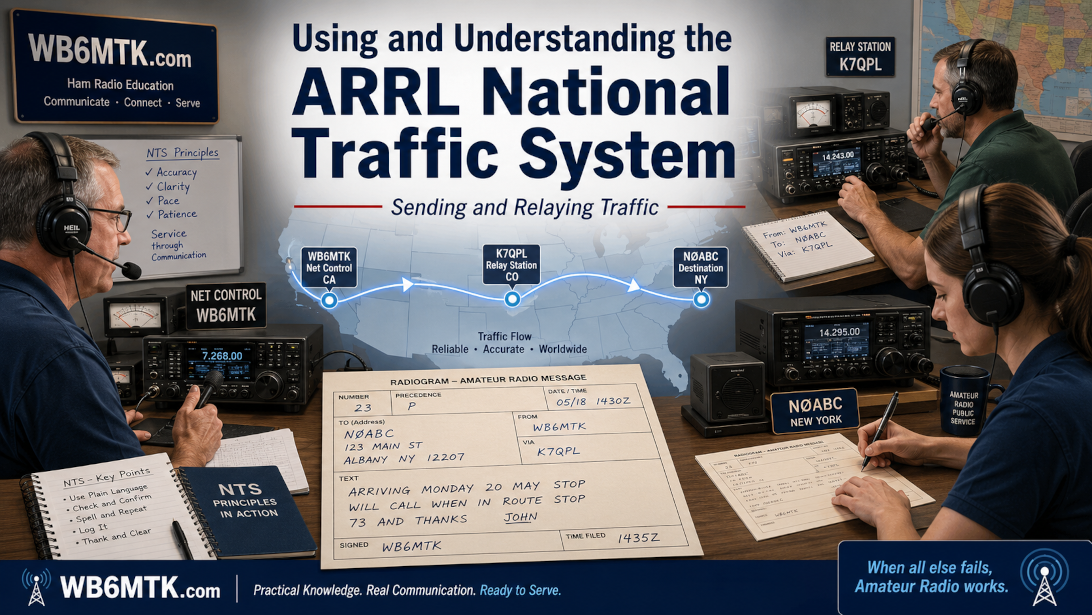
Using and Understanding the ARRL National Traffic System Method of Sending and Relaying Traffic
A practical guide to formal message handling, radiograms, nets, and disciplined amateur radio traffic relay
| Author: | Eric Werny, WB6MTK |
| Publisher: | WB6MTK.com |
| Topic: | Amateur Radio, Emergency Communications, ARRL NTS, Radiogram Traffic Handling |
| Recommended audience: | New amateur radio operators, emergency communications volunteers, net control stations, ARES/RACES participants, and radio club training groups |
| Last reviewed: | May 2026 |
Summary
The ARRL National Traffic System, commonly called NTS, is a structured amateur radio message-handling system designed to move written messages accurately from one location to another by radio. It uses organized nets, trained operators, standard message formats, relay stations, and delivery procedures to ensure that information is passed clearly and reliably.
The basic message form used in the system is the ARRL Radiogram. A radiogram contains specific fields such as message number, precedence, handling instructions, station of origin, check, place of origin, filing time, filing date, address, message text, signature, and delivery information.
The purpose of NTS is not casual conversation. Its purpose is accurate written message transfer. This makes it valuable for emergency communications, public service events, welfare traffic, training, and situations where normal communications may be disrupted.
Definition
The ARRL National Traffic System is an organized amateur radio network for sending, receiving, relaying, and delivering formal written messages using standardized procedures and message formats.
A properly handled NTS message should be:
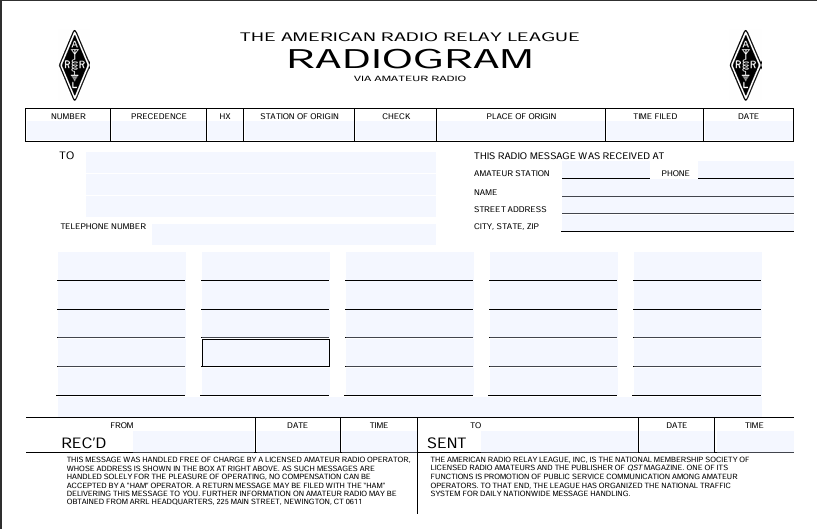
Downloadable – Fillable Radiogram Form
- Written down
- Numbered
- Given a precedence
- Checked for word count accuracy
- Relayed using standard procedure
- Delivered to the intended recipient
- Logged by the stations involved
The NTS method exists because radio voice communication can easily introduce errors. Names, numbers, addresses, phone numbers, times, locations, and instructions must be copied correctly. Formal traffic handling reduces misunderstanding by using a disciplined message format.
Why the National Traffic System Matters
Many new amateur radio operators first encounter ham radio through repeaters, handheld radios, casual nets, or digital modes. These are useful parts of amateur radio, but they do not automatically teach formal message discipline.
The National Traffic System teaches operators how to move information in a way that is:
- Organized
- Repeatable
- Verifiable
- Logged
- Efficient
- Suitable for emergency or public service use
During an emergency, a radio operator may need to pass a message exactly as received. That message may involve a shelter request, welfare inquiry, supply need, road condition, evacuation notice, or family status update.
In those cases, “close enough” is not good enough.
The NTS method trains operators to slow down, copy accurately, confirm message structure, and deliver the message responsibly.
What Kind of Messages Can Be Sent Through NTS?
NTS traffic may include several types of messages.
Common examples include:
- Welfare messages
- Emergency-related messages
- Public service event messages
- Training messages
- Administrative messages
- Operator-to-operator greetings
- Test messages for practice
- Club announcements
- Disaster relief communications
- Requests for information or supplies
A simple welfare message may say:
“ARRIVED SAFELY IN ST GEORGE X WILL CALL WHEN PHONES RESTORED”
A public service message may say:
“REST STOP THREE NEEDS TWO CASES WATER AND ONE MEDICAL VOLUNTEER”
A training message may say:
“THIS IS A PRACTICE RADIOGRAM TO IMPROVE MESSAGE HANDLING SKILLS”
The system is useful because the format remains the same whether the message is routine or urgent.
The ARRL Radiogram
The ARRL Radiogram is the standard written message form commonly associated with NTS traffic. It gives the message a fixed structure so that operators know exactly what information to send, copy, relay, and deliver.
A radiogram usually contains these main parts:
- Preamble
- Address
- Text
- Signature
- Delivery information
Each part has a specific purpose.
Part 1: The Preamble
The preamble identifies the message and provides the handling information needed to move it through the system.
A typical preamble includes:
- Message number
- Precedence
- Handling instructions, if any
- Station of origin
- Check
- Place of origin
- Time filed, if used
- Date filed
Example:
NR 12 R WB6MTK 14 ST GEORGE UT MAY 9
This means:
- NR 12 — Message number 12
- R — Routine precedence
- WB6MTK — Station of origin
- 14 — Check, meaning 14 words in the message text
- ST GEORGE UT — Place of origin
- MAY 9 — Date filed
The preamble is important because it helps operators track, verify, prioritize, and troubleshoot the message.
Message Number
The message number is assigned by the station that originates the message. It identifies the message in the originating station’s log.
Example:
NR 12
This means it is message number 12 from the originating station.
The number does not have to match any other station’s numbering system. It belongs to the station that created the message.
Precedence
Precedence tells operators how quickly the message should be handled. It is not about drama or personal importance. It is about message priority.
Common NTS precedence levels include:
Emergency
Used for messages having life-and-death urgency or requests for immediate emergency assistance.
Emergency traffic receives top priority.
Priority
Used for important messages with a specific time value, often related to emergency operations but not immediately life-threatening.
Welfare
Used for inquiries or reports about the health and welfare of individuals in a disaster area.
Routine
Used for normal traffic, training messages, greetings, administrative messages, and non-urgent communication.
Most practice traffic is Routine.
Operators should not overstate precedence. Calling a message “Emergency” when it is not truly emergency traffic damages the discipline of the system.
Handling Instructions
Handling instructions, often called HX instructions, provide special directions for handling or delivering a message.
Examples may indicate whether a delivery report is requested, whether the message should be delivered only within a certain time, or whether a reply is requested.
For many beginner training messages, no handling instruction is used.
Example without handling instruction:
NR 12 R WB6MTK 14 ST GEORGE UT MAY 9
Example with handling instruction:
NR 12 R HXG WB6MTK 14 ST GEORGE UT MAY 9
Operators should learn HX instructions after they understand the basic radiogram structure.
Station of Origin
The station of origin is the amateur radio station that first puts the message into NTS format and introduces it into the traffic system.
Example:
WB6MTK
The station of origin is not always the author of the message. It is the station responsible for originating the radiogram into the system.
Check
The check is the word count of the message text only. It does not include the preamble, address, signature, or delivery information.
Example:
CHECK 14
This means the text portion of the message contains 14 words or groups.
The check is one of the most important error-control tools in NTS. If the receiving station counts 13 or 15 words, something is wrong and must be corrected before the message is accepted.
Place of Origin
The place of origin is the location where the message originated.
Example:
ST GEORGE UT
This helps identify the geographical source of the message.
Time Filed
The time filed is optional for many routine messages. It is more important for priority or emergency traffic where timing matters.
If used, the time should be clearly stated and understood.
Example:
1430Z
or
1430 LOCAL
Operators should avoid ambiguity. If using UTC, say so. If using local time, say so.
Date Filed
The date filed is the date the message was created or entered into the system.
Example:
MAY 9
Dates should be copied carefully because delayed delivery or relayed traffic can otherwise create confusion.
Part 2: The Address
The address identifies who is supposed to receive the message.
A complete address should include:
- Recipient name
- Street address, if needed
- City
- State
- ZIP code, if available
- Telephone number, if available
- Email address, if appropriate and authorized
Example:
JOHN A SMITH
123 MAIN STREET
ST GEORGE UT 84770
435 555 1234
For practical delivery, the phone number is often the most important part. A radiogram with a complete address but no working phone number may be difficult to deliver.
Operators should copy names and numbers carefully. Use phonetics when needed.
Part 3: The Message Text
The text is the actual message being sent.
The standard radiogram text is usually limited to 25 words or fewer for routine traffic. Keeping the message short improves accuracy and efficiency.
Example text:
ARRIVED SAFELY IN ST GEORGE X WILL CALL WHEN PHONE SERVICE IS RESTORED
In formal radiogram style, the letter X is commonly used as a period. It is spoken as “X-RAY” when sent by voice.
The message above would be read as:
ARRIVED SAFELY IN ST GEORGE X-RAY WILL CALL WHEN PHONE SERVICE IS RESTORED
The receiving operator writes the text exactly as transmitted.
Counting the Check
The check is the number of words or groups in the message text.
Using this example:
ARRIVED SAFELY IN ST GEORGE X WILL CALL WHEN PHONE SERVICE IS RESTORED
Count:
- ARRIVED
- SAFELY
- IN
- ST
- GEORGE
- X
- WILL
- CALL
- WHEN
- PHONE
- SERVICE
- IS
- RESTORED
The check is 13.
The preamble would include:
WB6MTK 13 ST GEORGE UT MAY 9
If the receiving station counts 12 or 14, the message must be corrected before the receiving station accepts responsibility for it.
Using “X” in the Text
The letter X is commonly used to represent a period in radiogram text.
Example:
MEETING POSTPONED UNTIL MONDAY X CALL CLUB PRESIDENT FOR DETAILS
This means:
Meeting postponed until Monday. Call club president for details.
Operators should avoid unnecessary punctuation. Simple wording improves accuracy.
Avoiding Difficult Message Text
Good radiogram text is brief and clear.
Poor text:
I just wanted to let you know that we are kind of okay over here and things seem to be getting better but we are still not totally sure what is going on.
Better text:
WE ARE SAFE X POWER OUT X WILL CONTACT YOU WHEN SERVICE RETURNS
The second version is clearer, shorter, and easier to relay accurately.
Part 4: The Signature
The signature identifies who the message is from.
Example:
ERIC WB6MTK
or
MARY SMITH
The signature is not counted in the check.
The signature should be copied exactly as sent.
Part 5: Delivery Information
After the message is delivered, the delivering station should record delivery details.
Useful delivery information includes:
- Date delivered
- Time delivered
- Method of delivery
- Person reached
- Whether a reply was requested
- Whether delivery failed
Example:
DELIVERED BY PHONE MAY 9 1615 LOCAL TO JOHN SMITH
If delivery fails, the station should record the reason.
Example:
PHONE DISCONNECTED
NO ANSWER AFTER THREE ATTEMPTS
ADDRESS INCOMPLETE
RECIPIENT UNKNOWN
Good records protect the integrity of the traffic system.
How a Message Moves Through the National Traffic System
A message generally moves through NTS in stages.
The path may look like this:
- Message is created by the originating station
- Message is sent to a local traffic net
- Message is relayed to a section net
- Message is relayed to a region or area net, if needed
- Message is routed toward the destination area
- Message is received by a local delivery station
- Message is delivered by phone, email, mail, or in person
- Delivery result is logged
Not every message travels through every level. Some messages may be delivered locally. Others may move across multiple nets and regions.
The purpose of the system is to route traffic from the origin area to the destination area using trained operators.
Local Nets
A local net handles traffic within a city, county, or local operating area. This is often where new operators first learn traffic handling.
Local nets may handle:
- Practice radiograms
- Club traffic
- Welfare traffic
- Local emergency traffic
- Liaison traffic to higher-level nets
New operators should begin by listening to local traffic nets before attempting to pass traffic.
Section Nets
A section net usually covers an ARRL section, often corresponding to a state or part of a state.
Section nets help move traffic between local areas and connect local operators to wider NTS routing.
Region and Area Nets
Region and area nets help move traffic longer distances. These nets may use HF voice, CW, digital modes, or other accepted methods depending on the net and operating conditions.
The higher the traffic moves in the system, the more important disciplined operating becomes.
Liaison Stations
A liaison station connects one net to another.
For example, a station may check into a local net, collect outbound traffic, and then take that traffic to a section net. Another liaison station may move traffic from the section net to a region net.
Liaison stations are essential because they create the chain of movement between nets.
A strong traffic system depends on reliable liaison operators.
Voice Procedure for Sending a Radiogram
When sending a radiogram by voice, the sending station should speak clearly, use standard phonetics when needed, and pause naturally so the receiving station can write.
A simple exchange may sound like this:
Sending station:
Net control, WB6MTK has one routine radiogram for Cedar City, Utah.
Net control:
WB6MTK, call your receiving station.
Receiving station:
WB7ABC ready to copy.
Sending station:
Number twelve routine WB6MTK check thirteen St George Utah May nine.
Then the sender continues with the address, text, and signature.
The receiving station should not pretend to copy if something was missed. Ask for fills immediately.
Requesting Fills
A fill is a request for missing or unclear information.
Examples:
Say again word after GEORGE.
Say again all before PHONE.
Confirm check.
Spell recipient’s last name phonetically.
Say again telephone number.
Asking for a fill is not a sign of weakness. It is a sign of professionalism.
The worst mistake is accepting a message that was not copied correctly.
Confirming the Check
After copying the message, the receiving station should count the text and confirm that it matches the check.
If the check matches, the receiving station can acknowledge receipt.
Example:
WB6MTK, this is WB7ABC. Check thirteen confirmed. Message received.
If the check does not match:
WB6MTK, this is WB7ABC. I count twelve. Request repeat text.
The message should not be considered properly received until the discrepancy is resolved.
Example Radiogram
Below is a simple practice radiogram.
Preamble
NR 12 R WB6MTK 13 ST GEORGE UT MAY 9
Address
JOHN SMITH
123 MAIN STREET
CEDAR CITY UT 84720
435 555 1234
Text
ARRIVED SAFELY IN ST GEORGE X WILL CALL WHEN PHONE SERVICE IS RESTORED
Signature
ERIC WB6MTK
Check
The text contains 13 words:
- ARRIVED
- SAFELY
- IN
- ST
- GEORGE
- X
- WILL
- CALL
- WHEN
- PHONE
- SERVICE
- IS
- RESTORED
So the check is correct.
Example Voice Transmission
The sending station might transmit the message like this:
Number twelve routine WB6MTK check thirteen St George Utah May nine.
To John Smith, one two three Main Street, Cedar City Utah eight four seven two zero, telephone four three five five five five one two three four.
Text: Arrived safely in St George X-ray will call when phone service is restored.
Signature: Eric WB6MTK.
The receiving station would copy the message, count the words in the text, confirm the check, and ask for fills if needed.
How to Deliver a Radiogram
The delivering station has a responsibility to deliver the message accurately and courteously.
A delivery call might sound like this:
Hello, my name is Eric. I am an amateur radio operator, call sign WB6MTK. I have a short radiogram message for John Smith. Is this John Smith?
Once the recipient is confirmed:
The message reads: “Arrived safely in St George. Will call when phone service is restored.” It is signed, “Eric WB6MTK.”
The delivering station should avoid making the message sound alarming if it is routine. Explain that amateur radio operators sometimes handle formal messages as part of public service and emergency communications training.
After delivery, log the result.
What Makes a Good Traffic Handler?
A good traffic handler is not merely someone with a powerful radio. A good traffic handler is someone who can copy, confirm, relay, and deliver information with discipline.
Good traffic handlers:
- Listen carefully
- Write accurately
- Use standard procedure
- Ask for fills
- Confirm the check
- Keep good logs
- Avoid unnecessary conversation
- Respect net control
- Deliver messages promptly
- Maintain confidentiality where appropriate
Traffic handling is a skill. It improves through practice.
Common Mistakes New Operators Make
New operators often make predictable mistakes when learning NTS traffic.
Mistake 1: Sending Too Fast
Speed causes errors. The goal is not to sound experienced. The goal is to be copied accurately.
Mistake 2: Not Counting the Check
The check is not optional. It verifies the message text.
Mistake 3: Adding Words During Relay
A relay station should not improve, rewrite, or interpret the message. The message should be passed as received.
Mistake 4: Failing to Ask for Fills
If something is missed, ask for it. Guessing destroys message accuracy.
Mistake 5: Using Emergency Precedence Incorrectly
Emergency precedence should be reserved for true emergencies. Routine training traffic should be marked Routine.
Mistake 6: Poor Address Information
A message cannot be delivered if the address or phone number is incomplete. The originating station should collect enough information to support delivery.
Mistake 7: No Delivery Follow-Up
A message is not truly complete until it is delivered or the delivery attempt is documented.
NTS and Emergency Communications
The National Traffic System can be especially valuable during emergencies because it teaches disciplined communication before the emergency occurs.
During an emergency, operators may be tired, stressed, working with limited power, and operating under poor band conditions. A standard message format helps reduce confusion.
NTS skills support emergency operations by teaching:
- Message accuracy
- Net discipline
- Relay procedure
- Written logging
- Priority handling
- Clear delivery
- Operator accountability
Even when an emergency operation does not use the full radiogram format, the skills learned through NTS still apply.
An operator who can handle formal traffic is usually better prepared to support emergency nets, shelter communications, welfare traffic, and public service operations.
NTS Compared With Casual Radio Communication
Casual radio communication is flexible and conversational. NTS communication is structured and exact.
Casual radio might sound like:
“Tell Bob we made it okay and we’ll call later.”
NTS traffic would be written as:
ARRIVED SAFELY X WILL CALL WHEN SERVICE RETURNS
Casual communication depends on memory and interpretation. NTS communication depends on written format, word count, relay discipline, and delivery records.
Both styles have a place in amateur radio. But during emergency or public service operations, formal traffic handling provides a level of accuracy that casual communication does not.
Best Practices for Learning NTS
New operators should approach NTS as a practical skill, not as a complicated tradition.
Recommended steps:
- Listen to a local traffic net
- Print several blank radiogram forms
- Practice copying slow messages
- Learn the preamble fields
- Practice counting the check
- Send a short routine message
- Ask experienced traffic handlers for feedback
- Learn common prowords and phonetics
- Volunteer as a relay station
- Practice delivery procedure
The best way to learn traffic handling is to handle traffic.
Simple Practice Exercise
Use the following message text:
MEETING CHANGED TO SEVEN PM X PLEASE NOTIFY CLUB MEMBERS
Count the words:
- MEETING
- CHANGED
- TO
- SEVEN
- PM
- X
- PLEASE
- NOTIFY
- CLUB
- MEMBERS
The check is 10.
A complete practice preamble might be:
NR 15 R WB6MTK 10 ST GEORGE UT MAY 9
This is a good example for beginner training because the text is short, clear, and easy to verify.
Practical Example: Relaying Traffic During a Local Emergency
Imagine a power outage affects part of Washington County. Cellular service is overloaded, and a neighborhood radio net is activated.
A neighborhood station originates this message:
NEED STATUS CHECK ON RESIDENTS AT 450 EAST RIDGE DRIVE X POWER OUT SINCE 1415
The message is entered into radiogram format and passed to net control. Net control assigns a relay station to move the message to an operator closer to the destination area.
The receiving operator copies the message, confirms the check, and attempts delivery or field verification as directed by the net’s operating plan.
The value of the system is not just the radio transmission. The value is that each operator knows:
- Who sent the message
- What the message says
- Where it is going
- How many words are in the text
- Who accepted responsibility for the relay
- Whether it was delivered
This is what separates formal traffic handling from casual radio chatter.
Plain-Language Glossary
Traffic
A formal message being sent by radio.
Net
An organized on-air meeting of stations, usually managed by a net control station.
Net Control Station
The station responsible for managing the net and directing traffic flow.
Radiogram
A standard written message form used for formal amateur radio traffic.
Preamble
The first part of a radiogram containing message number, precedence, check, origin, place, and date.
Check
The number of words or groups in the message text.
Fill
A repeat or clarification requested by the receiving station.
Relay
The act of receiving a message and passing it to another station.
Delivery
The final step where the message is given to the intended recipient.
Liaison Station
A station that moves traffic from one net to another.
Conclusion
The ARRL National Traffic System method teaches amateur radio operators how to move written messages accurately, efficiently, and responsibly. Its strength is not in speed or technology alone. Its strength is discipline.
The radiogram format, message check, precedence system, net structure, relay process, and delivery procedure all serve one purpose: to protect the accuracy of the message from origin to destination.
For new operators, learning NTS is one of the best ways to develop professional radio habits. It teaches listening, writing, patience, accuracy, and accountability.
In emergency communications, the most valuable operator is not always the one with the most expensive radio. The most valuable operator is often the one who can copy a message correctly, relay it without changing it, and deliver it with confidence.
A trained traffic handler turns amateur radio from conversation into communication.
Frequently Asked Questions
What is the ARRL National Traffic System?
The ARRL National Traffic System is an organized amateur radio message-handling system used to send, relay, and deliver formal written messages through local, section, region, and area nets.
What is an ARRL Radiogram?
An ARRL Radiogram is a standard message form used in amateur radio traffic handling. It includes a preamble, address, message text, signature, and delivery information.
What does “check” mean in a radiogram?
The check is the number of words or groups in the message text. It helps confirm that the receiving station copied the complete message correctly.
What does “traffic” mean in amateur radio?
Traffic means a formal message that is being sent, received, relayed, or delivered by amateur radio operators.
Can new amateur radio operators participate in NTS?
Yes. New operators can begin by listening to traffic nets, learning the radiogram format, practicing message copying, and sending short routine messages.
Is NTS only for emergencies?
No. NTS is used for training, routine messages, welfare messages, public service events, and emergency communications. Routine practice traffic helps operators develop the skills needed during real emergencies.
What is the most important skill in traffic handling?
Accuracy is the most important skill. A traffic handler must copy the message correctly, confirm the check, ask for fills when needed, and relay the message without changing its meaning.
What is a liaison station?
A liaison station moves traffic from one net to another. Liaison stations help connect local nets with wider section, region, and area traffic systems.
Should a radiogram be rewritten to sound better?
No. A relay station should not rewrite, improve, shorten, or interpret the message. The message should be passed as received unless correction is requested through proper procedure.
Why should amateur radio operators learn NTS today?
NTS teaches disciplined communication, formal message handling, net procedure, logging, relay accuracy, and emergency communication habits. These skills remain valuable even when modern communication systems are available.
References and Further Reading
The following sources are appropriate references for this article:
- American Radio Relay League, National Traffic System
- American Radio Relay League, Methods and Practices Guidelines for the National Traffic System
- American Radio Relay League, Radiogram Form and Instructions
- American Radio Relay League, ARES Field Resources Manual
- Federal Communications Commission, 47 CFR Part 97 — Amateur Radio Service
- National Association for Amateur Radio, Public Service Communications Resources
- FEMA, National Incident Management System
- FEMA, Community Emergency Response Team Basic Training Materials
- Department of Homeland Security, Auxiliary Communications Field Operations Guide