
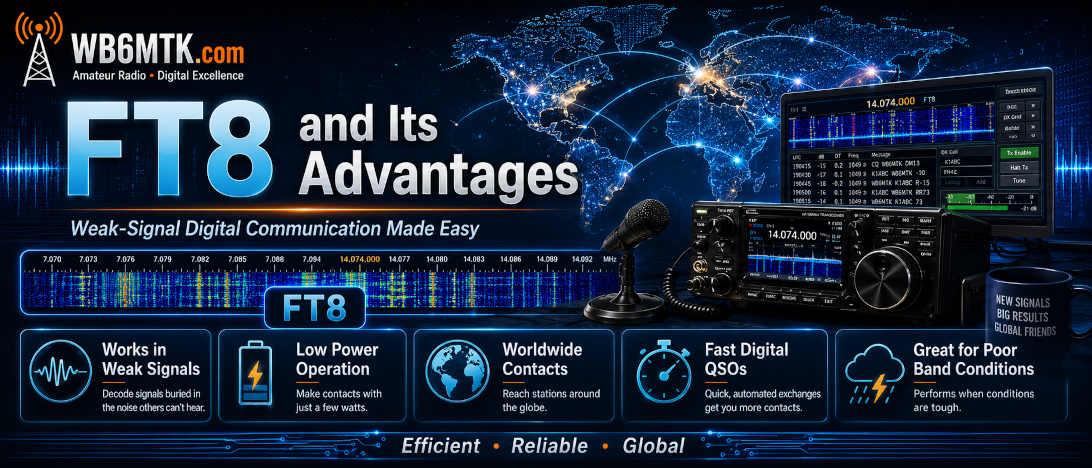
The Advantages of Using FT8 in Amateur Radio Communications
| Author: | Eric Werny, WB6MTK | |
| Publisher: | WB6MTK.com | |
| Website: | www.wb6mtk.com | |
| Topic: | Amateur Radio, FT8, Digital Modes, Weak-Signal Communication, HF PropagationRecommended audience: New amateur radio operators, HF operators, digital-mode users, QRP operators, DXers, portable operators, and radio clubs teaching modern amateur radio communications | |
| Last reviewed: | May 2026 |
Summary
FT8 is one of the most widely used digital modes in modern amateur radio. Developed by Joe Taylor, K1JT, and Steve Franke, K9AN, FT8 was introduced in 2017 as part of the WSJT-X software suite. The name FT8 refers to Franke-Taylor design, 8-frequency shift keying.
FT8 became popular because it allows amateur radio operators to make contacts under weak-signal conditions where traditional voice modes may fail. It can decode signals far below the noise level, uses very narrow bandwidth, works well with modest antennas and low power, and produces useful propagation data through worldwide reporting systems.
FT8 does not replace SSB, CW, RTTY, JS8Call, or other modes. It is not intended for long conversations. Its strength is efficient, structured, weak-signal contact exchange. For operators with limited space, high noise, low power, or poor propagation, FT8 can turn a quiet band into a usable communications path.
In simple terms:
FT8 helps amateur radio operators make reliable digital contacts when signals are too weak for normal voice communication.
Definition
FT8 is a weak-signal amateur radio digital mode that uses synchronized 15-second transmit and receive cycles to exchange structured contact information such as call signs, signal reports, and grid squares.
FT8 is commonly used for:
- HF weak-signal communication
- DX contacts
- QRP operation
- Propagation testing
- Antenna comparison
- Portable operation
- Digital-mode activity
- Contact logging
- Band-condition monitoring
A typical FT8 contact is short, structured, and efficient. It usually exchanges only the information needed to confirm a valid contact.
1. Why FT8 Became So Popular
FT8 became popular because it solved a real problem in amateur radio: how to communicate when signals are weak, noisy, or unreliable.
Many amateur radio operators face difficult operating conditions, including:
- Small antennas
- HOA restrictions
- Urban noise
- Poor solar conditions
- Limited power
- Indoor antennas
- Portable setups
- Compromised stations
- Crowded bands
- Inconsistent propagation
Traditional SSB voice may require stronger signals to be comfortable. CW can work very well under weak conditions, but it requires operator skill. FT8 gives many operators a way to make contacts with modest equipment and difficult propagation.
This is one reason FT8 changed the modern HF operating landscape.
It made weak-signal communication accessible to more operators.
2. Exceptional Weak-Signal Performance
One of FT8’s greatest advantages is weak-signal decoding.
FT8 can often decode signals that are far below what a human ear can clearly hear. In many cases, operators can complete contacts when the audio sounds like noise or when no obvious signal is heard at all.
This makes FT8 useful for:
- Weak propagation
- Low-power operation
- Small antennas
- High-noise environments
- Marginal band openings
- Long-distance DX attempts
- Poor receiving conditions
For an operator using a simple wire antenna or a low-power station, FT8 can make the difference between hearing nothing and completing a contact.
The practical lesson is simple:
FT8 does not need a loud signal to work. It needs a decodable signal.
That is a major reason it has become so valuable.
3. Efficient Use of Bandwidth
FT8 uses very narrow bandwidth compared with traditional voice operation.
A typical SSB voice signal may occupy about 2.4 to 3 kHz of bandwidth. FT8 signals occupy a much smaller slice of spectrum. This allows many operators to share a narrow part of the band at the same time.
This is important because crowded HF bands require efficient spectrum use.
FT8 allows many stations to operate in close proximity without using the amount of bandwidth required by voice communication.
Efficient bandwidth use makes FT8 useful for:
- Busy digital segments
- DX activity
- Contests
- Special-event operations
- Weak-signal monitoring
- High-volume contact activity
FT8 is one example of how digital modes can make very efficient use of amateur radio spectrum.
4. Reliable Communication in Poor Conditions
HF radio conditions are constantly changing.
Propagation can be affected by:
- Solar activity
- Time of day
- Season
- Band selection
- Geomagnetic storms
- Local noise
- Antenna limitations
- Power level
- Path distance
FT8 performs well when traditional voice contacts are difficult.
This does not mean FT8 can overcome every propagation problem. No mode can. But FT8 can often complete contacts under conditions where SSB would not be practical.
This makes it especially useful during:
- Low solar activity
- Weak band openings
- Noisy receive conditions
- QRP operation
- Portable operation
- Compromised antenna use
For many operators, FT8 keeps HF useful even when voice activity seems limited.
5. Global Reach With Modest Equipment
FT8 has opened the door for many operators who do not have large towers, beams, amplifiers, or ideal antenna space.
A modest FT8 station may include:
- HF transceiver
- Computer or laptop
- Accurate computer clock
- WSJT-X or similar software
- USB audio interface or radio with built-in USB audio
- Wire antenna
- Basic antenna tuner, if needed
- Internet access for spotting and logging, if available
With this modest setup, many operators can work stations across the country or around the world.
FT8 is especially useful for operators who face:
- Small lots
- HOA restrictions
- Indoor antennas
- Portable operation
- Limited budgets
- Low-power stations
- Temporary antennas
This is one of the most important contributions of FT8. It gives smaller stations a better chance to participate in DX activity.
6. Structured and Efficient Contact Exchange
FT8 is built around a structured operating format.
Most FT8 transmissions occur in synchronized time slots. Each message is short and contains only essential contact information.
A typical FT8 exchange may include:
- Calling CQ
- Call sign exchange
- Grid square
- Signal report
- Acknowledgment
- 73 or closing message
This structure reduces ambiguity and makes contacts efficient.
FT8 is not designed for long conversations. It is designed for reliable contact exchange under weak-signal conditions.
This is why FT8 works well for:
- DX hunting
- Grid chasing
- Band openings
- Contact confirmation
- Propagation study
- High-efficiency digital operation
Operators who want conversation may prefer modes such as SSB, CW, PSK31, or JS8Call. Operators who want reliable weak-signal contact exchange often use FT8.
7. Low Barrier to Entry for New Digital Operators
FT8 is one of the easier digital modes for many new operators to begin using.
A new operator needs to learn several basic steps:
- Install WSJT-X or compatible software
- Connect radio audio to the computer
- Set transmit and receive audio levels correctly
- Synchronize the computer clock
- Select the correct band and frequency
- Configure the radio for digital operation
- Decode signals on the waterfall
- Complete a basic exchange
- Log the contact
This may sound like a lot at first, but once configured, FT8 becomes straightforward.
The waterfall display helps operators see activity visually. The structured exchange helps reduce uncertainty. Automatic decoding helps beginners understand what stations are on the air.
FT8 can be a useful gateway into digital amateur radio.
8. Propagation Mapping and Signal Reporting
FT8 is not only a contact mode. It is also a powerful propagation observation tool.
Because FT8 messages are structured and widely reported, operators can use online systems to see where their signal is being received.
Services such as PSK Reporter allow operators to view near-real-time reception reports from stations around the world.
This helps operators answer practical questions:
- Where is my signal being heard?
- Is the band open?
- Which antenna is working better?
- What direction is propagation favoring?
- How far is my low-power signal reaching?
- What bands are active right now?
- Is my station transmitting properly?
This makes FT8 extremely useful for antenna testing and band-condition awareness.
An operator can change antennas, power levels, bands, or times of day and compare real reception reports.
That is valuable station intelligence.
9. FT8 for QRP and Portable Operation
FT8 is highly useful for QRP and portable operators.
QRP operation usually means transmitting with low power, often 5 watts or less. Low-power operation can be challenging on voice modes, especially with small field antennas.
FT8 improves the odds of success.
Portable operators may use:
- Compact HF transceivers
- Battery power
- Small laptops or tablets
- Portable verticals
- End-fed wires
- Lightweight dipoles
- Temporary field antennas
- Solar charging
FT8 allows operators to make meaningful contacts with modest equipment from parks, mountaintops, campsites, emergency exercises, or temporary field locations.
This makes FT8 especially attractive for:
- Parks on the Air
- Summits on the Air
- Field Day
- Portable DXing
- Emergency practice
- Antenna testing
- Low-power experimentation
For operators who like to do more with less, FT8 is a powerful tool.
10. FT8 as a Scientific and Experimental Tool
FT8 contributes to amateur radio experimentation because of the large amount of signal data it produces.
Every FT8 transmission may contribute to a larger picture of propagation behavior.
When reception reports are uploaded to spotting systems, operators can observe:
- Band openings
- Geographic coverage
- Time-of-day effects
- Antenna performance
- Solar-cycle effects
- Seasonal propagation changes
- Low-power signal reach
- Weak-signal paths
- Ionospheric behavior
This makes FT8 part of a large informal global propagation experiment.
Amateur radio has always been about experimentation. FT8 continues that tradition in a modern digital form.
11. What FT8 Does Not Do Well
FT8 has many advantages, but it also has limits.
FT8 is not ideal for:
- Long conversations
- Emergency voice communication
- Detailed message exchange
- Casual ragchewing
- Teaching conversational operating skills
- Passing complex traffic
- Replacing operator judgment
- Replacing SSB, CW, or other modes
FT8 is structured and efficient, but that strength is also a limitation.
A standard FT8 contact does not communicate personality, tone, story, or detailed information. It confirms a contact and provides signal information.
That is useful, but it is not the whole of amateur radio.
FT8 should be seen as one tool in the amateur radio toolbox.
12. FT8 Compared With Other Modes
Different amateur radio modes serve different purposes.
The best mode depends on the operating goal.
| Mode | Strengths | Limitations | Best Use Cases |
|---|---|---|---|
| FT8 | Excellent weak-signal decoding, efficient bandwidth use, structured contacts | Limited conversational ability | DX hunting, weak-signal contacts, propagation study |
| FT4 | Faster than FT8, useful for contests | Slightly less sensitive than FT8 | Contesting, high-rate contacts |
| JS8Call | Based on FT8-style weak-signal technology but supports free-text messaging | Slower and less widely used than FT8 | Keyboard messaging, emergency-style text communication, group communication |
| PSK31 | Narrow bandwidth, real-time keyboard chat | Requires stronger signals than FT8 and can be more noise-sensitive | Casual digital conversations, low-power chat |
| RTTY | Classic digital mode, widely recognized in contests | Wider bandwidth and less weak-signal capability than FT8 | Contesting, traditional digital operation |
| CW | Very efficient, human-decoded, excellent weak-signal mode | Requires skill and practice | DX, portable operation, low-power operation, radio tradition |
| SSB | Natural voice communication, conversational, widely used | Requires stronger signals and more bandwidth | Nets, ragchews, emergency voice, general HF communication |
FT8 is not “better” than all other modes. It is better for a specific purpose: structured weak-signal digital contacts.
13. Practical Example: A Small Station Working DX
Imagine an operator with a modest station:
- 100-watt HF transceiver
- Simple 40-meter wire antenna
- Laptop running WSJT-X
- No tower
- No amplifier
- Suburban noise
- Limited antenna height
On SSB, the operator may hear little activity and struggle to be heard.
On FT8, the same operator may decode stations across the country or overseas. With careful audio levels, accurate time synchronization, and patience, the operator may complete DX contacts that would be difficult on voice.
This does not mean FT8 is magic. It means FT8 is optimized for weak-signal exchange.
For small stations, that optimization matters.
14. Practical Example: Using FT8 to Test an Antenna
FT8 is useful for antenna testing.
An operator can compare two antennas by transmitting at the same power level and checking reception reports.
For example:
- Transmit on 20 meters using Antenna A
- Check where the signal is heard
- Switch to Antenna B
- Transmit again at the same power level
- Compare reports on PSK Reporter
- Note differences in distance, direction, and signal strength
This kind of testing is not perfect because propagation changes constantly. But repeated tests can reveal useful patterns.
FT8 gives operators a practical way to see how their stations are performing.
15. Best Practices for FT8 Operation
FT8 works best when operators use good technical and operating habits.
Recommended practices include:
- Keep your computer clock accurately synchronized
- Set transmit audio levels carefully
- Avoid overdriving the radio audio input
- Use appropriate power
- Watch your ALC level
- Use the correct digital mode frequency
- Confirm your grid square
- Log contacts accurately
- Avoid transmitting over active stations when possible
- Keep your software updated
- Use proper station identification
- Understand your license privileges
- Monitor signal reports for station performance
- Use FT8 as a tool, not as the only mode
- Learn the radio theory behind the digital mode
Good FT8 operation is not just clicking buttons. It requires station discipline.
16. Common FT8 Mistakes
New FT8 operators often make avoidable mistakes.
Mistake 1: Computer Clock Not Synchronized
FT8 depends on accurate timing. If the computer clock is off, decoding and transmitting may fail.
Mistake 2: Too Much Audio Drive
Overdriving the audio input can create distorted transmissions and unwanted splatter.
Mistake 3: Wrong Radio Mode or Filter Setting
Many radios require correct digital or USB data settings for clean operation.
Mistake 4: Poor Sound Card Configuration
Incorrect input or output selection can prevent decoding or transmitting.
Mistake 5: Not Understanding the Exchange
Even though FT8 is semi-automated, the operator should understand what each message means.
Mistake 6: Treating FT8 as Fully Automatic Radio
The operator remains responsible for legal and proper station operation.
FT8 software assists the operator. It does not replace the operator.
Conclusion
FT8 has earned its place as one of the most important digital modes in modern amateur radio.
Its weak-signal performance, efficient bandwidth use, structured contact format, modest station requirements, and propagation-reporting value have changed how many operators use HF radio.
FT8 allows operators with simple antennas, low power, difficult locations, or poor band conditions to make contacts that might otherwise be impossible. It also gives operators a powerful way to study propagation, test antennas, and understand where their signals are being heard.
However, FT8 is not a replacement for the rest of amateur radio. It is not designed for long conversation, emergency voice nets, detailed traffic handling, or traditional operating skill development.
The best amateur radio operator understands FT8 as one tool among many.
Use FT8 for what it does best: weak-signal digital contacts, propagation awareness, modest-station DX, and efficient spectrum use.
Amateur radio is strongest when operators understand both the technology and the purpose behind the mode.
Frequently Asked Questions
What is FT8?
FT8 is a weak-signal digital mode used in amateur radio. It uses synchronized transmit and receive cycles to exchange short, structured messages such as call signs, grid squares, and signal reports.
Who developed FT8?
FT8 was developed by Joe Taylor, K1JT, and Steve Franke, K9AN, and was introduced in 2017 as part of the WSJT-X software suite.
Why is FT8 so popular?
FT8 is popular because it can decode very weak signals, works well with modest equipment, uses narrow bandwidth, supports automated logging, and helps operators make contacts during poor propagation.
Is FT8 good for beginners?
Yes. FT8 can be a good entry point into digital modes, but beginners should still learn proper radio setup, audio levels, timing, license privileges, and station operation.
Can FT8 be used for conversations?
Not in the normal sense. FT8 is designed for short, structured exchanges, not long conversations. Operators who want keyboard chat may prefer JS8Call or PSK31.
Does FT8 work with low power?
Yes. FT8 works very well with low power and is popular among QRP operators. A few watts and a simple antenna can sometimes produce impressive results.
What equipment is needed for FT8?
A typical FT8 setup includes an HF transceiver, computer, WSJT-X or compatible software, audio interface or USB connection, accurate computer clock, and an antenna.
Why does FT8 require accurate time?
FT8 uses synchronized transmit and receive cycles. If the computer clock is not accurate, the software may fail to decode signals or transmit at the correct time.
Is FT8 better than SSB or CW?
FT8 is better for structured weak-signal digital contacts. SSB is better for voice conversation, and CW remains excellent for human-operated weak-signal communication. Each mode has a different purpose.
Can FT8 help test antennas?
Yes. FT8 reception reports from systems such as PSK Reporter can help operators compare antennas, power levels, bands, and propagation paths.
References and Further Reading
The following sources are useful references for FT8, digital modes, weak-signal communication, and amateur radio operating practice:
- WSJT-X User Guide and official documentation
- Joe Taylor, K1JT, and Steve Franke, K9AN, FT8 development resources
- American Radio Relay League, Digital Modes resources
- American Radio Relay League, The ARRL Handbook for Radio Communications
- American Radio Relay League, HF Digital Communications articles
- Federal Communications Commission, 47 CFR Part 97 — Amateur Radio Service
- PSK Reporter propagation reporting network
- Hamspots digital-mode spotting resources
- Amateur radio club digital-mode training materials
- Manufacturer manuals for radios with USB audio and digital-mode operation
